Tag the questions with any skills you have. Your dashboard will track each student's mastery of each skill.
Give this quiz to my class
Q 1/15
Score 0
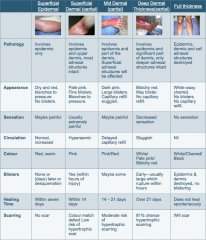
PTA observes a burn on the dorsal surface of a patient's arm. The wound area is mottled red with a number of blisters. The PTA informs the patient that healing should take place in less than 3 weeks. This description is MOST indicative of a:
45
full-thickness burn
superficial burn
deep partial-thickness burn
superficial partial-thickness burn
Q 2/15
Score 0
A PTA prepares to complete a sensory assessment on a patient rehabilitation from a lower extremity burn. Which of the following would serve as the BEST predictor of altered sensation?
45
percentage of body surface affected
extent of hypertrophic scarring
presence of a skin graft
depth of burn injury
15 questions
Q.
PTA observes a burn on the dorsal surface of a patient's arm. The wound area is mottled red with a number of blisters. The PTA informs the patient that healing should take place in less than 3 weeks. This description is MOST indicative of a:
1
45 sec
Q.
A PTA prepares to complete a sensory assessment on a patient rehabilitation from a lower extremity burn. Which of the following would serve as the BEST predictor of altered sensation?
2
45 sec
Q.
A PTA discusses the use of a topical moisturizer with a patient to combat dryness and itching of the skin in the area of a healed burn. Which scenario would MOST likely require the use of a moisturizer for an indefinite period?
3
45 sec
Q.
What answer is not a characteristic of an Arterial Insufficiency Ulcer?
4
45 sec
Q.
A PTA is treating a patient that has experienced deep partial-thickness burns on her right anterior and posterior arm, anterior trunk and posterior trunk, and left anterior/posterior leg. Using rule of nine, what is the total percentage of body surface burned?
5
45 sec
Q.
A patient suffers a chemical burn on the cubital area of the elbow. Which position would be the MOST appropriate for splinting of the involved upper extremity?
6
45 sec
Q.
What answer is not a characteristic of an Venous Insufficiency Ulcer?
7
45 sec
Q.
A PTA works with a patient who has type 2 diabetes mellitus and neuropathy in the bilateral LE. The PTA should educate the patient about appropriate foot care by telling the patient to:
8
45 sec
Q.
A PTA is working with a CVA patient that has a decubitus ulcer on her sacrum and left greater trochanter. What is the best position to move this patient into?
9
45 sec
Q.
A PTA is performing wound care on a a patient with a stage IV pressure injury on her right greater trochanter. What is the MOST likely answer that identifies the wound as a stage IV?
10
45 sec
Q.
What stage is this pressure sore in?
11
45 sec
Q.
What wound dressing is derived from seaweed?
12
45 sec
Q.
A PTA is providing wound care to a patient's heel. What wound dressing is MOST likely being used as a prophylactic measure to reduce the risk of skin breakdown?
13
45 sec
Q.
A PTA is treating a patient who has burns on her arms. The the burns are discolored and appear to have broken blisters. What time of burn classification is being shown?
14
45 sec
Q.
A PTA prepares a patient education program for an individual with chronic venous insufficiency. Which of the following would NOT be appropriate to include in the patient education program?