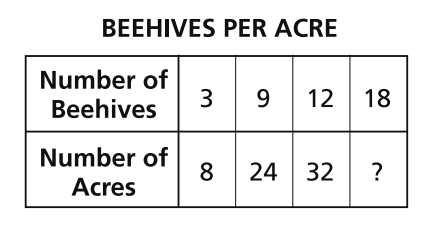
Make tables of equivalent ratios relating quantities with whole-number measurements, find missing values in the tables, and plot the pairs of values on the coordinate plane. Use tables to compare ratios.
Find a percent of a quantity as a rate per 100 (e.g., 30% of a quantity means 30/100 times the quantity); solve problems involving finding the whole, given a part and the percent.
Find a percent of a quantity as a rate per 100. Solve problems that involve finding the whole given a part and the percent, and finding a part of a whole given the percent.
Make tables of equivalent ratios relating quantities with whole-number measurements, find missing values in the tables, and plot the pairs of values on the coordinate plane. Use tables to compare ratios.
Track each student's skills and progress in your Mastery dashboards
Give this quiz to my class
Q 1/9
Score 0
30
Q 2/9
Score 0
30
9 questions
Q.
1
30 sec
6.RP.A.1
Q.
2
30 sec
6.RP.A.3.A
Q.
3
30 sec
6.RP.A.3.C
Q.
A car travels 180 miles in 3 hours. At the same speed, how far will it travel in 5 hours?
4
30 sec
6.RP3
Q.
A water tank is filled to 75% of its capacity with 150 gallons of water. What is the total capacity of the tank?
5
30 sec
6.RP3c
Q.
A cyclist travels 40 miles in 2.5 hours. What is the average speed in miles per hour?
6
30 sec
6.RP3
Q.
A car consumes 8 gallons of fuel to travel 120 miles. How many miles can it travel with 20 gallons of fuel at the same rate?
7
30 sec
6.RP3
Q.
A car's fuel tank is 40% full with 20 liters of fuel. What is the full capacity of the tank?
8
30 sec
6.RP3c
Q.
If the ratio of boys to girls in a class is 2:3, and there are a total of 25 students, how many girls are in the class? Use the table of equivalent ratios to find the answer.