Make tables of equivalent ratios relating quantities with whole-number measurements, find missing values in the tables, and plot the pairs of values on the coordinate plane. Use tables to compare ratios.
Find and position integers and other rational numbers on a horizontal or vertical number line. Find and position pairs of integers and other rational numbers on a coordinate plane.
Evaluate expressions given specific values for their variables. Include expressions that arise from formulas in real-world problems. Perform arithmetic operations, including those involving whole-number exponents, in the conventional order (Order of Operations).
Interpret and compute quotients of fractions, and solve word problems involving division of fractions by fractions.
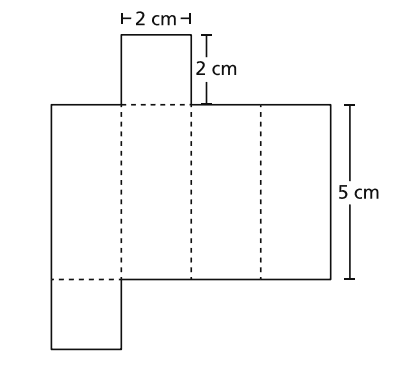
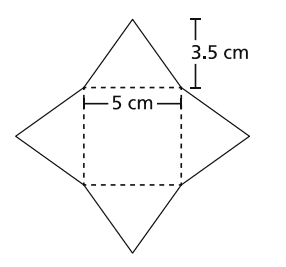
Represent three-dimensional figures using nets made up of rectangles and triangles, and use the nets to find the surface area of these figures. Apply these techniques in the context of solving real-world and mathematical problems.
Solve unit rate problems.
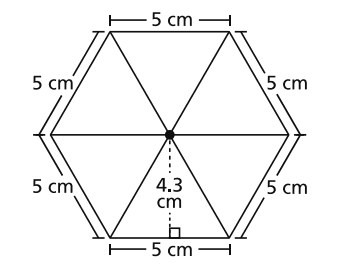
Find the area of right triangles, other triangles, special quadrilaterals, and polygons by composing into rectangles or decomposing into triangles and other shapes. Apply these techniques in the context of solving real-world and mathematical problems.
Write and evaluate numerical expressions involving whole-number exponents.
Find a percent of a quantity as a rate per 100. Solve problems that involve finding the whole given a part and the percent, and finding a part of a whole given the percent.
Identify parts of an expression using mathematical terms (term, coefficient, sum, difference, product, factor, and quotient); view one or more parts of an expression as a single entity.
Understand solving an equation or inequality as a process of answering a question: which values from a specified set, if any, make the equation or inequality true? Use substitution to determine whether a given number in a specified set makes an equation or inequality true.
Understand the concept of a ratio and use ratio language to describe a ratio relationship between two quantities.
Write expressions that record operations with numbers and with letters standing for numbers.
Understand that positive and negative numbers are used together to describe quantities having opposite directions or values. Use positive and negative numbers to represent quantities in real-world contexts, explaining the meaning of 0 in each situation.
Use ratio reasoning to convert measurement units; manipulate and transform units appropriately when multiplying or dividing quantities.
Find the volume of a right rectangular prism with fractional edge lengths in the context of solving real-world and mathematical problems.
Understand the concept of a unit rate a/b associated with a ratio a:b with b=/=0, and use rate language in the context of a ratio relationship.
Write an inequality of the form x > c, x ≥ c, x ≤ c, or x < c to represent a constraint or condition in a real-world or mathematical problem. Recognize that inequalities of these forms have infinitely many solutions; represent solutions of such inequalities on a number line.
Find the greatest common factor of two whole numbers less than or equal to 100 and the least common multiple of two whole numbers less than or equal to 12. Use the distributive property to express a sum of two whole numbers 1-100 with a common factor as a multiple of a sum of two whole numbers with no common factor other than 1. Find the least common multiple of two whole numbers less than or equal to 12.
Use variables to represent two quantities in a real-world problem that change in relationship to one another. Given a verbal context and an equation, identify the dependent variable, in terms of the other quantity, thought of as the independent variable. Analyze the relationship between the dependent and independent variables using graphs and tables, and relate these to the equation.
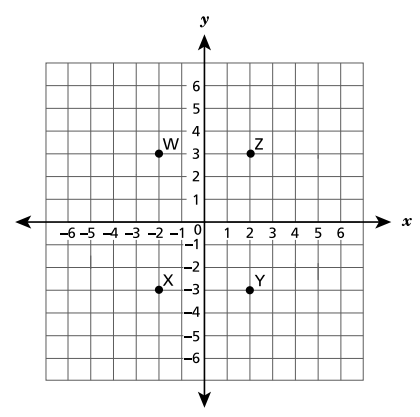
Solve real-world and mathematical problems by graphing points in all four quadrants of the coordinate plane. Include use of coordinates and absolute value to find distances between points with the same first coordinate or the same second coordinate.
Solve real-world and mathematical problems by writing and solving equations of the form x + p = q and px = q for cases in which p, q and x are all nonnegative rational numbers.
Track each student's skills and progress in your Mastery dashboards