Loading...


Scalp/Calvarial Recon
Quiz by Ariel
Tag the questions with any skills you have. Your dashboard will track each student's mastery of each skill.
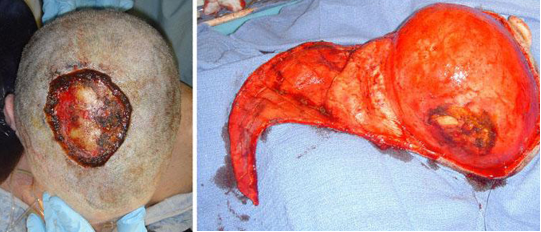
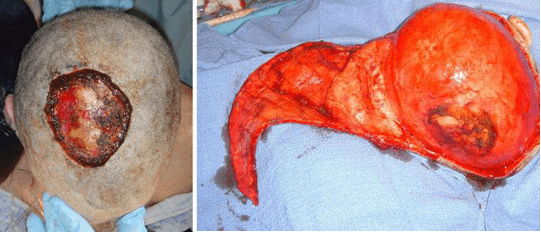
A 79-year-old woman comes to the office because of a large scalp defect following Mohs micrographic surgery for basal cell carcinoma. A photograph of the defect (left) and a rotation flap designed to cover the defect (right) are shown. At the completion of the procedure, a large “dog ear” is noted at the pivot point of the flap. Which of the following is the most appropriate next step in management?
Staged advancement
Burrow triangle
Direct excision
Observation
Compression
A 15-year-old girl is evaluated 2 months after a failed scalp replantation because of an avulsion injury. Skin grafting is planned, followed by staged tissue expansion. Between which of the following layers of the scalp is the most appropriate anatomic plane for tissue expander placement?
A 79-year-old woman comes to the office because of a large scalp defect following Mohs micrographic surgery for basal cell carcinoma. A photograph of the defect (left) and a rotation flap designed to cover the defect (right) are shown. At the completion of the procedure, a large “dog ear” is noted at the pivot point of the flap. Which of the following is the most appropriate next step in management?
A 70-year-old woman has a circular defect 18 cm in diameter on the parietal aspect of the scalp after excision of squamous cell carcinoma. The pericranium has been removed with the scalp tissue. Adjuvant radiation therapy is planned beginning 4 to 6 weeks after surgery. Which of the following is most appropriate for coverage of the defect?
An 83-year-old man undergoes radiation therapy and surgical resection and coverage with a cranial bone graft to treat meningioma. The graft becomes infected and is removed 6 weeks after the procedure. One year later, the patient is scheduled to undergo reconstruction of the resulting 23-cm2 defect in the skull. Which of the following is a relative contraindication for the subsequent use of hydroxyapatite in this patient?
A 65-year-old man develops a hemorrhagic stroke requiring decompressive craniotomy. The bone is found to be unusable and a customized polyetheretherketone (PEEK) prosthesis is planned. Which of the following is the most common complication of using this material?