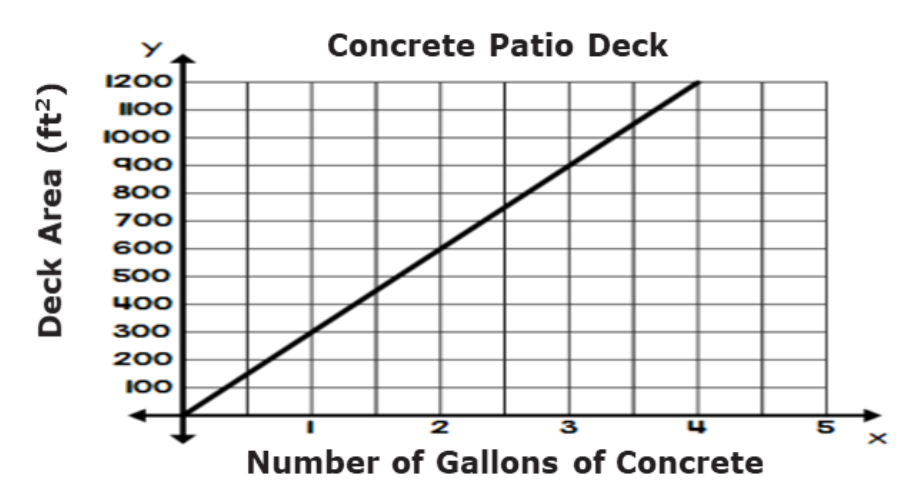
Calculate the rate of change of a linear function represented tabularly, graphically, or algebraically in context of mathematical and real-world problems.
Write and solve equations involving direct variation.
Solve linear equations in one variable, including those for which the application of the distributive property is necessary and for which variables are included on both sides.
Graph linear functions on the coordinate plane and identify key features, including x-intercept, y-intercept, zeros, and slope, in mathematical and real-world problems.
Write linear equations in two variables given a table of values, a graph, and a verbal description.
Write systems of two linear equations given a table of values, a graph, and a verbal description.
Solve systems of two linear equations with two variables for mathematical and real-world problems.
Describe the relationship between the linear factors of quadratic expressions and the zeros of their associated quadratic functions.
Solve linear inequalities in one variable, including those for which the application of the distributive property is necessary and for which variables are included on both sides.
Determine the domain and range of a linear function in mathematical problems; determine reasonable domain and range values for real-world situations, both continuous and discrete; and represent domain and range using inequalities.
Write exponential functions in the form f(x) = abx (where b is a rational number) to describe problems arising from mathematical and real-world situations, including growth and decay.
Multiply polynomials of degree one and degree two.
Graph exponential functions that model growth and decay and identify key features, including y-intercept and asymptote, in mathematical and real-world problems.
Write the equation of a line that contains a given point and is perpendicular to a given line.
Factor, if possible, trinomials with real factors in the form ax2 + bx + c, including perfect square trinomials of degree two.
Determine the effects on the graph of the parent function f(x) = x2 when f(x) is replaced by af(x), f(x) + d, f(x - c), f(bx) for specific values of a, b, c, and d.
Determine the slope of a line given a table of values, a graph, two points on the line, and an equation written in various forms, including y = mx + b, Ax + By = C, and y - y1 = m(x - x1).
Graph the solution set of linear inequalities in two variables on the coordinate plane.
Simplify numerical radical expressions involving square roots.
Interpret the meaning of the values of a and b in exponential functions of the form f(x) = abx in real-world problems.
Track each student's skills and progress in your Mastery dashboards