The student applies mathematical process standards to develop and use strategies and methods for positive rational number computations in order to solve problems with efficiency and accuracy. The student is expected to:
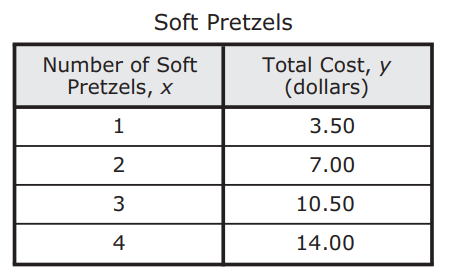
Solve for products of decimals to the hundredths, including situations involving money, using strategies based on place-value understandings, properties of operations, and the relationship to the multiplication of whole numbers;
The student applies mathematical process standards to identify locations on a coordinate plane. The student is expected to:
Graph in the first quadrant of the coordinate plane ordered pairs of numbers arising from mathematical and real-world problems, including those generated by number patterns or found in an input-output table.
The student applies mathematical process standards to develop concepts of expressions and equations. The student is expected to:
Represent and solve multi-step problems involving the four operations with whole numbers using equations with a letter standing for the unknown quantity;
The student applies mathematical process standards to develop concepts of expressions and equations. The student is expected to:
Represent and solve problems related to perimeter and/or area and related to volume.
The student applies mathematical process standards to develop and use strategies and methods for positive rational number computations in order to solve problems with efficiency and accuracy. The student is expected to:
Solve with proficiency for quotients of up to a four-digit dividend by a two-digit divisor using strategies and the standard algorithm;
The student applies mathematical process standards to represent, compare, and order positive rational numbers and understand relationships as related to place value. The student is expected to:
Represent the value of the digit in decimals through the thousandths using expanded notation and numerals;
The student applies mathematical process standards to develop concepts of expressions and equations. The student is expected to:
Generate a numerical pattern when given a rule in the form y = ax or y = x + a and graph;
The student applies mathematical process standards to classify twodimensional figures by attributes and properties. The student is expected to classify twodimensional figures in a hierarchy of sets and subsets using graphic organizers based on their attributes and properties.
The student applies mathematical process standards to represent, compare, and order positive rational numbers and understand relationships as related to place value. The student is expected to:
Compare and order two decimals to thousandths and represent comparisons using the symbols >, <, or =; and
The student applies mathematical process standards to develop and use strategies and methods for positive rational number computations in order to solve problems with efficiency and accuracy. The student is expected to:
Add and subtract positive rational numbers fluently; and
The student applies mathematical process standards to identify locations on a coordinate plane. The student is expected to:
Describe the key attributes of the coordinate plane, including perpendicular number lines (axes) where the intersection (origin) of the two lines coincides with zero on each number line and the given point (0, 0); the x-coordinate, the first number in an ordered pair, indicates movement parallel to the x-axis starting at the origin; and the y-coordinate, the second number, indicates movement parallel to the y-axis starting at the origin;
The student applies mathematical process standards to develop and use strategies and methods for positive rational number computations in order to solve problems with efficiency and accuracy. The student is expected to:
Divide whole numbers by unit fractions and unit fractions by whole numbers.
The student applies mathematical process standards to select appropriate units, strategies, and tools to solve problems involving measurement. The student is expected to solve problems by calculating conversions within a measurement system, customary or metric.
The student applies mathematical process standards to develop and use strategies and methods for positive rational number computations in order to solve problems with efficiency and accuracy. The student is expected to:
Represent multiplication of decimals with products to the hundredths using objects and pictorial models, including area models;
The student applies mathematical process standards to solve problems by collecting, organizing, displaying, and interpreting data. The student is expected to:
Solve one- and two-step problems using data from a frequency table, dot plot, bar graph, stem-and-leaf plot, or scatterplot
The student applies mathematical process standards to develop and use strategies and methods for positive rational number computations in order to solve problems with efficiency and accuracy. The student is expected to:
Solve for quotients of decimals to the hundredths, up to four-digit dividends and two-digit whole number divisors, using strategies and algorithms, including the standard algorithm;
The student applies mathematical process standards to develop and use strategies and methods for positive rational number computations in order to solve problems with efficiency and accuracy. The student is expected to:
Multiply with fluency a three-digit number by a two-digit number using the standard algorithm;
The student applies mathematical process standards to develop concepts of expressions and equations. The student is expected to:
Simplify numerical expressions that do not involve exponents, including up to two levels of grouping;
The student applies mathematical process standards to understand, recognize, and quantify volume. The student is expected to:
Recognize a cube with side length of one unit as a unit cube having one cubic unit of volume and the volume of a three-dimensional figure as the number of unit cubes (n cubic units) needed to fill it with no gaps or overlaps if possible; and
The student applies mathematical process standards to develop concepts of expressions and equations. The student is expected to:
Identify prime and composite numbers;
The student applies mathematical process standards to manage one's financial resources effectively for lifetime financial security. The student is expected to:
Describe actions that might be taken to balance a budget when expenses exceed income; and
The student applies mathematical process standards to develop and use strategies and methods for positive rational number computations in order to solve problems with efficiency and accuracy. The student is expected to:
Represent division of a unit fraction by a whole number and the division of a whole number by a unit fraction such as 1/3 ÷ 7 and 7 ÷ 1/3 using objects and pictorial models, including area models;
The student applies mathematical process standards to manage one's financial resources effectively for lifetime financial security. The student is expected to:
Balance a simple budget.
The student applies mathematical process standards to develop and use strategies and methods for positive rational number computations in order to solve problems with efficiency and accuracy. The student is expected to:
Estimate to determine solutions to mathematical and real-world problems involving addition, subtraction, multiplication, or division;
Track each student's skills and progress in your Mastery dashboards