The student applies mathematical process standards to represent and use rational numbers in a variety of forms. The student is expected to:
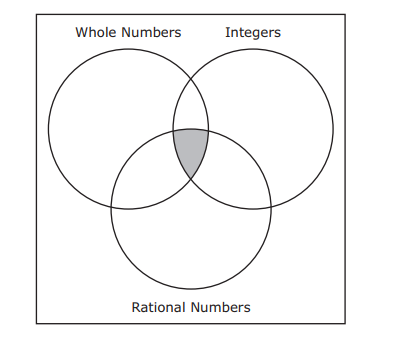
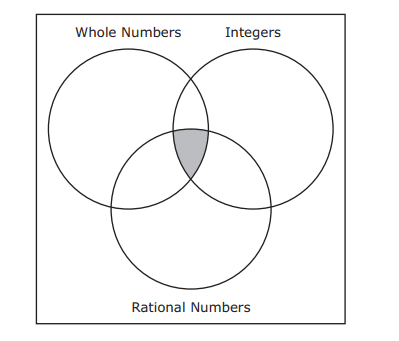
Classify whole numbers, integers, and rational numbers using a visual representation such as a Venn diagram to describe relationships between sets of numbers;
The student applies mathematical process standards to represent and use rational numbers in a variety of forms. The student is expected to:
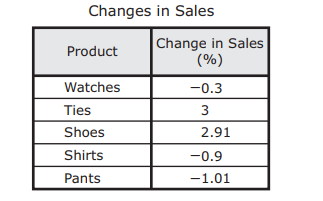
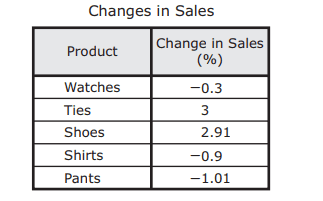
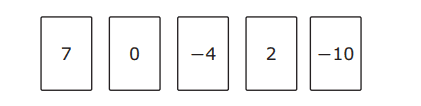
Order a set of rational numbers arising from mathematical and real-world contexts; and
The student applies mathematical process standards to represent and use rational numbers in a variety of forms. The student is expected to:
Extend representations for division to include fraction notation such as a/b represents the same number as a ÷ b where b ≠ 0.
The student applies mathematical process standards to develop an understanding of proportional relationships in problem situations. The student is expected to:
Generate equivalent forms of fractions, decimals, and percents using real-world problems, including problems that involve money; and
The student applies mathematical process standards to develop concepts of expressions and equations. The student is expected to:
Generate equivalent numerical expressions using order of operations, including whole number exponents and prime factorization;
The student applies mathematical process standards to develop concepts of expressions and equations. The student is expected to:
Distinguish between expressions and equations verbally, numerically, and algebraically;
The student applies mathematical process standards to develop concepts of expressions and equations. The student is expected to:
Generate equivalent expressions using the properties of operations: inverse, identity, commutative, associative, and distributive properties.
The student applies mathematical process standards to represent addition, subtraction, multiplication, and division while solving problems and justifying solutions. The student is expected to:
Recognize that dividing by a rational number and multiplying by its reciprocal result in equivalent values;
The student applies mathematical process standards to represent addition, subtraction, multiplication, and division while solving problems and justifying solutions. The student is expected to:
Determine, with and without computation, whether a quantity is increased or decreased when multiplied by a fraction, including values greater than or less than one;
The student applies mathematical process standards to represent addition, subtraction, multiplication, and division while solving problems and justifying solutions. The student is expected to:
Represent integer operations with concrete models and connect the actions with the models to standardized algorithms;
The student applies mathematical process standards to represent addition, subtraction, multiplication, and division while solving problems and justifying solutions. The student is expected to:
Add, subtract, multiply, and divide integers fluently; and
The student applies mathematical process standards to represent addition, subtraction, multiplication, and division while solving problems and justifying solutions. The student is expected to:
Multiply and divide positive rational numbers fluently.
The student applies mathematical process standards to develop an understanding of proportional relationships in problem situations. The student is expected to:
Apply qualitative and quantitative reasoning to solve prediction and comparison of realworld problems involving ratios and rates;
The student applies mathematical process standards to solve problems involving proportional relationships. The student is expected to:
Solve real-world problems to find the whole given a part and the percent, to find the part given the whole and the percent, and to find the percent given the part and the whole, including the use of concrete and pictorial models; and
The student applies mathematical process standards to use multiple representations to describe algebraic relationships. The student is expected to:
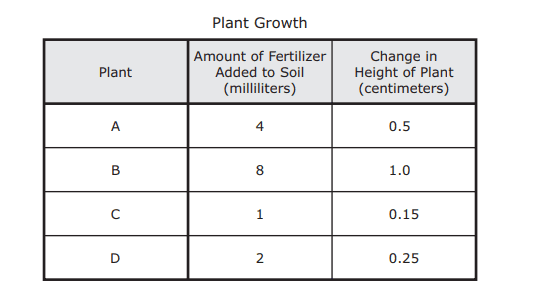
Identify independent and dependent quantities from tables and graphs;
The student applies mathematical process standards to use multiple representations to describe algebraic relationships. The student is expected to:
Represent a given situation using verbal descriptions, tables, graphs, and equations in the form y = kx or y = x + b.
The student applies mathematical process standards to use equations and inequalities to represent situations. The student is expected to:
Represent solutions for one-variable, one-step equations and inequalities on number lines; and
The student applies mathematical process standards to use equations and inequalities to solve problems. The student is expected to:
Model and solve one-variable, one-step equations and inequalities that represent problems, including geometric concepts; and
The student applies mathematical process standards to use equations and inequalities to solve problems. The student is expected to:
Determine if the given value(s) make(s) one-variable, one-step equations or inequalities true.
The student applies mathematical process standards to develop an understanding of proportional relationships in problem situations. The student is expected to:
Convert units within a measurement system, including the use of proportions and unit rates.
The student applies mathematical process standards to use geometry to represent relationships and solve problems. The student is expected to:
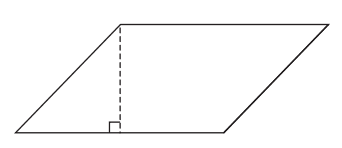
Determine solutions for problems involving the area of rectangles, parallelograms, trapezoids, and triangles and volume of right rectangular prisms where dimensions are positive rational numbers.
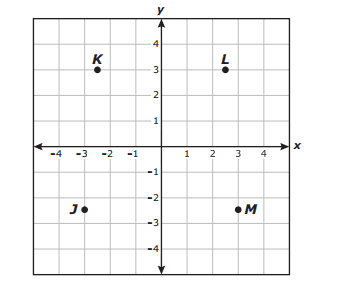
The student applies mathematical process standards to use coordinate geometry to identify locations on a plane. The student is expected to graph points in all four quadrants using ordered pairs of rational numbers.
The student applies mathematical process standards to use numerical or graphical representations to analyze problems. The student is expected to:
Summarize numeric data with numerical summaries, including the mean and median (measures of center) and the range and interquartile range (IQR) (measures of spread), and use these summaries to describe the center, spread, and shape of the data distribution; and
The student applies mathematical process standards to use numerical or graphical representations to analyze problems. The student is expected to:
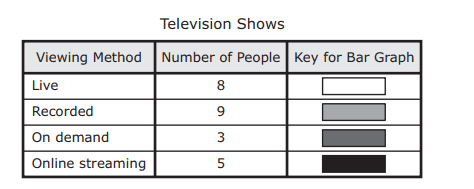
Summarize categorical data with numerical and graphical summaries, including the mode, the percent of values in each category (relative frequency table), and the percent bar graph, and use these summaries to describe the data distribution.
The student applies mathematical process standards to use numerical or graphical representations to solve problems. The student is expected to:
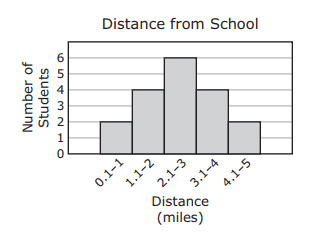
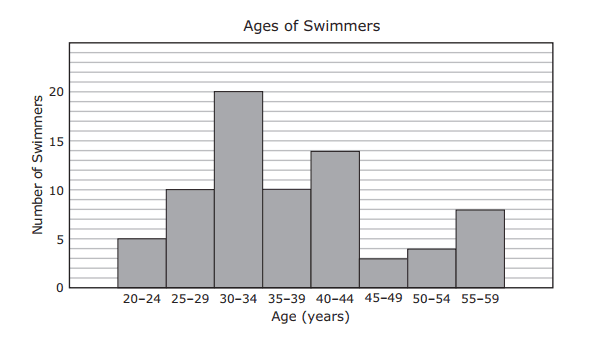
Interpret numeric data summarized in dot plots, stem-and-leaf plots, histograms, and box plots; and
The student applies mathematical process standards to use numerical or graphical representations to solve problems. The student is expected to:
Distinguish between situations that yield data with and without variability.
The student applies mathematical process standards to develop an economic way of thinking and problem solving useful in one's life as a knowledgeable consumer and investor. The student is expected to:
Distinguish between debit cards and credit cards;
The student applies mathematical process standards to develop an economic way of thinking and problem solving useful in one's life as a knowledgeable consumer and investor. The student is expected to:
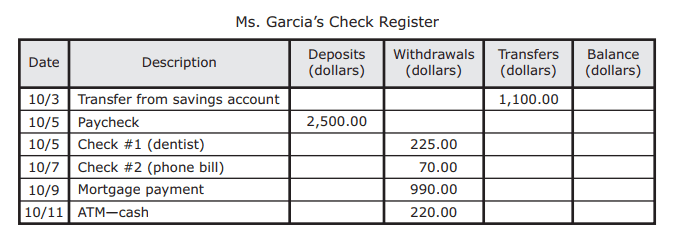
Balance a check register that includes deposits, withdrawals, and transfers;
The student applies mathematical process standards to develop an economic way of thinking and problem solving useful in one's life as a knowledgeable consumer and investor. The student is expected to:
Describe the information in a credit report and how long it is retained;
The student applies mathematical process standards to develop an economic way of thinking and problem solving useful in one's life as a knowledgeable consumer and investor. The student is expected to:
Compare the annual salary of several occupations requiring various levels of postsecondary education or vocational training and calculate the effects of the different annual salaries on lifetime income.
Track each student's skills and progress in your Mastery dashboards