Loading...


Syst. Mic- TT2 - Online Unit 5
Quiz by Ese Ararile
Tag the questions with any skills you have. Your dashboard will track each student's mastery of each skill.
Three categories of molecular diagnostic tests that are nucleic acid-based
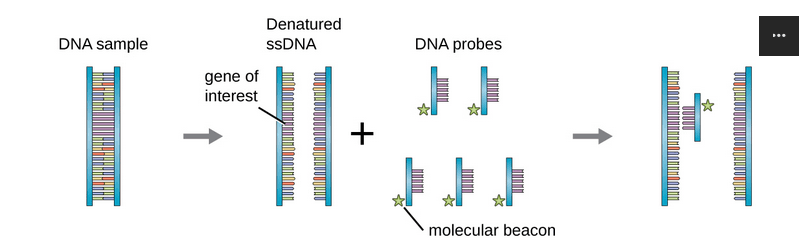
Hybridization methods are based on the ability of two nucleic acid strands, one the ____ and the other the ____, with complementary base sequences to bond specifically with each other and form a double-stranded molecule.
Complementary base sequences to bond specifically with each other and form a double-stranded molecule, also called ____ or ____
The probe consists of a short, ______ nucleic acid molecule complementary to a nucleic acid target of a suspected pathogen 20 to 50 bases long (aka oligonucleotide probe).
Depending on the design, what kind of duplexes can be formed in a hybridization assay?
The hybridization assay probes are labelled with a molecular tag or beacon, such as ...
What can probes be designed to identify?
The environmental conditions set the _____ for a hybridization reaction
At max stringency (higher temperature) hybridization conditions, probes will only hybridize with the exact target sequences that are perfectly complementary (maximum number of hydrogen bonds). At lower temperatures, probes will be able to hybridize to targets they do not match exactly and are only roughly complementary for part of the sequence.
In the hybridization buffer, stringency increases as salt concentration decreases
Increase in salt concentration leads to reduced stringency in the hybridization buffer
Arrange the processes correctly
Gel blotting is a technique for visualizing a particular subset of macromolecules, such as _________, initially present in a complex mixture through separation of the molecules by electrophoresis
What type of membranes are used for "blotting"?
The blotted DNA is usually covalently attached to the membrane by briefly exposing the blot to ___ light.
Organize the steps of Western Blotting

Northern blots are usually used to detect the amount of mRNA made through gene expression within a tissue or organism sample
Pick all differences in Northern blot technique over Southern blotting
In ______, proteins are separated on a gel (usually acrylamide) before transfer to a membrane, which is then probed with an antibody that specifically binds to an antigenic site on the target. The antibody is then detected by other antibodies with a fluorescent or colour production marker system.
Western blot gives bands proportional to the amount and size of the target protein.
____ utilizes the cells or tissues as the solid support matrix. FISH can be used in diagnostic labs to identify pathogens or DNA / RNA targets of interest and also to detect and localize the presence or absence of specific DNA or RNA sequences in tissue or cells.
FISH is used to detect the presence/absence of specific DNA sequences on chromosomes. The probe is attached to a fluorescent molecule and binds to those targets that show a high degree of sequence complementarity. What does FISH stand for?
In PNA-FISH assay, the synthetic probe mimics DNA, but the deoxyribose phosphate backbone is replaced by a ____ to which the nucleobases are linked.
What does PNA mean in PNA-FISH assay?
The target molecule is ribosomal ribonucleic acid (rRNA) in ...
Based on the image shown, please group accordingly

Blot assays are primarily designed for...
Upon the use of blotting, is it possible to obtain estimates of the abundance of the target molecule from densitometry measurements of signal intensity?
Polymerase Chain Reaction (PCR) combines complementary nucleic acid _____ with nucleic acid amplification
Please link the PCR processes according to temperature
In the PCR the reaction steps occur in the same tube containing:
Target nucleic acid
DNA Primers
Buffers to enhance polymerase activity
Deoxynucleotides
Taq DNA polymerase
Conventional PCR is quantitative and doesn't require electrophoresis afterwards
What type of PCR involves more than one primer pair included in the PCR mixture
_____ involves sequential use of two primer sets. The first set is used to amplify a target sequence. The amplicon is then used as the target sequence for a second amplification using primers internal to those of the first amplicon.
_____ uses short (random) primers not specifically complementary to a particular sequence of a target DNA
Reverse transcriptase PCR is a quantitative method
Reverse transcriptase PCR begins with the use of the reverse transcriptase enzyme to convert ____ molecules into ____, which is then used as a template for traditional PCR.
Real-time PCR (qPCR) ...
Real-time PCR requires an electrophoresis step
What PCR type does this describe? "Amplified DNA is labelled with fluorescent dyes enabling amplification of DNA visually by reading the fluorescence of each well; fluorescence is measured after each cycle enabling testing to be analyzed in real-time".
Numerous real-time PCR automated instruments are available, each with unique features that permit some flexibility. All have a thermal cycler, light source, an emission detection source, and a computer interface to selectively monitor the formation of amplified product.
Each endonuclease recognizes a specific nucleotide sequence known as the _______
Differences in the restriction patterns are known as RFLPs which stands for ____
_____ involves methods that determine the exact nucleotide sequence of a single gene or gene fragment obtained from an organism.

Nucleic acid sequencing is used for
Sanger DNA sequencing method is also called ...
The chain termination method involves DNA replication of a double-stranded template with the use of a DNA primer to initiate synthesis of a complementary strand
Next-generation sequencing is a type of sequencing which is not automated but relies on sophisticated software for rapid DNA sequencing.
Group these components of the sequencing process
454 Life Sciences’ pyrosequencing and Illumina’s Solexa technology are examples of next-generation sequencing
Since ____, automated sequencing techniques used by laboratories fall under the umbrella of next-generation sequencing.
