Loading...

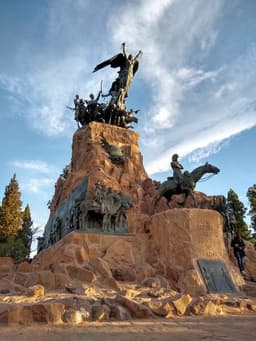
THE ANDES ARMY MONUMENT
Quiz by Romina Tommasi
Customize this quiz to suit your class
Instantly translate to 100+ languages
Tag the questions with any skills you have. Your dashboard will track each student's mastery of each skill.
Give this quiz to my class
The monument was created by...
Juan Manuel Ferrari, a Uruguayan painter.
Juan Manuel Ferrari, a Uruguayan sculptor
Juan Manuel Ferrari, an Argentinian sculptor.
The monument in honour of the Andes Army was inaugurated in...
1914
1910
1814
1912
The monument was created by...
The monument in honour of the Andes Army was inaugurated in...
The friezes and sculptures are made of...
The horse with its front legs on th floor represents...
There are 2 groups of ... on each side of San Martin
On the sides and at the back, there are 3 .... that show relevant moments of the Andes Army preparations.
The first frieze shows ...
The second frieze shows ...
The third frieze shows the ... of the Army
"Tropero" Sosa was a...
There are 3 ...: Argentina's, Chile's and Peru's.
At the top...
 Argentina Where Is It? Argentina is the second-largest country in South America. It is the eighth-largest country in the world. Five countries share borders with Argentina. About forty-three million people live in Argentina. The capital of Argentina is Buenos Aires. Its name means "fair winds." About fifteen million people live in Buenos Aires. People. Most people in Argentina live in large cities. Other people live in the country. Some of these people are farmers. They grow crops such as wheat and grapes. Men, women, and children from all over the world live in Argentina. Many people are from Europе. Most people in Argentina speak Spanish. Land. Argentina has mountains, lakes, and rivers. The Andes Mountains are in the west. They are the longest group of mountains in the world. Argentina has many different kinds of animals. Monkeys, wild cats, and many other animals live there. Some of the most beautiful places in Argentina are rivers. Some of the river water falls from very high places. The falls are some of the biggest in the world. History. People have lived in Argentina for thousands of years. Long ago, the Spanish ruled the country. Then, army leaders took control. The army leaders did not let people have any say in their rules. This was unfair for most people. Today, people in Argentina can help make rules. They choose leaders who share their ways of thinking. Celebration. One of the biggest parties in Argentina lasts for days. People dress up as clowns and animals. They have a lot of fun. There is music, dancing, and a big parade. Food. Argentine pies can be filled with lots of different things. A family cooks meat on a grill. People in Argentina eat meat cooked on a grill. They also eat little pies filled with meat, vegetables, or cheese. Conclusion. Argentina is a country with people from all over the world. They help to make it a great place with a bright tomorrow. Lesson 2: Plate Tectonics There are a few handfuls of major plates and dozens of smaller, or minor, plates. Six of the majors are named for the continents embedded within them, such as the North American, African, and Antarctic plates. Though smaller in size, the minors are no less important when it comes to shaping the Earth. The tiny Juan de Fuca plate is largely responsible for the volcanoes that dot the Pacific Northwest of the United States. The plates make up Earth's outer shell, called the lithosphere. (This includes the crust and uppermost part of the mantle.) Churning currents in the molten rocks below propel them along like a jumble of conveyor belts in disrepair. Most geologic activity stems from the interplay where the plates meet or divide. The movement of the plates creates three types of tectonic boundaries: convergent, where plates move into one another; divergent, where plates move apart; and transform, where plates move sideways in relation to each other. They move at a rate of one to two inches (three to five centimeters) per year. Convergent BoundariesWhere plates serving landmasses collide, the crust crumples and buckles into mountain ranges. India and Asia crashed about 55 million years ago, slowly giving rise to the Himalaya, the highest mountain system on Earth. As the mash-up continues, the mountains get higher. Mount Everest, the highest point on Earth, may be a tiny bit taller tomorrow than it is today. These convergent boundaries also occur where a plate of ocean dives, in a process called subduction, under a landmass. As the overlying plate lifts up, it also forms mountain ranges. In addition, the diving plate melts and is often spewed out in volcanic eruptions such as those that formed some of the mountains in the Andes of South America. At ocean-ocean convergences, one plate usually dives beneath the other, forming deep trenches like the Mariana Trench in the North Pacific Ocean, the deepest point on Earth. These types of collisions can also lead to underwater volcanoes that eventually build up into island arcs like Japan. Divergent Boundaries At divergent boundaries in the oceans, magma from deep in the Earth's mantle rises toward the surface and pushes apart two or more plates. Mountains and volcanoes rise along the seam. The process renews the ocean floor and widens the giant basins. A single mid-ocean ridge system connects the world's oceans, making the ridge the longest mountain range in the world. On land, giant troughs such as the Great Rift Valley in Africa form where plates are tugged apart. If the plates there continue to diverge, millions of years from now eastern Africa will split from the continent to form a new landmass. A mid-ocean ridge would then mark the boundary between the plates. Transform Boundaries The San Andreas Fault in California is an example of a transform boundary, where two plates grind past each other along what are called strike-slip faults. These boundaries don't produce spectacular features like mountains or oceans, but the halting motion often triggers large earthquakes, such as the 1906 one that devastated San Francisco.La Isla de Pascua This 64-square mile island off Chile’s west coast goes by many names. Its English name is Easter Island, marking the day in 1722 when it was discovered by a European. In Spanish, it is called Isla de Pascua. The Rapa Nui, its first inhabitants, called it “The Navel of the World.” Experts do not agree on the history of Easter Island. It is unclear where the first people came from or when they arrived. Many people believe they came from neighboring Polynesia around AD 300. This culture built 900 enormous stone statues for which the island is famous. The statues are known as moai. Most of the moai are made of volcanic tuff. Tuff is a soft rock made from the ash that is forced out during a volcanic eruption. It is easier to carve than hard stones like marble, but it is not ideal for carving small details. The moai are considered megaliths (large stones that form prehistoric monuments). They stand up to 33 feet high when on their ceremonial platform (the average height is about 13 feet), and they weigh up to 82 tons. They usually have a trunk (body), inset arms, and an exaggerated head with angular edges. The head of each moai takes up about one-third of the total figure. It all shows that the people who created them could engineer monumental structures. Many moai stand with their backs to the sea. They watch the island like protective markers. Some low-relief carvings of religious deities were added to the backs of the moai at a later date. Experts are still trying to understand how they were carved and moved, and what they might mean. Chile took control of the island in 1888. At that time, its population was less than 200. The government used it for grazing livestock. Today, the mystery of Easter Island makes it a popular tourist spot. Valparaíso Valparaíso is a colorful blend of old and new traditions in Chile. This port city is an interesting example of daily life in Chile. Before the Panama Canal was opened in 1914, all ships traveling east to west had to pass all the way around South America. Valparaíso was ideally positioned as a stopping point in the Southern Pacific. Valparaíso has a long history of playing host to a large array of cultures and ideas. The city was known around the world as a place that embraced learning and new ideas. Pablo Neruda had a home in Valparaíso in the 1920s. After the Panama Canal was completed, shipping traffic declined significantly. Valparaíso was forgotten and fell upon hard times. In the 1990s, the government of Chile made an effort to revitalize the colorful port. Today it is a UNESCO (United Nations Educational, Scientific and Cultural Organization) World Heritage site. True to its history of embracing learning, it is also home to four universities. Tourists can visit the first stock exchange in Latin America. Valparaíso also has Chile’s first public library. Visitors stroll through cobblestone streets in the historic district. Here they can also view the city’s iconic colorful buildings. At night, music and street performers liven the experience. Try It Yourself Two Spanish words comprise the name of this city. Val means valley. Paraiso means paradise. The name Valparaíso means Paradise Valley. Can you recognize descriptive Spanish words in other Spanish place names? Start with names of places around you. Las Comidas Tradicionales To Chileans, nothing says home like pastel de choclo, a type of casserole made of beef and corn. The body of the casserole is flavorful. It contains beef, onions, raisins, and roasted chicken. It is topped off with a layer of creamed corn and then baked. Baking it brings out the sweetness in the corn, adding a contrast to the savory meat. The preferred type of corn is called choclo. This variety is grown in rugged conditions in the Andes. The kernels are large and hearty compared to other varieties. Another favorite dish in Chile is a type of meat stew called cazuela. Originally a native dish, it is now known as comfort food in Chile. Pork, beef, lamb, or chicken still on the bone is boiled in a traditional clay pot. To that, corn, potatoes, and other local vegetables are added. It is seasoned with onion and garlic. Pablo Rogat/Shutterstock When Chileans think about dessert, manjar is the first ingredient on their minds. It is a caramel sauce made from cooking milk, sugar, and vanilla. It is found in many desserts. It is used as filling in cakes, pies, and cookies. It is refrigerated to make puddings and custards. People even use it to sweeten their coffee.The 1972 Andes Flight DisasterI am happy: the verb 'ser', 'soy' and 'es'THE SAILORThe House That Kept SecretsTHE LOST KEY