Loading...


The Click Wise: Digital Detective Files
Quiz by THEA RIANE ESCRUPULO
Customize this quiz to suit your class
Instantly translate to 100+ languages
Tag the questions with any skills you have. Your dashboard will track each student's mastery of each skill.
Give this quiz to my class
BREAKING NEWS! Google bans cat pics on the internet!
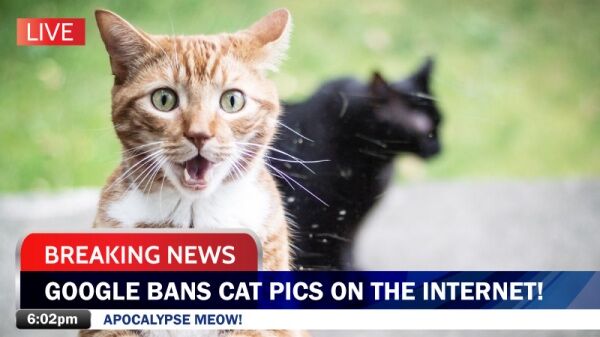
FAKE
REAL
DOH launches nationwide immunization drive vs measles, rubella, polio
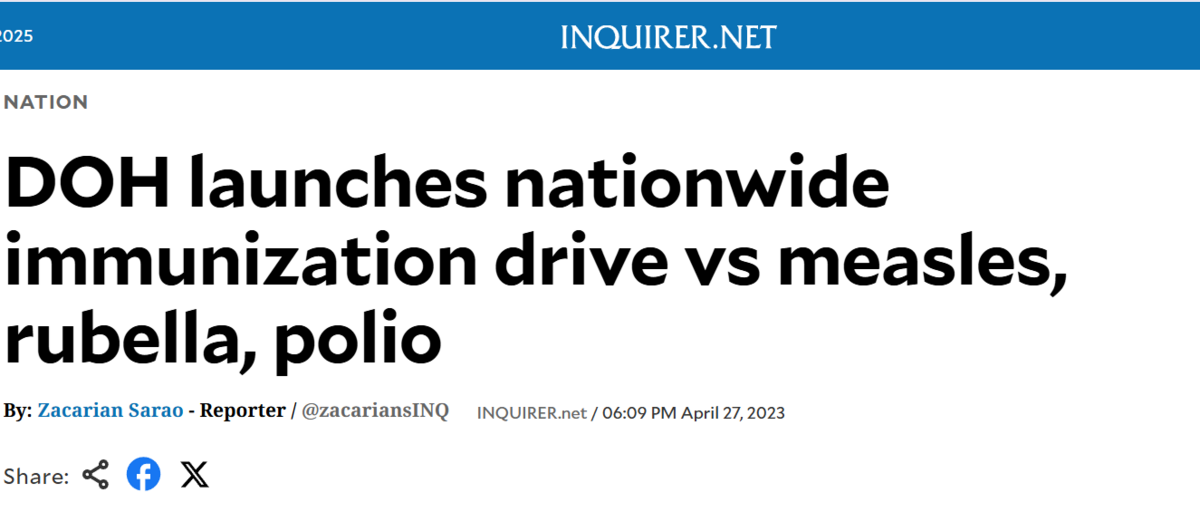
FAKE
REAL
BREAKING NEWS! Google bans cat pics on the internet!
DOH launches nationwide immunization drive vs measles, rubella, polio
Manny Pacquiao returning to the ring after losing Philippines senatorial race

Garlic cures all forms of cancer – doctors say hospitals are hiding this truth!

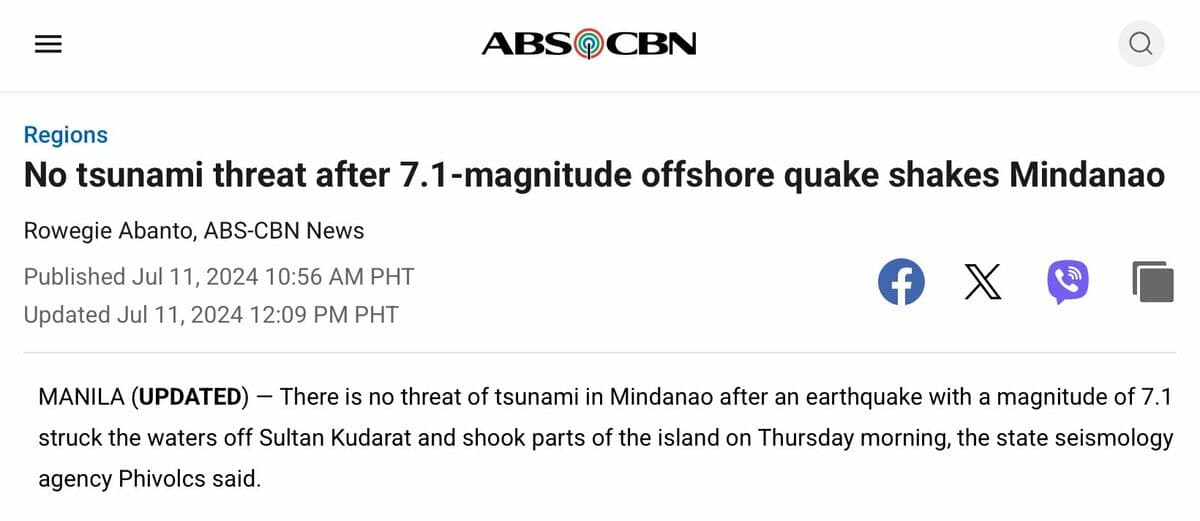
No tsunami threat after 7.1-magnitude offshore quake shakes Mindanao
Baby Elephant Found in Manila River! A viral social media post shows a photo of a baby elephant swimming in the Pasig River, claiming it escaped from a nearby zoo.

You’re playing an online game and someone you don’t know sends you a message asking your name and where you live.
What should you do if someone online asks you private questions?
You see a message on a website: “YOU WON A FREE PHONE! CLICK HERE!”

Someone posts a mean comment on your classmate's picture

You see a scary picture while using the internet

You see a new game app on the phone that looks fun, but it says it needs access to your camera and photos

 The Blue Planet Earth is called the Blue Planet. Do you know why? The Earth looks blue from space because there is water on 70% of our planet. Sometimes there are storms over warm ocean water. These are hurricanes. The wind is very strong, and it blows in a circle. North of the equator, hurricane winds blow counterclockwise. South of the equator, the winds blow clockwise. Hurricanes form at the equator. It is very rainy and moist there. There are many different animals and beautiful plants.What is a Hurricane, Typhoon, or Tropical Cyclone? The terms "hurricane" and "typhoon" are regionally specific names for a strong "tropical cyclone". A tropical cyclone is the generic term for a non-frontal synoptic scale low-pressure system over tropical or sub-tropical waters with organized convection (i.e. thunderstorm activity) and definite cyclonic surface wind circulation (Holland 1993). Tropical cyclones with maximum sustained surface winds of less than 17 m/s (34 kt, 39 mph) are usually called "tropical depressions" (This is not to be confused with the condition mid-latitude people get during a long, cold and grey winter wishing they could be closer to the equator). Once the tropical cyclone reaches winds of at least 17 m/s (34 kt, 39 mph) they are typically called a "tropical storm" or in Australia a Category 1 cyclone and are assigned a name. If winds reach 33 m/s (64 kt, 74 mph), then they are called: "hurricane" (the North Atlantic Ocean, the Northeast Pacific Ocean east of the dateline, or the South Pacific Ocean east of 160E) "typhoon" (the Northwest Pacific Ocean west of the dateline) "severe tropical cyclone" or "Category 3 cyclone" and above (the Southwest Pacific Ocean west of 160°E or Southeast Indian Ocean east of 90°E) "very severe cyclonic storm" (the North Indian Ocean) "tropical cyclone" (the Southwest Indian Ocean) Coriolis Effect The Coriolis Effect—the deflection of an object moving on or near the surface caused by the planet’s spin—is important to fields, such as meteorology and oceanography. Storm Approaching Southeast Asia Because of the Coriolis Effect, hurricanes spin counterclockwise in the Northern Hemisphere, while these types of storms spin clockwise in the Southern Hemisphere. This Northern Hemisphere storm, approaching Southeast Asia, is spinning counterclockwise. Earth is a spinning planet, and its rotation affects climate, weather, and the ocean through the Coriolis Effect. Named after the French mathematician Gaspard Gustave de Coriolis (born in 1792), the Coriolis Effect refers to the curved path that objects moving on Earth’s surface appear to follow because of the spinning of the planet. As Earth turns, points near the equator—countries like Ecuador and Kenya—are moving much faster than places near the planet’s poles. This is because Earth is shaped like a marble: Its circumference is larger near its middle (the equator) than near its top and bottom. All places on Earth experience a day that is about 24 hours long, but points near the equator have to travel longer distances in the same period of time, which means that those places move faster. Scientists say these points have more “angular momentum.” This is why rockets are usually launched from places near the equator, like Cape Canaveral, Florida, United States. Such locations give rockets a large initial speed, which helps them get into orbit using the least possible amount of fuel. The Coriolis Effect influences wind patterns, which in turn dictate how ocean currents move. Imagine wind near the equator flowing to the north. That wind starts with a certain speed due to Earth’s rotation (near the equator, Earth rotates at a speed of roughly 1,600 kilometers per hour (1,000 miles per hour) from west to east). As the wind travels north toward the North Pole, it moves over parts of Earth that are rotating progressively more slowly. Since the wind retains its angular momentum, it keeps moving from west to east, overtaking the part of Earth turning more slowly below it. As a result, the wind appears to bend to the east (that is, to the right). This is the Coriolis Effect in action. Wind flowing south from the equator would likewise bend to the east. This effect is responsible for many meteorological and oceanographic phenomena. For instance, due to the Coriolis Effect, hurricanes in the Northern Hemisphere spin in a counterclockwise direction, while hurricanes in the Southern Hemisphere (known as cyclones) spin in a clockwise direction. Ocean-circling currents known as “gyres” also spin in spiral patterns thanks to the Coriolis Effect. There is an urban legend that water in toilets spins in opposite directions in the Northern and Southern Hemispheres because of the Coriolis Effect. But that isn't true—a toilet bowl is too small for the effect to be observed. Instead, other factors like the shape of the toilet bowl and the direction that the water enters are largely responsible for how the flushing water moves.1. What calm area near the Equator is characterized by minimal wind movement? Answer: Doldrums 2. What are visible accumulations of tiny water droplets or ice crystals in the air called? Answer: Clouds 3. Which cloud type is high, thin, and made of ice crystals? Answer: Cirrus 4. What do we call the apparent deflection of winds and currents due to Earth’s rotation? Answer: Coriolis effect 5. In which hemisphere do storms rotate clockwise? Answer: Southern Hemisphere 6. What are winds that blow consistently from one direction over a specific area called? Answer: Prevailing winds 7. What is the area where prevailing winds meet called? Answer: Convergence zone 8. Which wind zone blows from the polar regions toward the mid-latitudes? Answer: Polar easterlies 9. In which hemisphere do storms rotate counterclockwise? Answer: Northern Hemisphere 10. Which wind zone blows from west to east across the mid-latitudes? Answer: Westerlies 11. What are the calm areas around 30° north and south latitude with little precipitation called? Answer: Horse latitudes 12. What winds blow toward the Equator from the northeast in the Northern Hemisphere and from the southeast in the Southern Hemisphere? Answer: Trade winds 13. Which cloud type is mid-level and blankets the sky, often bringing overcast weather? Answer: Stratus 14. Which cloud type is puffy and can bring heavy rain or snow depending on height? Answer: Cumulus 15. What prefixes indicate the height of clouds in the atmosphere? Answer: Cirro-, alto-, nimbo-The Left Click Technique - Starter QuizRHYMES (click the audio to listen to the instructions)Listen and click the correct picture Billy gets lost. Billy is a puppy. He lives in a big house with a blue roof. He loves to play fetch with Emmy. Emmy throws the ball. Billy chases it. Then, Billy sees Cat. He drops the ball and chases Cat. Cat runs down the street, and Billy chases him. Emmy cries, “Come back, Billy.” Cat runs through a farm, and Billy chases him. Cat runs into the forest, and Billy chases him. Cat climbs up a tree. Billy turns to go home. He cannot see the big house with a blue roof.“ Oh, no, I am lost,” Billy says. Billy runs down a path. He sees Fox. “How can I get home?” he asks Fox. “I have never been out of the forest,” says Fox. “Ask Cow in the farmer’s field,” Fox says. Billy runs to the farmer’s field. Billy says to Cow, “I am lost. “Do you know the way to my house?” Billy asks. “I have never been off the farm,” says Cow. “Ask Owl,” Cow says. Billy goes to Owl in the barn. “Please wake up, Owl,” says Billy. “I need your help,” he says. “I am lost!” he cries. “Do you know a big house with a blue roof?” Billy asks. “Yes, I do,” Owl says. Owl flies, and Billy chases her. Then, Billy sees Emmy at the big house with a blue roof. “Thank you, Owl,” says Billy. Create an interactive "fill the gaps" quiz in seconds - complete with a 'Hall of Fame'! Instructions: 1. Edit the title of this quiz (above) to something appropriate. 2. COPY and PASTE your text into this box (TIP - plain text for best results, to avoid formatting glitches), and edit it as you wish. 3. DOUBLE-CLICK any word to turn it into a 'gap'. 4. To put the word back, simply double-click the gap again or drag the word from the top of the screen to the correct gap. 5. When you are finished, click 'save' to turn your work into an interactive quiz for your students - complete with a Leaderboard so you can see how quickly they finished! Note: When you save your work, you will provide a password which will allow you to edit the quiz again later. How is personal data collected? There are several ways that an unauthorised person can try and collect your data. These include: •phishing •smishing •vishing •pharming. Phishing Phishing is when a person sends a legitimate looking email to a user. The email contains a link to a website that also looks legitimate. The user is encouraged to click the link and to input personal data into a form on the website. The email could also simply ask the user to reply to the email with their personal data. The user is tricked into giving their personal data to a source that they believe is legitimate. However, both the email and the linked website are from a fake unauthorised source. The personal data that is input is then collected by an unauthorised person. This person can then use this data for criminal acts, for example, to commit fraud or steal the person's identity. Intimidation has become a common feature of phishing emails, threatening the user that they must click the link and rectify a situation immediately, or there will be a further issue. The aim of a phishing attack is to steal the user's personal data. Figure 5.1: Phishing. A real-life example of phishing PayPal have been the subject of several different phishing emails. Users receive an email that looks as though it has been sent from PayPal, as it has the PayPal branding. The email normally warns of an issue such as unexpected activity on their account, or that some kind of verification of their account is required. The user is then asked to click a link to log into their account and resolve the issue. The link takes them to a webpage that looks like the PayPal login page. If the user inputs their login details into this page, they will not be taken to their account. It is often at this stage that the user may realise that the email and webpage are fake. However, they have already given the unauthorised person their PayPal login details. Figure 5.2: An example of a phishing email claiming to be from PayPal. How to recognise phishing There are several guidelines to be aware of regarding emails to avoid being subjected to phishing. These include: •Don't even open an email that is not from a sender that you recognise or a trusted source. •Legitimate companies will never ask you for your personal data using email. Be immediately suspicious of any email that requests your personal data. •Legitimate companies will normally address you by your name. Be suspicious of any email that addresses you as ‘Dear Member' or ‘Dear Customer'. •Legitimate companies will send an email that uses their domain name. If you hover your mouse over the sender's name, it will show the email address that the email is sent from. If this does not look legitimate, for example, does not contain the correct domain name, then it is probably fake. For example, if the sender's email is user@paypal1.com rather than user@paypal.com, this is from an incorrect domain name. •Legitimate companies are protective of their professional reputation and thoroughly check any communications. They will make sure that all information given is grammatically and correctly spelt. Be suspicious of any email that contains bad grammar or spelling mistakes. •A link in an email from a legitimate company will also normally contain the domain name of the company. You can sometimes hover over the link, or right click and inspect the link, to see the address of the URL that is attached. If the URL does not contain the domain name, or also contains typical errors such as spelling mistakes, then be suspicious of this. PRACTICAL ACTIVITY 5.02 Ask a friend or a member of your family if they have ever received an email that they believed was a phishing email. Ask them how they identified it was phishing. Ask them if they know all of the given guidelines for identifying phishing emails. Smishing Smishing (or SMS phishing) is a variant of phishing that uses SMS text messages to lure the user into providing their personal details. The user is sent an SMS text message that either contains a link to a website, in the same way that phishing does, or it will ask the user to call a telephone number to resolve an urgent issue. The same advice can be followed for smishing as given for phishing. The user must question at all times any links that are sent from an unknown or suspicious user. It is advisable that if a user believes the message may be legitimate, to type in the domain name for the legitimate company website into their web browser, rather than following the link in the message. Users should block any numbers that they believe are suspicious to prevent any further risk of smishing from that number. Figure 5.3: Smishing. Vishing Vishing (or voice phishing) has the same aim as phishing, to obtain a user's personal details. The user receives a telephone call that could either be an automated system or could be a real person. An automated voice could speak to the user and advise them that an issue has occurred, such as there has been suspicious activity regarding their bank account. The user may then be asked to call another number, or just to simply press a digit and be directed to another automated system. This system will ask them to provide their bank account details to resolve the issue. The bank account details have then been obtained by the unauthorised user and can be used to commit a crime against the user. The automated system could be replaced by a real person who will try to do the same thing. They will try to convince the user that there has been an issue with an account they have and to provide the log-in details or PIN for the account to verify who they are so the issue can be resolved. The precaution to take for vishing is that no company will ever call you and ask you to provide any log-in details or PIN details over the telephone. They may ask you to provide other personal information, and if you are in doubt that the person on the other end of the phone is legitimate, it is always advisable to put the phone down and call the company back on a legitimate number that you may already know or can obtain. Figure 5.4: Vishing. Pharming Pharming is when an unauthorised user installs malicious code on a person's hard drive or server. The malicious code is designed to redirect a user to a fake website when they type in the address of a legitimate one. The fake website is designed to look like the legitimate one, to trick the user and make sure they are not aware that their request has been redirected. The user will then enter their personal details into the fake website, believing it is the legitimate one, and the unauthorised person will now have their personal data. A common technique used in pharming is called domain name server (DNS) cache poisoning. This technique exploits vulnerabilities in the DNS and diverts the internet traffic intended for a legitimate server toward a fake one instead. The unauthorised user needs to find a way to install the malicious code on the computer. They often hide the malicious code in an email attachment or link. When the user opens the email attachment or clicks the link, the malicious code is downloaded also. Figure 5.5: Pharming. The aim of a pharming attack is also to steal a user's personal data. A real-life example of pharming In 2007 50 different companies all over the world were subject to a pharming attack, these included PayPal, eBay, Barclays bank and American Express. Over a three-day period, hackers managed to infect over 1000 PCs a day with a malicious pharming code. When users who had been infected visited the websites of the different companies, they were redirected to a legitimate-looking version of the site that was designed to steal their personal data. The original email, containing the malicious code, was set up to look like a shocking news story. Users were encouraged to click a link in the email to find out more information. The code was downloaded when the user clicked the link. This was quite a sophisticated attack that required legitimate looking websites to be set up for a large number of companies. It is not known how much money the hackers were able to retrieve as a result. How to prevent pharming All of the guidelines to avoid being subjected to phishing are also relevant for recognising pharming. There are also several other precautions that can be taken to check for pharming attacks. These include: •Have a firewall installed and operational. A firewall monitors incoming and outgoing traffic from your computer. It checks this traffic against set criteria and will flag and stop any traffic that does not meet the criteria. A firewall could detect and block suspicious traffic, such as a malicious code trying to enter your system. •Have an anti-virus program installed that is designed to detect malicious pharming code. You need to scan your computer on a regular basis to check for any malicious code. It is advisable to set up an automatic scan on a daily basis at a time when your computer will normally be switched on. •Be aware when using public Wi-Fi connections. A hacker could look to directly access your computer and install the malicious code if you are connected to a public Wi-Fi connection. It is often advisable to use a VPN when using public Wi-Fi. This will help shield your internet activity and personal details from a hacker, making it more difficult for them to access your computer. Smishing can also be used as a form of pharming. A user is sent a link, that when they click is designed to download malware onto their mobile device. Therefore, it is advisable to have security software installed on your mobile and also scan it regularly to detect any presence of malware.