Loading...


The United States Constitution and Government
Quiz by Cecilia Bazan
Customize this quiz to suit your class
Instantly translate to 100+ languages
Tag the questions with any skills you have. Your dashboard will track each student's mastery of each skill.
Give this quiz to my class
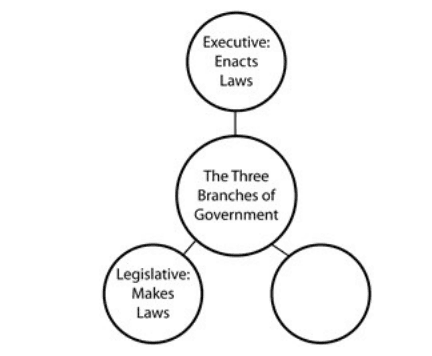


 Powers granted to the national government by the United States Constitution which are spelled out (written) specifically in the Constitution are called ___________ powers. Denied Concurrent Federal Enumerated This was the first plan of government for the United States. It was meant to be a league of friendship between the states. It was too weak and failed. Magna Carta Mayflower Compact Petition of Right Articles of Confederation What gave Congress the power to regulate both foreign and interstate trade? Commerce Clause Kansas-Nebaska Act Supremacy Clause Santa Clause What is the structure of the national government? a) Unitary b) Federal c) Confederal d) Autocratic What is the relationship between the three branches of government, including separation of powers? a) They have no relationship b) They work independently of each other c) They share powers and work together d) They have overlapping powers 16. What is the relationship between the state governments and national government? a) State governments have more power than the national government b) State governments have no power compared to the national government c) State governments and the national government have equal power d) State governments and the national government have separate powers 17. What powers are denied by the state governments but given to the national government? a) Reserved powers b) Concurrent powers c) Denied powers d) Implied powers 18. What powers are shared by both the state governments and national government? a) Reserved powers b) Enumerated powers c) Concurrent powers d) Implied powers 19. States had no government at all when the United States was born. a) True b) False 20. The central government of the U.S. is known as the federal government. a) True b) FalseSeparation of Church and State: The distance in the relationship between organized religious and the nation state. Due process: The government must act fairly and in accord with established rules in all that it does. Free Speech: Speech that is protected by the First Amendment to the United States Constitution Right of Assembly: The freedom of meeting together in groups protected by the first amendment. Constitutional Guarantee: The idea that the Constitution guarantees certain rights to all people. Civil Liberties: The guarantees of the safety of persons, opinions, and property from the arbitrary acts of government including freedom of religion. Civil Rights: A term used for those positive acts of government that seek to make constitutional guarantees a reality for all people, prohibitions of discrimination. Equal Protection: a guarantee under the 14th Amendment to the United States Constitution that a state must treat an individual or class of individuals the same as it treats other individuals or classes in like circumstances Racial Discrimination: Prejudiced or prejudicial outlook, action, or treatment based on race. Religious Liberty: Religious freedom based on the establishment and free-exercises clauses of the first amendment.Chapter 7 Study Guide Answers What does the Bill of Rights do? The Bill of Rights lists our basic rights. Who is the person mainly responsible for the Bill of Rights? James Madison is the person mainly responsible for the Bill of Rights. The Bill of Rights is part of which document? The Bill of Rights is part of the United States Constitution. Whose job is it to protect our rights listed in the bill of rights? It is the job of the federal courts (judicial branch) to protect our rights. What are the five rights listed in the first amendment? Freedom of speech: includes symbolic speech; does not include speech that could endanger the public safety. Religion: Right to believe whatever you want, but you can’t do whatever you want in the name of religion (can’t break the law). Press: The free flow of information and ideas; can’t print lies or information that could be helpful to an enemy in wartime. Assembly: Use public property for meetings and demonstrations (i.e. parades, protests, political rallies). Must be done legally and peaceably. Right to petition: Means you can appeal to the government if you’re unhappy about something or some policy. Give one example of speech NOT protected under the first amendment. An example of speech not protected under the first amendment would be crying “fire” in a crowded movie theater (anything that could potentially endanger the public safety). What does the second amendment give us the right to? The second amendment gives us the right to bear arms. What does the third amendment state we are not legally obligated to do? Under the third amendment, we are not obligated to quarter (or house) soldiers in our homes. What does the fourth amendment protect us from? The fourth amendment protects us from unreasonable search and seizure. What is needed in order to search or seize property? A warrant is needed, which must be issued by a judge, in order to search and seize property. What five rights are we guaranteed under the Fifth Amendment? Right to a grand jury: determines whether or not the government has enough evidence to bring someone to trial. Double jeopardy: Once a person has been found not guilty, he cannot be tried again for the same crime. Self incrimination: A person has the right to remain silent; he does not have to testify against himself. Due process: The government must follow a clear set of rules (a process) as it carries out the law and takes your life, liberty, or property. Just compensation: If the government has to take someone’s land, they will offer a fair price. What is the right stated in the “Miranda Warning”? The main right stated in the “Miranda Warning” is the right to remain silent. What are the four rights stated under the sixth amendment? Right to a speedy and public trial, and an impartial jury. Right to a jury of people that live in the defendant’s area (jury of your peers). To hear and question all witnesses Right to an attorney As stated in the seventh amendment, we have the right to which type of trial depending on how much money a person is being sued for? What can a judge NOT do? Under the seventh amendment, we have the right to a jury trial depending on how much money is at stake in a civil trial. A judge cannot overturn a decision made by a jury. What are the four things that are prohibited under the eighth amendment? The four things that are prohibited (or not allowed) under the eighth amendment are: excessive fines, excessive bail, cruel and unusual punishments, and poor prison conditions. Under the ninth amendment, rights not listed in the Bill of Rights belong to whom? According to the ninth amendment, rights not listed in the Bill of Rights belong to the people. The tenth amendment states that powers not given to the national government are reserved for whom? According to the tenth amendment, powers not specifically given to the national government are reserved for the people and the states. What is meant by the term “double jeopardy”? The term “double Jeopardy” refers to a person being retried for a crime in which he has already been acquitted, or found “not guilty”. What does it mean to be indicted by a grand jury? To be indicted by a grand jury means that a person will be going to trial and will retain all of the rights listed in the fifth, sixth, seventh, and eighth amendments.1. Battle of Lexington At the Battle of Lexington in 1775, British soldiers and colonial militia faced each other on the village green. A shot was fired, but no one knows for sure who fired first. Even so, this moment is often called the beginning of the American Revolution. Why is the Battle of Lexington still considered the start of the American Revolution, even though it is unclear who fired the first shot? A. It marked the first time colonists and British soldiers fought in open battle B. It proved that colonists planned the war long before the fighting began C. It showed that British soldiers were fully responsible for starting the war D. It confirmed that colonists had already declared independence from Britain 2. Battle of Concord After the fighting at Lexington, British troops marched to Concord to destroy colonial supplies. Instead, colonial militia gathered and fought back, forcing the British to retreat toward Boston. Why is the Battle of Concord considered an important turning point in the early American Revolution? A. It showed that colonial militias could organize and successfully push back British troops B. It proved that the British army had already lost control of all the colonies C. It confirmed that the colonies had officially declared independence from Britain D. It demonstrated that foreign countries were already helping the colonial forces 3. Second Continental Congress Much of the early violent conflict between colonists and British soldiers took place in Boston. After fighting broke out at Lexington and Concord near Boston, colonial leaders met at the Second Continental Congress in 1775 to decide what to do next. Which answer best describes the main actions taken by the Second Continental Congress? A. They created an army, chose a leader, and tried to avoid war with Britain B. They declared independence, wrote the Constitution, and ended the war C. They raised taxes, formed a monarchy, and supported British rule D. They ended slavery, gave women rights, and expanded voting laws 4. Olive Branch Petition In 1775, colonial leaders sent a letter called the Olive Branch Petition to King George III of Britain. Based on this situation, what was the main purpose of the Olive Branch Petition sent to the king? A. To ask the king to restore peace between both sides B. To declare independence from Britain and begin a new nation C. To request help from foreign countries in the war effort D. To organize protests against British taxes across the colonies 5. Battle of Bunker Hill On June 17, 1775, during the Battle of Bunker Hill in Boston, colonial forces fought against the British on a hill overlooking the city. The fighting was intense and led to heavy losses on both sides. Which statement best explains why the Battle of Bunker Hill was an important battle in the war? A. The colonists won the battle, showing they were stronger than British forces B. The colonists won the battle, showing the British that the war would be short and easy for the colonists C. The British won the battle, showing the war would be difficult and costly for both sides D. The British won the battle, showing British forces could defeat the colonists easily 6. Pamphlets During the American Revolution, pamphlets were short printed writings that were inexpensive to produce and often written in everyday language so many colonists could read them. How did these features of pamphlets most affect their role in the American Revolution? A. They helped spread ideas widely, allowing more colonists to form and share opinions B. They limited ideas to educated leaders, keeping most colonists uninvolved C. They replaced newspapers entirely, becoming the only source of information D. They prevented disagreement, causing most colonists to think the same way 7. Thomas Paine’s Common Sense In 1776, Thomas Paine published Common Sense, a widely read piece of writing about the relationship between the colonies and Britain. How did this pamphlet most influence colonial thinking during the American Revolution? A. It encouraged colonists to support independence from Britain B. It convinced colonists to remain loyal to the British government C. It explained how colonial armies should organize attacks D. It described laws colonists were expected to follow 8. Declaration of Independence In July 1776, the Declaration of Independence listed complaints against King George III and explained the colonists’ ideas about government and rights. How do these parts of the Declaration of Independence work together to support the colonists’ decision? A. They connect ideas about rights to real examples, justifying separation from Britain B. They describe past events in detail, showing how the war had already ended C. They list future plans for government, explaining how leaders would be chosen D. They organize military actions, showing how the colonies planned to win 9. Washington Crosses the Delaware and Battle of Trenton In December 1776, George Washington led his army across the Delaware River and launched a surprise attack on Hessian mercenaries in Trenton. Which statement best explains why Washington’s crossing of the Delaware and the attack on Trenton was an important turning point in the war? A. It defeated British forces completely, ending the war in a short time B. It boosted morale, helping discouraged soldiers choose to keep fighting C. It brought foreign allies into the war, adding support for the colonies D. It led to independence, allowing the colonies to form a new nation 10. Battle of Saratoga In 1777, American forces defeated the British at the Battle of Saratoga, a major event during the American Revolution. Which statement best explains why the Battle of Saratoga was an important turning point in the war? A. It brought French support, helping Americans gain a strong advantage in the war B. It ended the war quickly, forcing Britain to surrender all control in the colonies C. It improved army training, helping soldiers become more skilled in future battles D. It changed leadership roles, causing new generals to take control of the army 11. Battle of Yorktown In 1781, American forces surrounded British troops at Yorktown, leading to a major moment in the American Revolution. Which statement best explains why the Battle of Yorktown was an important event in the war? A. French forces helped the Americans win, leading to the end of major fighting in the war B. Italian forces helped the British win, leading to a final victory over the American army C. German forces switched sides and helped the Americans win, leading to a final defeat for British troops D. French forces helped the British win, leading to a complete end of the war in the colonies 12. Treaty of Paris After the Battle of Yorktown, British public opinion turned against the war, and peace negotiations began. In 1783, American leaders signed the Treaty of Paris, which included agreements between the United States and Britain. Which statement best explains how the Treaty of Paris reflected the outcome of the American Revolution? A. Both sides made agreements, recognizing independence B. Americans gained independence, taking land without agreements C. British leaders kept control, ending the war with power D. Both sides refused compromise, continuing the warJohn Adams the first Vice President and second President of the United States James Armistead black slave who served in the colonial army as a spy General Edward Braddock commander of all British forces in North America during the French and Indian War Nathan Hale "I only regret that I have but one life to lose for my country." Patrick Henry Virginian who said, "Give me liberty, or give me death!" New York City our nation's first capital Battle of Bunker Hill the first major battle in the War for Independence judicial the branch of government that interprets the law executive the branch of government that enforces the law legislative the branch of government that makes the law Articles of Confederation the first plan of government that the United States had agreed upon Bill of Rights lists the rights or freedoms the Constitution gives to Americans; written in the form of ten amendments Constitution of the U.S. plan of government our country still follows today Declaration of Independence document written by Jefferson declaring the independence of the colonies from England First Amendment gives Americans the following freedoms: religion, speech, press, and assembly Treaty of Paris document signed by England giving up the American colonies and making them officially free and independent Inauguration Day The day the President takes his oath of office Valley Forge Washington's army spent the harsh winter of 1777-1778 Second Continental Congress The decision to organize the Continental Army was made at the ??? in 1775. constitutional republic The form of government in which the people and their elected representatives are limited by a constitution patriots Those who wanted America to be free from Britain's controlDescribe the structure and powers of the executive branch of the U.S. government. Executive Structure: Chief Executive: President -- needs a majority (270 votes) of the electoral vote to win -- if no majority -- goes to House of Reps (each state’s reps collectively get one vote for President: V.P. decided by Senate (each Senator getting one vote); 4 year term; can only be re-elected once (22nd Amendment); must be at least 35 years old and a natural-born citizen of the United States and resident for 14 years President’s Cabinet -- his formal advisors made up of the heads of executive departments (over a dozen departments today) (i.e. State Department (Secretary of State), Justice Department (Attorney General), Department of Defense (Secretary of Defense), Department of Health and Human Services, Department of Education, Department of the Interior, Department of Labor, Department of Commerce, Department of Agriculture, Department of Homeland Security, Department of Energy, Department of Transportation, Department of Housing and Urban Development) Executive Powers: Enforces the laws Can issue executive orders Can veto proposed legislation Acts as commander in chief of military With the consent of the Senate -- makes treaties with other nations Nominates ambassadors and Supreme Court justices, court of appeals judges, and district court judges (confirmed by the United States Senate) Can grant pardons to people convicted of violating federal (national) laws How can a U.S. President be removed? If commits certain crimes related to their duties -- House of Representatives can vote to impeach the president (to impeach = to formally accuse the president of the crimes specified in the Constitution) -- only three so far -- Donald Trump (2020), Bill Clinton (1998), and Andrew Johnson (1868); Nixon resigned before could be impeached (1974) If the House of Reps votes to impeach, the Senate puts the president on trial, with the senators serving as the jury. -- If found guilty, the president is removed.During the American Revolution, the Founding Fathers met to develop a government that would take over as soon as the British left. By 1777, they had written the Articles of Confederation, which created the first United States government. Under the Articles, the states joined together in an alliance of separate state powers with a very weak central government. For example, the government could not collect taxes or keep a standing military. After ten years, the Founding Fathers realized the Articles created a government that was too weak to work! They decided it was time for a change. The Founding Fathers wanted a stronger government that had more authority with the states. Representatives from each state gathered in Philadelphia on May 14, 1787 to discuss possible changes. They agreed on a federalist government, where a central power would oversee and share authority with the states. To make sure the federal government did not gain too much power, they created three branches to provide for checks and balances. The legislative branch would make the laws, the judicial branch would interpret the laws, and the executive branch would enforce the laws. This solved many problems, but one large issue remained: how would the states be represented in this new federal government? At first, the bigger states wanted the population of a state to determine the amount of representation. But the smaller states called foul! The bigger states would end up deciding the laws for everyone. The smaller states suggested that each state have an equal number of representatives. But that would end up giving smaller states too much power. Finally delegates from Connecticut submitted a solution: Why not have two houses make up the legislative branch? The Senate would have an equal number of representatives from each state. Representation in the House of Representatives would be based on the state’s population. This model is called bicameral representation and helped the delegates find a compromise. Between May and September 1787, the delegates at the Constitutional Convention compromised on many issues in order to unite and build a strong national government. They decided the office of the executive would consist of one person and that the national government would have the power to tax and to create a military. These decisions determined that the new federal government would have more authority than before. Some delegates disagreed with the new system, but many of their concerns would be addressed when the Bill of Rights was added to the Constitution in 1789. Looking Ahead At the end of the Constitutional Convention, the delegates signed the Constitution. Many saw a bright future ahead for the United States. The document guarantees a government with three branches based on a system of checks and balances. The delegates of the Convention successfully created a government that addressed the needs of small and large states alike, while providing for a federal government that would tie them together. Fed. 51: To the People of the State of New York: TO WHAT expedient, then, shall we finally resort, for maintaining in practice the necessary partition of power among the several departments, as laid down in the Constitution? The only answer that can be given is, that as all these exterior provisions are found to be inadequate, the defect must be supplied, by so contriving the interior structure of the government as that its several constituent parts may, by their mutual relations, be the means of keeping each other in their proper places. Without presuming to undertake a full development of this important idea, I will hazard a few general observations, which may perhaps place it in a clearer light, and enable us to form a more correct judgment of the principles and structure of the government planned by the convention. In order to lay a due foundation for that separate and distinct exercise of the different powers of government, which to a certain extent is admitted on all hands to be essential to the preservation of liberty, it is evident that each department should have a will of its own; and consequently should be so constituted that the members of each should have as little agency as possible in the appointment of the members of the others. Were this principle rigorously adhered to, it would require that all the appointments for the supreme executive, legislative, and judiciary magistracies should be drawn from the same fountain of authority, the people, through channels having no communication whatever with one another. Perhaps such a plan of constructing the several departments would be less difficult in practice than it may in contemplation appear. Some difficulties, however, and some additional expense would attend the execution of it. Some deviations, therefore, from the principle must be admitted. In the constitution of the judiciary department in particular, it might be inexpedient to insist rigorously on the principle: first, because peculiar qualifications being essential in the members, the primary consideration ought to be to select that mode of choice which best secures these qualifications; secondly, because the permanent tenure by which the appointments are held in that department, must soon destroy all sense of dependence on the authority conferring them. It is equally evident, that the members of each department should be as little dependent as possible on those of the others, for the emoluments annexed to their offices. Were the executive magistrate, or the judges, not independent of the legislature in this particular, their independence in every other would be merely nominal. But the great security against a gradual concentration of the several powers in the same department, consists in giving to those who administer each department the necessary constitutional means and personal motives to resist encroachments of the others. The provision for defense must in this, as in all other cases, be made commensurate to the danger of attack. Ambition must be made to counteract ambition. The interest of the man must be connected with the constitutional rights of the place. It may be a reflection on human nature, that such devices should be necessary to control the abuses of government. But what is government itself, but the greatest of all reflections on human nature? If men were angels, no government would be necessary. If angels were to govern men, neither external nor internal controls on government would be necessary. In framing a government which is to be administered by men over men, the great difficulty lies in this: you must first enable the government to control the governed; and in the next place oblige it to control itself. A dependence on the people is, no doubt, the primary control on the government; but experience has taught mankind the necessity of auxiliary precautions. This policy of supplying, by opposite and rival interests, the defect of better motives, might be traced through the whole system of human affairs, private as well as public. We see it particularly displayed in all the subordinate distributions of power, where the constant aim is to divide and arrange the several offices in such a manner as that each may be a check on the other that the private interest of every individual may be a sentinel over the public rights. These inventions of prudence cannot be less requisite in the distribution of the supreme powers of the State. But it is not possible to give to each department an equal power of self-defense. In republican government, the legislative authority necessarily predominates. The remedy for this inconveniency is to divide the legislature into different branches; and to render them, by different modes of election and different principles of action, as little connected with each other as the nature of their common functions and their common dependence on the society will admit. It may even be necessary to guard against dangerous encroachments by still further precautions. As the weight of the legislative authority requires that it should be thus divided, the weakness of the executive may require, on the other hand, that it should be fortified. An absolute negative on the legislature appears, at first view, to be the natural defense with which the executive magistrate should be armed. But perhaps it would be neither altogether safe nor alone sufficient. On ordinary occasions it might not be exerted with the requisite firmness, and on extraordinary occasions it might be perfidiously abused. May not this defect of an absolute negative be supplied by some qualified connection between this weaker department and the weaker branch of the stronger department, by which the latter may be led to support the constitutional rights of the former, without being too much detached from the rights of its own department? If the principles on which these observations are founded be just, as I persuade myself they are, and they be applied as a criterion to the several State constitutions, and to the federal Constitution it will be found that if the latter does not perfectly correspond with them, the former are infinitely less able to bear such a test. There are, moreover, two considerations particularly applicable to the federal system of America, which place that system in a very interesting point of view. First. In a single republic, all the power surrendered by the people is submitted to the administration of a single government; and the usurpations are guarded against by a division of the government into distinct and separate departments. In the compound republic of America, the power surrendered by the people is first divided between two distinct governments, and then the portion allotted to each subdivided among distinct and separate departments. Hence a double security arises to the rights of the people. The different governments will control each other, at the same time that each will be controlled by itself. Second. It is of great importance in a republic not only to guard the society against the oppression of its rulers, but to guard one part of the society against the injustice of the other part. Different interests necessarily exist in different classes of citizens. If a majority be united by a common interest, the rights of the minority will be insecure. There are but two methods of providing against this evil: the one by creating a will in the community independent of the majority that is, of the society itself; the other, by comprehending in the society so many separate descriptions of citizens as will render an unjust combination of a majority of the whole very improbable, if not impracticable. The first method prevails in all governments possessing an hereditary or self-appointed authority. This, at best, is but a precarious security; because a power independent of the society may as well espouse the unjust views of the major, as the rightful interests of the minor party, and may possibly be turned against both parties. The second method will be exemplified in the federal republic of the United States. Whilst all authority in it will be derived from and dependent on the society, the society itself will be broken into so many parts, interests, and classes of citizens, that the rights of individuals, or of the minority, will be in little danger from interested combinations of the majority. In a free government the security for civil rights must be the same as that for religious rights. It consists in the one case in the multiplicity of interests, and in the other in the multiplicity of sects. The degree of security in both cases will depend on the number of interests and sects; and this may be presumed to depend on the extent of country and number of people comprehended under the same government. This view of the subject must particularly recommend a proper federal system to all the sincere and considerate friends of republican government, since it shows that in exact proportion as the territory of the Union may be formed into more circumscribed Confederacies, or States oppressive combinations of a majority will be facilitated: the best security, under the republican forms, for the rights of every class of citizens, will be diminished: and consequently the stability and independence of some member of the government, the only other security, must be proportionately increased. Justice is the end of government. It is the end of civil society. It ever has been and ever will be pursued until it be obtained, or until liberty be lost in the pursuit. In a society under the forms of which the stronger faction can readily unite and oppress the weaker, anarchy may as truly be said to reign as in a state of nature, where the weaker individual is not secured against the violence of the stronger; and as, in the latter state, even the stronger individuals are prompted, by the uncertainty of their condition, to submit to a government which may protect the weak as well as themselves; so, in the former state, will the more powerful factions or parties be gradnally induced, by a like motive, to wish for a government which will protect all parties, the weaker as well as the more powerful. It can be little doubted that if the State of Rhode Island was separated from the Confederacy and left to itself, the insecurity of rights under the popular form of government within such narrow limits would be displayed by such reiterated oppressions of factious majorities that some power altogether independent of the people would soon be called for by the voice of the very factions whose misrule had proved the necessity of it. In the extended republic of the United States, and among the great variety of interests, parties, and sects which it embraces, a coalition of a majority of the whole society could seldom take place on any other principles than those of justice and the general good; whilst there being thus less danger to a minor from the will of a major party, there must be less pretext, also, to provide for the security of the former, by introducing into the government a will not dependent on the latter, or, in other words, a will independent of the society itself. It is no less certain than it is important, notwithstanding the contrary opinions which have been entertained, that the larger the society, provided it lie within a practical sphere, the more duly capable it will be of self-government. And happily for the REPUBLICAN CAUSE, the practicable sphere may be carried to a very great extent, by a judicious modification and mixture of the FEDERAL PRINCIPLE. PUBLIUS.