Tag the questions with any skills you have. Your dashboard will track each student's mastery of each skill.
Give this quiz to my class
Q 1/25
Score 0
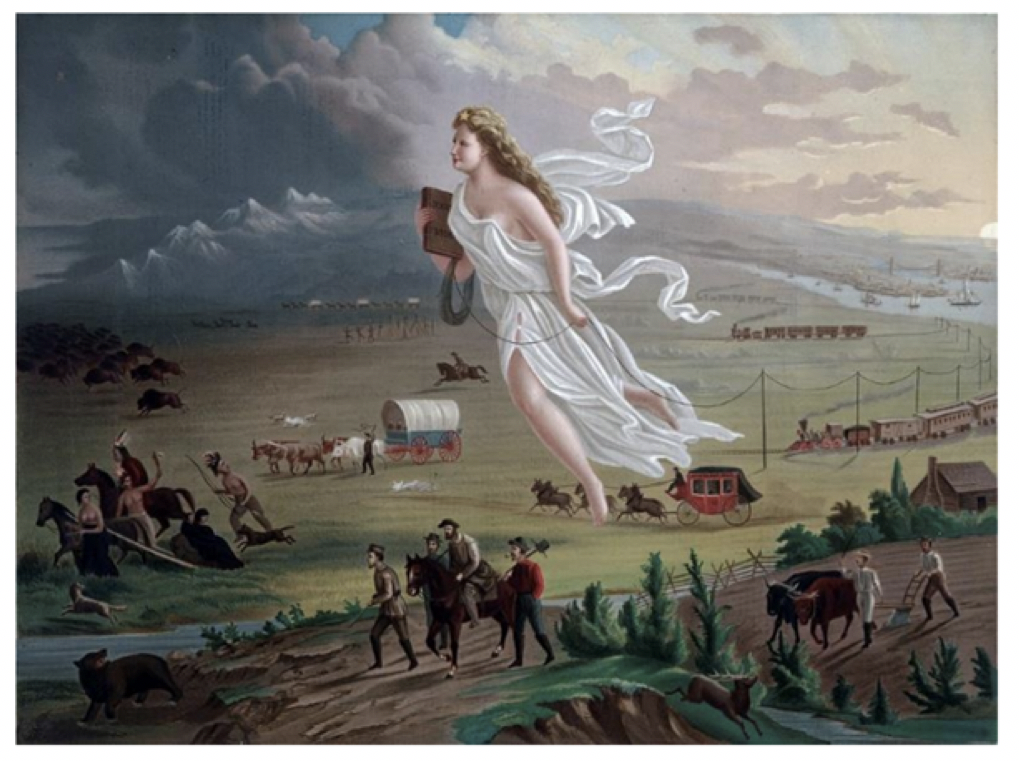
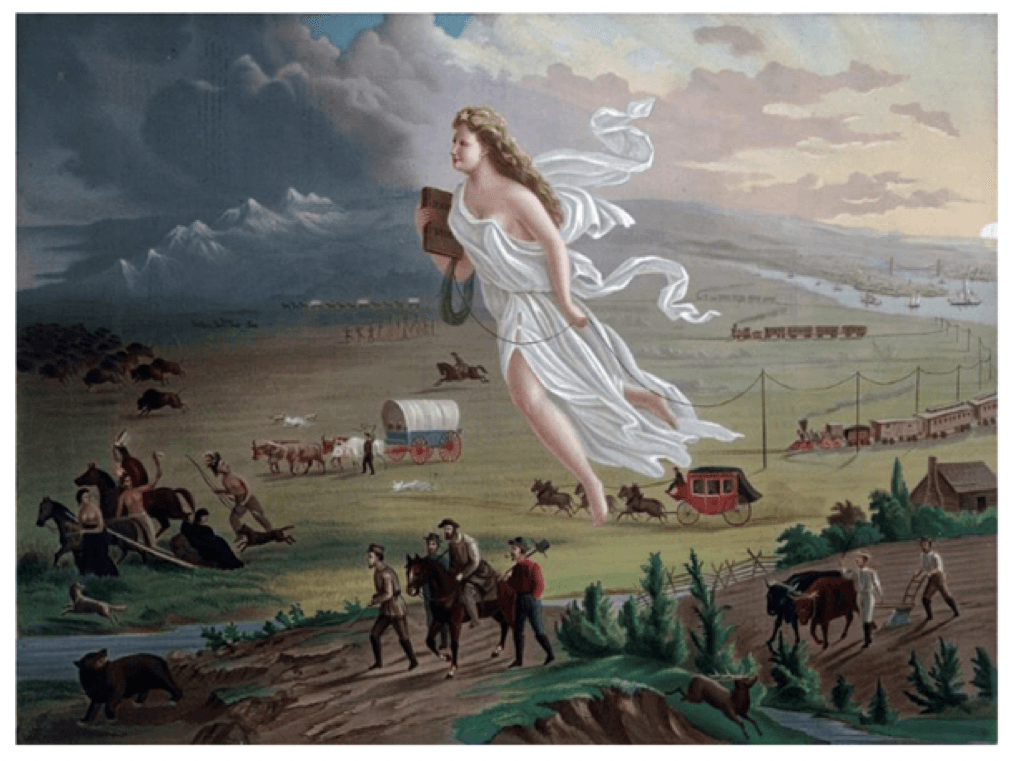
1. Below is a famous painting depicting the concept of Manifest Destiny in the United States in the 19th century. All of the figures are moving to the LEFT in the painting because -
30
c. "Manifest Destiny" was the philosophy behind Westward Expansion, and west is usually on the left side of a map.
a. There is no meaning; it's just how the artist painted the picture.
d. American politics were moving to the left at this time.
b. "Manifest Destiny" referred to free Black individuals moving from the South to the North, and north is usually on the left side of a map.
Q 2/25
Score 0
2. Which of the following is true of Manifest Destiny in the 1800s?
30
a. It was based on pervasive belief in white supremacy and European-American cultural superiority.
b. Native Americans were perceived as inferior and the westward movement of Americans into traditionally indigenous lands was considered an absolute right of white people.
d. All of the above statements are true of Manifest Destiny.
c. Many of the first westward settlers were missionaries seeking to Christianize indigenous groups.
25 questions
Q.
1. Below is a famous painting depicting the concept of Manifest Destiny in the United States in the 19th century. All of the figures are moving to the LEFT in the painting because -
1
30 sec
Q.
2. Which of the following is true of Manifest Destiny in the 1800s?
2
30 sec
Q.
3. What was one major reason that the Republic of Texas declared independence in 1836?
3
30 sec
Q.
4. The Missouri Compromise was necessary because-
4
30 sec
Q.
6. An important result of the Kansas-Nebraska Act was that it - ?
5
30 sec
Q.
7. Who were the "Forty-Niners?"
6
30 sec
Q.
8. What can best be inferred about California in the below newspaper article from 1848?
7
30 sec
Q.
9. What best describes the experiences of Chinese and Latin American immigrants who came to North America to join in the California Gold Rush?
8
30 sec
Q.
10. Based on the below excerpt and your knowledge from the unit, Lt. Col. William B. Travis was a(n) -
9
30 sec
Q.
11. What aspect of Manifest Destiny does the below quote illustrate?
10
30 sec
Q.
12. The table below best describes -
11
30 sec
Q.
13. Which of the following aspects of living in a Mexican colony upset white American settlers?
12
30 sec
Q.
15. What was "The Lone Star Republic?"
13
30 sec
Q.
16. Which of the following was NOT an outcome of the Treaty of Guadalupe Hidalgo?
14
30 sec
Q.
17. California became a state in 1850. What problem did this cause?
15
30 sec
Q.
18. The problem/s facing American farmers in the mid-19th century included-
16
30 sec
Q.
19. Why did American crop prices fall in the mid-19th century?
17
30 sec
Q.
20. What aspect of the era of Manifest Destiny is shown on this map?
18
30 sec
Q.
21. What traditional white American reasoning for Manifest Destiny does this quote illustrate?
19
30 sec
Q.
22. Which of the following best describes the result of the Battle of Little Big Horn?
20
30 sec
Q.
23. What happened at Wounded Knee, South Dakota Territory, in December of 1890?
21
30 sec
Q.
25. The pair of photos below of a young boy before and after admission to a U.S. government Indian residential school is sometimes referred to by the 19th century white American expression "Kill the Indian, Save the Man." This is an example of-
22
30 sec
Q.
26. The original goal of the Populist Party when it was founded in 1892 was to--
23
30 sec
Q.
28. The below poster from 1879 was intended to-
24
30 sec
Q.
30. Below is a famous painting produced by the Populist Party in 1875. Based on this picture and your knowledge from the unit, who did the Populists believe were the most important workers in the United States?