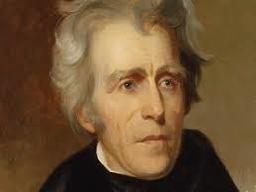
VUS.6.d Andrew Jackson and the Age of the Common Man
Quiz by Michael Blevins
Virginia and United States History
History and Social Science
Virginia Standards of Learning
Feel free to use or edit a copy
includes Teacher and Student dashboards
Measure skillsfrom any curriculum
Measure skills
from any curriculum
Tag the questions with any skills you have. Your dashboard will track each student's mastery of each skill.
With a free account, teachers can
- edit the questions
- save a copy for later
- start a class game
- automatically assign follow-up activities based on students’ scores
- assign as homework
- share a link with colleagues
- print as a bubble sheet
17 questions
Show answers
- Q1What political party evolved from Andrew Jackson's supporters within the Democratic-Republicans?Whig PartyFederalist PartyDemocratic PartyRepublican Party20s
- Q2The Americans textbook says, "During [John Q.] Adams’s presidency, most states eased the voting requirements, thereby enlarging the voting population. Fewer states now had property qualifications for voting. In the presidential election of 1824, approximately 350,000 white males voted. In 1828, over three times that number voted, and their votes helped Andrew Jackson." What historical trend is best described within this excerpt?the removal of property qualifications for voting had no impact on the 1828 election resultsthe expansion of suffrage within the USthe decline in potential voters within the USmore citizens voted in 1824 as compared to 182830s
- Q3What nickname is most associated with Andrew Jackson?the Common ManAndrew Jackson, he's our man!Father of the US BankOld Hickory20s
- Q4"The expansion of voting rights meant that candidates had to be able to speak to the concerns of ordinary people. Andrew Jackson had this common touch." Although several groups were not included in the movement towards more universal suffrage in the early 19th Century, which group of citizens most benefited from the expansion of voting rights?free African AmericanswomenNative Americanswhite males30s
- Q5The right of the a state to refuse to abide by a National law that would not benefit that state is referred to as _________________.NullificationNationalismFederalismImplied Powers20s
- Q6This law resulted in thousands of Native Americans to be forcibly moved from their ancestral lands onto reservations.The Indian Removal Act, 1830the Trail of Tearsthe Battle of Fallen TimbersWorcester v. Georgia (1832)20s
- Q7As a result of which battle did Andrew Jackson become a national hero?the Battle of New Orleansthe battle of Saratogathe Battle of Yorktownthe Battle of Fort McHenry20s
- Q8The Nullification Theory is also referred to as "States' Rights Theory." Which region of the US most supported this idea?the Norththe Midwest (Old Northwest)the western territories (Louisiana Territory)the South20s
- Q9The authors of the Americans stated, "[Andrew Jackson] fired nearly 10 percent of the federal employees, most of them holdovers from the Adams administration, and gave their jobs to loyal Jacksonians." This is an example of _____.the Spoils Systemthe 3/5 Compromisethe Great Compromisethe Trail of Tears20s
- Q10Andrew Jackson’s friends also became his primary advisers and were nicknamed his _________.Friends and Family PlanKitchen CabinetSupreme CourtFinsta Followers20s
- Q11Following the passage of the Indian Removal Act (1830), the Cherokee tribe sued the US Government. "In Worcester v. Georgia (1832), the Cherokee Nation finally won recognition as a distinct political community. The Court ruled that Georgia was not entitled to regulate the Cherokee nor to invade their lands." Who was Chief Justice of the Supreme Court when this ruling was made?John JayHenry ClayAndrew JacksonJohn Marshall20s
- Q12The forced relocation of Native Americans from the Southeastern US to reservations in present day Oklahoma became known as ___________.The Trail of Tearsthe Great Migrationthe War of 1812the Treaty of New Echota20s
- Q13One of the federal governments policies that created the debate over nullification involved taxes placed on manufactured goods imported from foreign countries. These types of taxes are commonly called _______.incomeexcisetariffssales20s
- Q14In what state did the nullification crisis become most critical?MassachusettsVirginiaNew YorkSouth Carolina20s
- Q15Which politician became the largest supporter/outspoken advocate for states' rights in the 1830s?Henry ClayJohn C. CalhounAndrew JacksonDaniel Webster20s