Weekly Quiz -2 Grade 10
Quiz by Arjumand Hasan Nahdi
Feel free to use or edit a copy
includes Teacher and Student dashboards
Measure skillsfrom any curriculum
Measure skills
from any curriculum
Tag the questions with any skills you have. Your dashboard will track each student's mastery of each skill.
With a free account, teachers can
- edit the questions
- save a copy for later
- start a class game
- automatically assign follow-up activities based on students’ scores
- assign as homework
- share a link with colleagues
- print as a bubble sheet
20 questions
Show answers
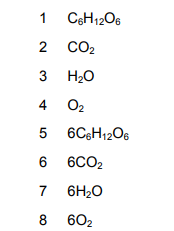
- Q1Some chemical symbols are listed. What is the equation for photosynthesis?1 + 8 → 6 + 76 + 7 → 1 + 83 + 4 → 1 + 26 + 7 → 5 + 860s
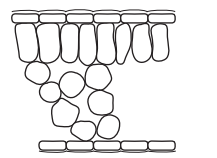
- Q2The diagram shows some of the structures seen in a section through a dicotyledonous leaf. Which two features are missing from this diagram?vascular bundle and cuticleguard cells and vascular bundleepidermis and guard cellscuticle and epidermis60s
- Q3Which structure has villi to increase its surface area?tracheaileumalveolusroot hair60s
- Q4The table shows the rates of absorption of two different sugars, arabinose and glucose, in living and dead intestines. The concentrations of the sugars inside the intestines were the same in each case. What are the main methods of absorption of arabinose and glucose in living intestine?arabinose - diffusion , glucose - active transportarabinose - active transport , glucose - diffusionarabinose - diffusion , glucose - diffusionarabinose - active transport , glucose - active transport60s
- Q5A student performed an experiment to see whether chlorophyll is necessary for photosynthesis. What is a suitable plant for this experiment?a plant that has white patches on its leavesa plant with black paper pinned to both sides of one leafa plant with wilted leavesa plant in a closed jar with no access to carbon dioxide60s
- Q6The diagram shows a section of the wall of the small intestine. Into which structure are most of the lipid components of the diet absorbed for transport to the rest of the body?ABDC60s
- Q7A surgical procedure involves the removal of the gall bladder. What are patients who have undergone this procedure not able to do?store bileproduce bilemix food with gastric juicestore urine60s
- Q8A plant was placed in water containing black dye. After 24 hours the plant was removed and sections were taken from the root and the stem. Which diagram shows the results?CBAD60s
- Q9Which statement best describes the movement of water through the stem of a plant?Water moves up the stem as it evaporates from the leaves.Water moves up the stem because it is used in photosynthesis.Water moves up the stem by osmosis.Water moves up the stem as it is pushed by water entering the roots.60s
- Q10A gland secretes different types of enzymes into part of the alimentary canal which allows digestion of proteins and starch. It also receives alkaline secretions from another gland and contains muscles that are used in peristalsis. Which part of the alimentary canal is being described?DBCA60s
- Q11What is not a function of transpiration?It causes water to move from the roots to the leaves.It causes minerals to travel up through the plant.It helps to release energy in cellsIt helps to keep the plant cool.60s
- Q12The diagram shows part of a tree trunk. A ring of bark including the phloem has been removed. The tree will eventually die because removing the bark stops the transport ofwater to the leavesmineral salts to the leaves.organic nutrients to the roots.oxygen to the roots.60s
- Q13The diagrams show an experiment to find the rate of photosynthesis in an aquatic plant in different conditions. Which plant produces the most bubbles per minute?ACBD60s
- Q14The following paragraph describes water uptake by roots. Root hair cells have ..1.. cell walls to allow them to absorb water. Cell cytoplasm has a ..2.. water potential than soil water so water moves by ..3.. from the soil to the root hair cell. Which words correctly complete gaps 1, 2 and 3?ACBD60s
- Q15The diagram shows the pathway of water molecules through part of a leaf, seen under a microscope, in transverse section. Where does water evaporate?ACCB60s