Loading...


Weekly Quiz 2 - Reconstructive Ladder
Quiz by Miguel Dorante
Tag the questions with any skills you have. Your dashboard will track each student's mastery of each skill.
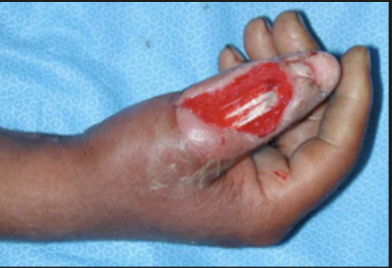
A 24-year-old right-hand-dominant male construction worker is evaluated because of a right dorsal thumb abscess that is treated with debridement and administration of antibiotics. A photograph of the residual defect is shown. Which of the following is the most appropriate method for reconstruction in this patient?
Coverage with a muscle flap
Coverage with a skin flap
Full-thickness skin grafting
Negative pressure wound therapy
Split-thickness skin grafting
A 54-year-old man is scheduled for correction of a defect on the back 1 week after undergoing resection of a 3 x 3-cm recurrent sarcoma. The skin was closed primarily during the procedure, but skin necrosis and wound breakdown occurred. History includes radiation therapy to the spine for soft-tissue sarcoma 2 years ago. Physical examination shows a 5 x 5-cm defect in the mid back at the level of T10 with exposed spinous processes. Which of the following is most appropriate to achieve complete wound closure?
A 24-year-old right-hand-dominant male construction worker is evaluated because of a right dorsal thumb abscess that is treated with debridement and administration of antibiotics. A photograph of the residual defect is shown. Which of the following is the most appropriate method for reconstruction in this patient?

A 50-year-old woman has wound breakdown in the lumbosacral region after spinal instrumentation, as shown in the photograph on the left. The superior aspect is closed with local paraspinal muscle advancement. The lower aspect is closed with a musculocutaneous V-Y advancement flap, as shown in the photograph on the right. Which of the following Mathes/Nahai classifications is most appropriate for this flap?

A 23-year-old man presents 2 years after sustaining full-thickness burns on the anterior neck. He has undergone tissue expansion and local flap reconstruction of the burn defect. He notes webbing and contracture at the margin of one of the prior flap reconstructions. Three identical 60-degree Z-plasties are planned over a total length of 12 cm. The expected gain in scar length is which of the following?
A 70-year-old woman has a circular defect 18 cm in diameter on the parietal aspect of the scalp after excision of squamous cell carcinoma. The pericranium has been removed with the scalp tissue. Adjuvant radiation therapy is planned beginning 4 to 6 weeks after surgery. Which of the following is most appropriate for coverage of the defect?