Use transformations to define congruence. • Verify experimentally the properties of rotations, reflections, and translations that create congruent figures. • Understand that a two-dimensional figure is congruent to another if the second can be obtained from the first by a sequence of rotations, reflections, and translations. • Given two congruent figures, describe a sequence that exhibits the congruence between them.
Solve real-world and mathematical problems by writing and solving equations and inequalities in one variable. • Recognize linear equations in one variable as having one solution, infinitely many solutions, or no solutions. • Solve linear equations and inequalities including multi-step equations and inequalities with the same variable on both sides.
Track each student's skills and progress in your Mastery dashboards
Give this quiz to my class
Q 1/4
Score 0
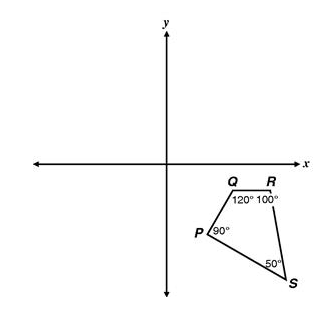
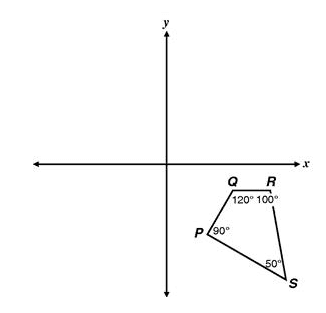
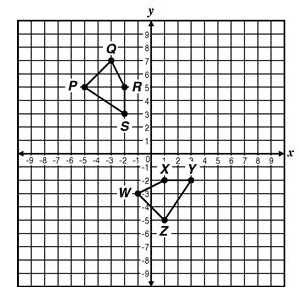
Quadrilateral PQRS is reflected over the y-axis to create Quadrilateral P'Q'R'S'. Which angle has the greatest measure?
300
Angle P
Angle Q
Angle S
Angle R
Q 2/4
Score 0
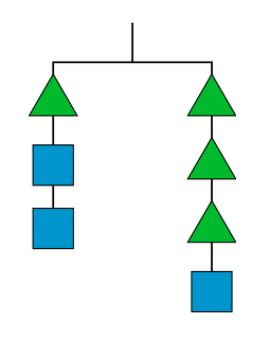
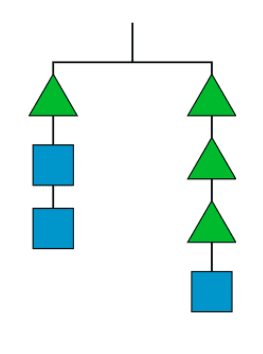
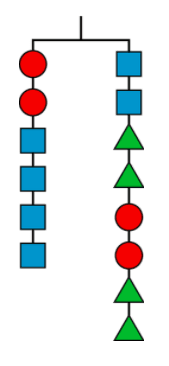
What is the weight of a square if a triangle weighs 4 grams?
300
8
0
6
4
4 questions
Q.
Quadrilateral PQRS is reflected over the y-axis to create Quadrilateral P'Q'R'S'. Which angle has the greatest measure?
1
300 sec
NC.8.G.2
Q.
What is the weight of a square if a triangle weighs 4 grams?
2
300 sec
NC.8.EE.7
Q.
Here is a hanger that is in balance. We don’t know how much any of its shapes weigh. How could you change the number of shapes on it, but keep it in balance?
3
300 sec
NC.8.EE.7
Q.
Quadrilateral PQRS is rotated 90° counterclockwise about the origin and then translated 6 units to the right to form Quadrilateral ZWXY. What segment has the same length as PQ?