explain the effect of translations, reflections over the x- or y-axis, and rotations limited to 90°, 180°, 270°, and 360° as applied to two-dimensional shapes on a coordinate plane using an algebraic representation
Track each student's skills and progress in your Mastery dashboards
Give this quiz to my class
Q 1/6
Score 0
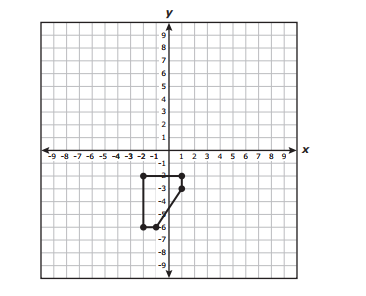
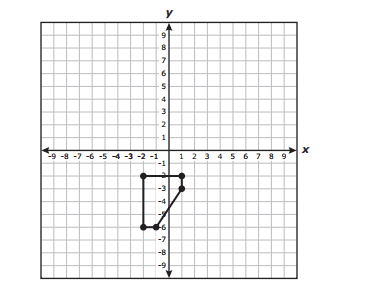
A figure is graphed on a coordinate grid as shown. The figure is rotated 180° clockwise with the origin as the center of rotation to create a new figure. Which rule describes this transformation?
60
(x, y ) → (x, −y)
( x, y ) → (− y, −x)
(x, y ) → ( -x, y)
(x, y ) → (− x, −y)
Q 2/6
Score 0
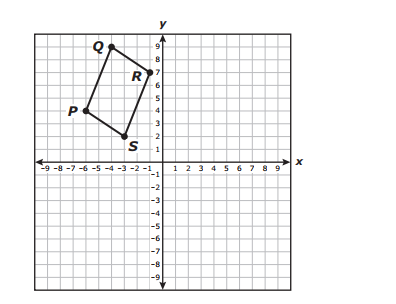
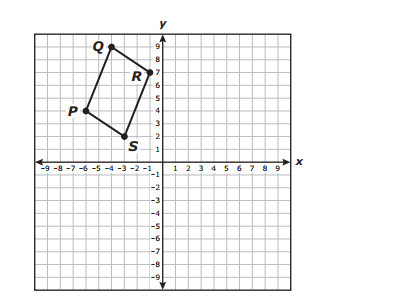
The coordinate grid shows parallelogram PQRS. Parallelogram PQRS is rotated 90° clockwise about the origin to create parallelogram PQRS′. Which rule describes this transformation?
60
(x , y)→ ( x, -y)
(x , y)→ ( y,x)
(x , y)→ ( y,-x)
(x , y)→ ( -x, y)
6 questions
Q.
A figure is graphed on a coordinate grid as shown. The figure is rotated 180° clockwise with the origin as the center of rotation to create a new figure. Which rule describes this transformation?
1
60 sec
8.10.C: Two-Dimensional Shapes
Q.
The coordinate grid shows parallelogram PQRS. Parallelogram PQRS is rotated 90° clockwise about the origin to create parallelogram PQRS′. Which rule describes this transformation?
2
60 sec
8.10.C: Two-Dimensional Shapes
Q.
The coordinates of the vertices of a quadrilateral are P (1, 2), R (1, 4), S (3, 4), and T (4, 2). Quadrilateral PRST is reflected across the y-axis to create quadrilateral P'R'S'T'
Which rule describes this transformation?
3
60 sec
8.10.C: Two-Dimensional Shapes
Q.
Triangle ABC was translated 2 units to the right and 3 units down. Which rule describes the translation that was applied to triangle ABC to create triangle A'B'C ′?
4
60 sec
8.10.C: Two-Dimensional Shapes
Q.
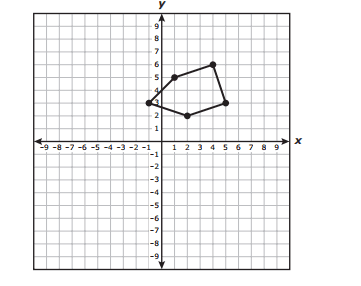
The coordinate grid shows a pentagon. The pentagon is translated 1 unit to the left and 10 units down to create a new pentagon. Which rule describes this transformation?
5
60 sec
8.10.C: Two-Dimensional Shapes
Q.
A circle is graphed on a coordinate grid and then reflected across the y-axis. If the center of the original circle was located at ( , x y), which ordered pair represents the center of the new circle after the transformation?