American Revolution
Quiz by HEINE, MATTHEW K
Grade 8
Social Studies K-HS (Archived)
Texas Essential Knowledge and Skills (TEKS)
Feel free to use or edit a copy
includes Teacher and Student dashboards
Measures 8 skills from
Track each student's skills and progress in your Mastery dashboards
With a free account, teachers can
- edit the questions
- save a copy for later
- start a class game
- automatically assign follow-up activities based on students’ scores
- assign as homework
- share a link with colleagues
- print as a bubble sheet
18 questions
Show answers
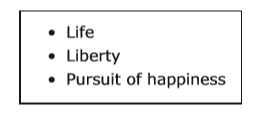
- Q1This list includes rights that are considered --unalienabletransferablelegislatedinherited30s8.19.A: Social Studies - Citizenship
- Q2How did mercantilist policies create tension between Great Britain and the colonies?By preventing colonists from trading with most other foreign countries.By introducing indentured servitude to the middle colonies.By limiting the amount of farmland each colonist could have.By requiring colonists to enlist in the military.30s8.4.A: Social Studies - History
- Q3John Hancock was one of the Founding Fathers committed to liberty. How ddi he demonstrate this commitment?By writing the Articles of Confederation.By organizing Committees of Correspondence.By signing the Declaration of Independence.By serving as commander in chief of the Continental Army.30s8.4.B: Social Studies - History
- Q4Why is the Battle of Saratoga considered a turning point in the Revolutionary War?The American victory convinced France to ally with the United States.The American defeat led many soldiers to desert the Continental Army.The British victory extended the fighting for another year.The British defeat marked the beginning of a steady decline30s8.4.C: Social Studies - History
- Q5What was one result of the Treaty of Paris of 1783?Competing Seminole and Spanish claims in West Florida were resolved.The British navy agreed to stop pressing American sailors into service.British territory in eastern Canada was ceded to France.Great Britain recognized the United States as an independent country.30s8.4.C: Social Studies - History
- Q6Which of the following best completes this diagram?Colonists dumped tea into the Boston Harbor.Colonists organized boycotts of British goods.Colonists signed the Declaration of Independence.Colonists sought military support from France.30s8.4.A: Social Studies - History
- Q7These acts contributed to the start of the Revolutionary War by --angering colonists who believed that their civil liberties had been violated.restricting colonial trade with American Indians.punishing colonists for resisting the authority of Parliament.imposing regulations on colonial agriculture.30s8.4.A: Social Studies - History
- Q8Which of these completes this graphic organizer?King George III allows colonists to petition Parliament for tax relief.Parliament repeals the Stamp and Sugar Act.King George III appoints colonial representatives to Parliament.Parliament passes the Intolerable Acts.30s8.20.C: Social Studies - Citizenship
- Q9Which of the following best completes this excerpt?TrentonYorktownSaratogaConcord30s8.4.C: Social Studies - History
- Q10The excerpt above reflects the dissatisfaction of American colonists with the --interference of Great Britain in the slave trade.economic consequences of the Great Awakening.political debates that took place at the Albany Convention.economic policies imposed by Great Britain following the French and Indian War.30s8.4.A: Social Studies - History
- Q11To which of the following is Abigail Adams referring in this excerpt?The bravery of American soldiers at Valley Forge.The American victory at the Battle of Yorktown.The arrival of French aid after the Battle of Saratoga.The negotiations of the Treaty of Paris by American diplomats.30s8.4.C: Social Studies - History
- Q12The rights listed above were --established by the ratification of the U.S. Constitution.defined by President George Washington in his Farewell Address.defined by Thomas Jefferson in the Declaration of Independence.established by a series of Supreme Court decisions.30s8.19.A: Social Studies - Citizenship
- Q13From 1690 to 1760, Parliament and the king of England allowed colonists in America to exercise a great deal of control over local and regional matters. Historians have described this practice as "salutary neglect." Which of the following happened as a direct result of this policy?The colonies developed a strong sense of self-government.Many proprietary colonies were converted to royal colonies.Many colonies sought economic aid from other countries.The colonies refused to participate in a system of common defense.30s8.3.A: Social Studies - History
- Q14All of the events listed above occurred during --the era of westward expansion.the Jacksonian era.the Era of Good Feelings.the Revolutionary era.30s8.1.A: Social Studies - History
- Q15British colonists objected to the Proclamation of 1763 because they --feared it would provoke attacks from American Indians.wanted to be able to trade freely with foreign nations.resented the limits it imposed on westward expansion.did not want to share control of the fur trade with France.30s8.4.A: Social Studies - History