Tag the questions with any skills you have. Your dashboard will track each student's mastery of each skill.
Give this quiz to my class
Q 1/26
Score 0
TRUE or FALSE: Active transport does not require additional energy to move molecules.
30
False
True
Q 2/26
Score 0
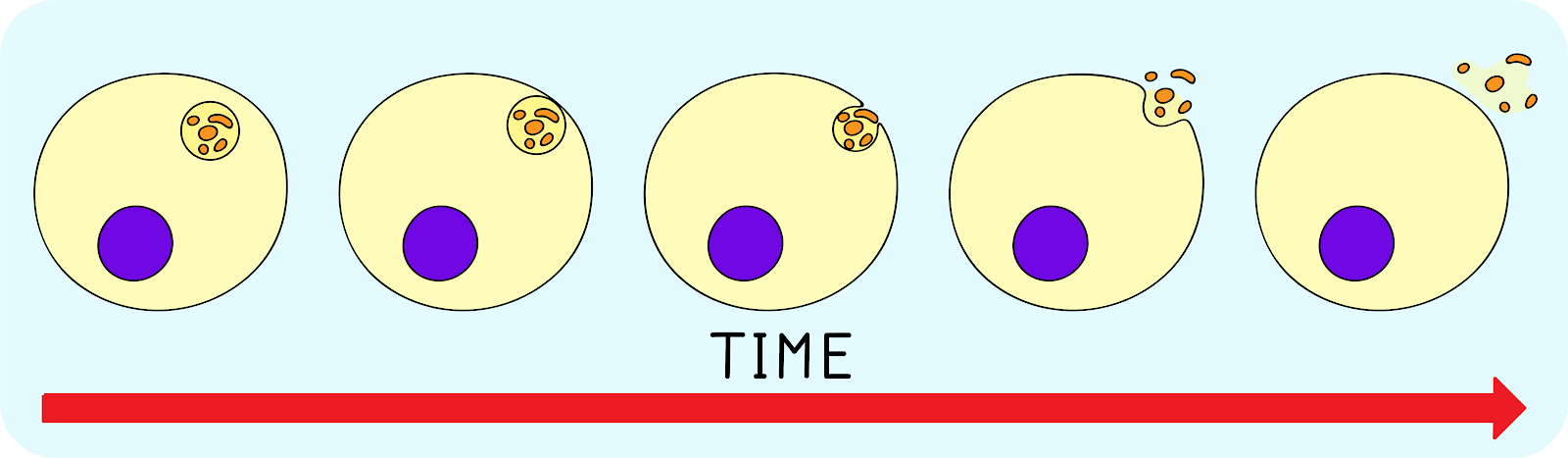
Which process is shown above?
30
Exocytosis
Exosymbiont
Endosymbiosis
Endocytosis
26 questions
Q.
TRUE or FALSE: Active transport does not require additional energy to move molecules.
1
30 sec
Q.
Which process is shown above?
2
30 sec
Q.
What is the purpose of this process?
3
30 sec
Q.
Which statement best describes the process of diffusion?
4
30 sec
Q.
What is osmosis?
5
30 sec
Q.
TRUE OR FALSE: Osmosis is an active process and requires extra energy for it to occur.
6
30 sec
Q.
What does the red dashed line between the two solutions represent?
7
30 sec
Q.
Which solution has the higher concentration of water?
8
30 sec
Q.
In which direction will the net movement of water be in, if any?
9
30 sec
Q.
If left for a few hours, what will happen to the volume of solution in the bag?
10
30 sec
Q.
How can we describe the solution in the beaker in comparison to the solution in the bag?
11
30 sec
Q.
Why do the red blood cells in group A look different from a normal, healthy red blood cell?
12
30 sec
Q.
"The pictures above show a _______________ protein transporting a molecule across the cell membrane". What is this type of protein?
13
30 sec
Q.
Which type of diffusion is shown in the pictures?
14
30 sec
Q.
Diffusion requires no extra energy from metabolism to transport substances. What kind of process is diffusion?
15
30 sec
Q.
The cell membrane can be described as a partially permeable membrane. What does this mean?
16
30 sec
Q.
TRUE or FALSE: During diffusion, individual particles/molecules move randomly in both directions (high to low and low to high concentrations).
17
30 sec
Q.
Use the information provided in the table to answer this question. In which cell will diffusion of glucose occur at the highest rate?
18
30 sec
Q.
When will the diffusion of glucose stop?
19
30 sec
Q.
Which of these is NOT a factor that can affect the rate of diffusion?
20
30 sec
Q.
What is the name of the type of channel protein that transports water molecules through the cell membrane?
21
30 sec
Q.
This is a simplified diagram of a plant cell. Some parts of the cell are labeled. Use this image to answer. Which label shows the cell membrane of the plant cell?
22
30 sec
Q.
TRUE or FALSE: All living cells have a cell membrane.
23
30 sec
Q.
Many of these molecules make up the basis of the cell membrane, with other molecules and proteins embedded within it. What is the name of this molecule?
24
30 sec
Q.
This molecule has a "head" and a "tail". Which end of the molecule is hydrophilic?
25
30 sec
Q.
What is the function of cholesterol in the cell membrane?