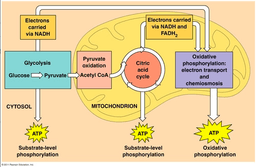
Develop a model to illustrate the role of photosynthesis and cellular respiration in the cycling of carbon among the biosphere, atmosphere, hydrosphere, and geosphere.
Track each student's skills and progress in your Mastery dashboards
Give this quiz to my class
Q 1/24
Score 0
the unit used to measure the heat energy required to increase the temperature of 1 kilogram of water by 1 degree Celsius.
30
Calorie
Q 2/24
Score 0
the energy releasing chemical breakdown of food molecules, such as glucose, and the storage of potential energy in a form that cells can use to perform work
30
Cellular respiration (6.1)
24 questions
Q.
the unit used to measure the heat energy required to increase the temperature of 1 kilogram of water by 1 degree Celsius.
1
30 sec
HS-LS2-5
Q.
the energy releasing chemical breakdown of food molecules, such as glucose, and the storage of potential energy in a form that cells can use to perform work
2
30 sec
Q.
with oxygen
3
30 sec
Q.
lacking oxygen
4
30 sec
Q.
a quantity of heat equal to 1,000 calories. Used to measure the energy content in food- usually called a calorie.
5
30 sec
Q.
a series of reactions that splits glucose into two molecules of pyruvate the first stage of cellular respiration
6
30 sec
Q.
a coenzyme that can accept electrons during the redox reactions of cellular metabolism.
7
30 sec
Q.
series of electron carrier molecules that shuttle electrons during a series of redox reactions that release energy used to make ATP
8
30 sec
Q.
the chemical cycle that completes the metabolic breakdown of glucose molecules begun in glycolysis by oxidizing acetyl CoA to carbon dioxide.
9
30 sec
Q.
glycolysis followed by the reduction of pyruvate to lactate, regenerating NAD+
10
30 sec
Q.
glycolysis followed by the reduction of pyruvate to ethyl alcohol, regenerating NAD+ and releasing carbon dioxide
11
30 sec
Q.
During glycolysis, each glucose molecule is broken down into two molecules of
12
30 sec
Q.
If oxygen is present, the pyruvic acid of glycolysis will leave the cytoplasm and enter the _____________ reaction located in the mitochondria.
13
30 sec
Q.
products of cellular respiration
14
30 sec
Q.
types of fermentation
15
30 sec
Q.
total APT made in cellular respiration
16
30 sec
Q.
reaction that occurs after glycolysis if no oxygen is present
17
30 sec
Q.
reactants of cellular respiration
18
30 sec
Q.
What kind of energy comes into and out of the image?
19
30 sec
Q.
A simple sugar that is an important source of energy.
20
30 sec
Q.
the transfer of electrons from one molecule to another is an oxidation-reduction reaction, also called: