Tag the questions with any skills you have. Your dashboard will track each student's mastery of each skill.
Give this quiz to my class
Q 1/14
Score 0
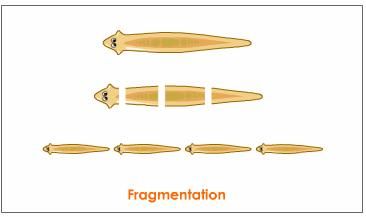
The worm in the picture can reproduce through a process called fragmentation. Which of the following statements is true regarding the new offspring?
120
they do not have a nucleus
they are genetically identical to the parent worm
they have different mutations than the parent
they each contain genetic material from 2 parents
Q 2/14
Score 0
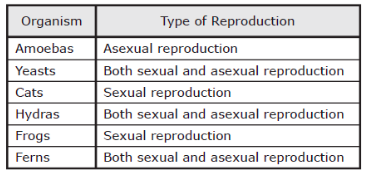
Based off the information in the table, which organisms only produce offspring that are genetically unique?
120
yeasts, hydras, and ferns
amoebas
cats and frogs
cats, frogs, yeasts, hydras, ferns
14 questions
Q.
The worm in the picture can reproduce through a process called fragmentation. Which of the following statements is true regarding the new offspring?
1
120 sec
Q.
Based off the information in the table, which organisms only produce offspring that are genetically unique?
2
120 sec
Q.
Hydra's reproduce through a process called budding. Which of the following is a disadvantage of this type of reproduction?
3
60 sec
Q.
Which organelle determines eye color?
4
60 sec
Q.
Which of the following is not involved in determining a person's height?
5
60 sec
Q.
Which of the following describes organisms that belong to the kingdom plantae?
6
120 sec
Q.
An organism is multicellular, eukaryotic, and heterotrophic. Which kingdom does it belong to?
7
60 sec
Q.
Force of water molecules against the cell wall, causing the plant to stand up straight is called....
8
60 sec
Q.
A plant's growth in response to gravity
9
60 sec
Q.
Which tropism is shown in the picture?
10
60 sec
Q.
Genetic material is primarily responsible for....
11
60 sec
Q.
Fill in the blanks in the following sentence: "_____________ is the passage of genetic material from parent to offspring. Genes are found within the _______________, inside the nucleus of the cell. _______________ are passed down from generation to generation and are not influenced by the organism's surroundings.
12
120 sec
Q.
A scientist discovers an organism that is purple, does not have a pointy hump, and has ears. Which organism did the scientist discover?
13
120 sec
Q.
An archaeologist discovers a granite rock. Which of the following describes this rock?