Loading...


Environmental Microbiology - Lecture 5
Quiz by Ese Ararile
Tag the questions with any skills you have. Your dashboard will track each student's mastery of each skill.
Bdellovirbio's interaction with E. coli is...?
What is the difference between syngerism and symbiosis?
Group these relationships accordingly
One-way -ve interaction, often through release of inhibitory chemicals
Organisms that live in the phyllosphere
The aerial portions of plants -> trunk, branches, stems, buds, flowers, leaves etc. make up the...?
Physical conditions, plant surfaces, carbon sources, and spatially heterogenous distributions of nutrients are all prevailing conditions in the phyllosphere
What can be controlled through the study of the phyllosphere?
The phyllosphere contains patchy, spatially heterogeneous distributions of heterotrophic microorganisms and plant pathogens
Plant immune-‐like defenses against pathogenic bacteria exclude localized cell death (the hypersensitive response)
Ice nucleating bacteria initiates frost damage at ___°C; in the absence of bacteria, damage does not begin until -8 to -10°C
A variant of P. syringae that cannot produce INA (ice nucleation-active) protein
The _____ is the narrow region of soil (5 mm) directly influenced by root secretions and associated soil microbes
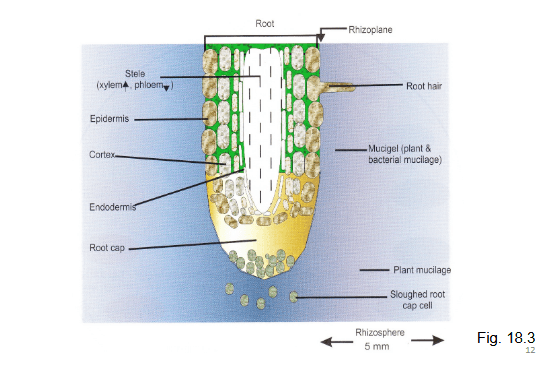
Group accordingly
You're most likely to find protozoa in the phyllosphere, not the rhizosphere
The rhizosphere effect is caused by the release of compounds (organic & inorganic) from the plant roots, but it is still almost the same as the surrounding bulk soil
Challenges of sampling methods for the rhizosphere
We use P. syringae in the food industry for its ice-nucleation properties
Group the root products
Which fall under root debris?
Nutrients like N, P & K may be depleted near the root surface
Secretions are active, and excretions are passive
Microbial processes in plant rhizosphere
Substances secreted by plants against competition and plant pathogens
A beneficial relationship between fungi and plant roots
Match the correct items
Protection against toxic agents (e.g., complexation of Al 3+ ) doesn't occur in the rhizosphere
Rhizosphere exists because of soil-plant-microbe interactions. Which is false?
Compounds released by the autolysis of older cells
Polysaccharides from the root cap, root cap cells, primary cell wall & other cells
Pick all that are true about Mucigel
Bacteria consume mucigel; but do not contribute to polysaccharides that make mucigel
Factors Affecting the Release of Compounds in Rhizosphere
The lower the R/S ratio, the more pronounced rhizosphere effect
The rhizosphere effect is defined as the "R/S" ratio. Please link the terms
Which have higher rhizophere microbial populations
If the R/S ratio is low (below 1), what could that indicate?
Eukaryotic fungi enhance plant N uptake through N fixation, while prokaryotic bacteria enhance plant P and other micronutrient uptake through mycorrhizal association
Bacteria and archaea that fix atmospheric nitrogen gas into a more usable form such as ammonia. They can utilize N2 gas as sole source of nitrogen for growth (e.g. Rhizobia, Frankia and Azospirillum)
Pick all true about Biological Dinitrogen fixation
Complete the equation for Nitrogen fixation: N2 + 3H2 -> ___
Two enzymes are used for Nitrogen fixation. Please link them appropriately
Nitrogen fixation is an anaerobic process. Therefore, only anaerobes are involved in this process.
Arrange these by nitrogen fixation ability
Pick all free-living N fixers
Nitrogen fixing requires at least 16 ATPs (sometimes up to 30). Reducing 1 N2 molecule requires that the protein complex form and dissociate 8 times. Order accordingly
N-fixing bacteria constitute ____ proteins as nitrogenase enzyme
Some diazotrophs contain hydrogenase enzymes to reoxidize and generate energy. What percent of energy is used for H2 production?
N fixation is an anaerobic process because dinitrogenase reductase is irreversibly inactivated by oxygen
Aerobic organisms have novel mechanisms to prevent interactions between nitrogenease enzyme and O. Link the organisms to the mechanisms
Casual/associative symbioses do not require genetic interactions btwn plant & microbes, and no morphological modifications occur in either partner
Azotobacter paspali associated with Paspalum notatum (tropical grass) and Acetobacter diazotrophicus with tropical sugarcane are examples of...?
Rhizobium spp interact with leguminous plants, causing physiological & genetic changes. ____ in the plants and the bacteria become ____
Root nodules develop in response to soil-borne rhizobia. The bacteria fix nitrogen in exchange for _____ source (supplied by plant photosynthesis).
The bacteroids formed by Rhizobia are X-shaped
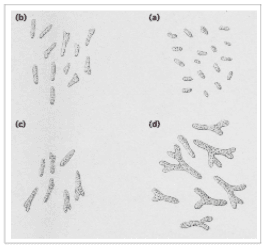
When plant host matures, root nodules lyse and Rhizobia are released back into the soil
Many legumes (peas, beans, soybeans) can fix ____ of the total nitrogen requirements and can be grown commercially with reduced N fertilizer
The small floating fern ____ provides cavities within its leaves that serve as a habitat for the cyanobacteria (Anabaena), which fixes nitrogen (intracellular association). This has been exploited by rice farmers for centuries to boost N status of rice paddies.
Mycorrhizae is a symbiotic (generally mutualistic) association btwn a fungus and the roots of a vascular plant. Divided into...
Hyphae of ectomycorrhizal fungi penetrate the cell wall and invaginate the cell membrane
Ectomycorrhizal fungi do not penetrate individual cells within the root; the root is enveloped in a fungal network
The fungi belonging to the Basidiomycota, Ascomycota, and Zygomycota - ~ 10% of plant families, mostly woody plants including the birch, eucalyptus, oak, pine, and rose, form...
Arbuscular mycorrhizas – formed by obligately symbiotic fungi from the division Glomeromycota - 85% of all plant families, are examples of...
Mycorrhiza assist plants in obtaining water, phosphorus and other micronutrients (e.g., Zn and Cu) from the soil. Fungi assist uptake by scavenging nutrients and using active transport to concentrate them against concentration gradients.
Both endo and ectomycorrhiza can demand up to 20-40% of the total photosynthetically fixed carbon the plant produces
Nutrients are released from fungal hyphae and taken up by plant roots; also, fungi act as ____
Plant pathogens
The study of causes, mechanisms, environmental factors and control of diseases caused by microbes
Rhizopus, a plant pathogenic fungus, long-thought to be responsible for the plant disease ____
Rhizopus is pathogenic because of endosymbiotic bacteria Burkholderia rhizoxinica that synthesize ____. New control strategies involve inhibiting the bacterium that inhabits the fungus.
Typical entry of plant viral pathogens is by ___
Match the terms to the descriptions
Biological control of plant diseases
Soil management processes for pathogen suppressive soils
