Loading...


Grade 7 PISA TEST
Quiz by Patrick Brylle Candelaria
Tag the questions with any skills you have. Your dashboard will track each student's mastery of each skill.
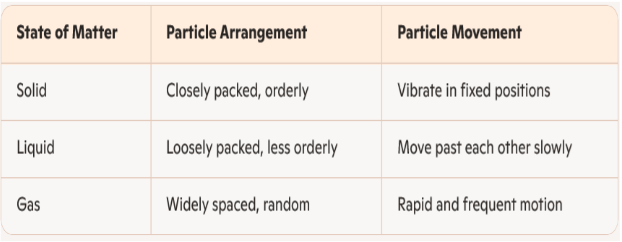
Below is a diagram showing how particle behavior changes across different states of matter:
Question: Why is understanding particle behavior of matter important for engineers designing buildings in cold regions?
To determine the color changes in materials under heat exposure.
To predict how fast air flows through building walls.
To select liquids that freeze at very high temperatures.
To ensure that materials maintain fixed shapes under low temperatures.
Below is a diagram showing how particle behavior changes across different states of matter:
Question: Which material would be least suitable for a climate-resilient roof that must remain stable in extremely hot and cold conditions?
Gas-filled insulation
Reinforced concrete
Liquid Metal coating
Solid ceramic tiles
Below is a diagram showing how particle behavior changes across different states of matter:
Question: Why is understanding particle behavior of matter important for engineers designing buildings in cold regions?
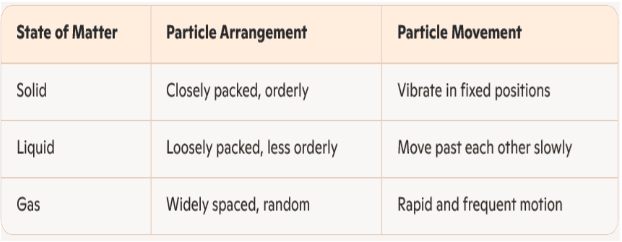
Below is a diagram showing how particle behavior changes across different states of matter:
Question: Which material would be least suitable for a climate-resilient roof that must remain stable in extremely hot and cold conditions?
Maria is stirring hot coffee using a metal spoon. After a while, the spoon feels very hot. Her father suggests using wooden spoon instead.
Why does the metal spoon get hotter than the wooden spoon?
Maya walks from his house to a nearby store that is 300 meters east of his house. After buying some groceries, he walks 200 meters west to visit his friend’s house.
How far has Maya walked in total?
Maya walks from his house to a nearby store that is 300 meters east of his house. After buying some groceries, he walks 200 meters west to visit his friend’s house.
What is Maya’s displacement from his house, using his house as the reference point?
A city located near a major fault line experiences frequent minor earthquakes. The local government distributes a disaster preparedness guide to all households. It includes the following:
What to do during an earthquake:
1. Drop to the ground, take cover under sturdy furniture, and hold on.
2. Stay away from windows and heavy objects.
3. Do not use elevators.
4. If outside, move to an open area away from buildings, trees and power lines.
What to do after an earthquake:
1. Check yourself and others for injuries
2. Be prepared for aftershocks
3. Do not use matches or lighters near gas leaks
4. Listen to emergency broadcasts for instructions
5. Stay out of damaged buildings
Why is it important to stay away from windows during an earthquake?
A city located near a major fault line experiences frequent minor earthquakes. The local government distributes a disaster preparedness guide to all households. It includes the following:
What to do during an earthquake:
1. Drop to the ground, take cover under sturdy furniture, and hold on.
2. Stay away from windows and heavy objects.
3. Do not use elevators.
4. If outside, move to an open area away from buildings, trees and power lines.
What to do after an earthquake:
1. Check yourself and others for injuries
2. Be prepared for aftershocks
3. Do not use matches or lighters near gas leaks
4. Listen to emergency broadcasts for instructions
5. Stay out of damaged buildings
Why should people must avoid using matches or lighters right after an earthquake?