Ask questions to determine where water is located on Earth’s surface (oceans, rivers, lakes, swamps, groundwater, aquifers, and ice) and communicate the relative proportion of water at each location.
Plan and carry out an investigation to illustrate the role of the sun’s energy in atmospheric conditions that lead to the cycling of water. (Clarification statement: The water cycle should include evaporation, condensation, precipitation, transpiration, infiltration, groundwater, and runoff.)
Analyze and interpret data to create graphic representations of the causes and effects of waves, currents, and tides in Earth’s systems.
Track each student's skills and progress in your Mastery dashboards
Give this quiz to my class
Q 1/10
Score 0
Many different tools are used to monitor the hydrosphere. Which is the BEST example of a bioindicator?
30
Secchi disc
rain guage
thermometer
microbacterium
Q 2/10
Score 0
Most of the earth's surface is covered by
30
land
ice
water
freshwater
10 questions
Q.
Many different tools are used to monitor the hydrosphere. Which is the BEST example of a bioindicator?
1
30 sec
S6E3a
Q.
Most of the earth's surface is covered by
2
30 sec
S6E3a
Q.
An example of an estuary is
3
30 sec
S6E3a
Q.
The place where salt water from the ocean mixes with fresh water from rivers and streams is called
4
30 sec
S6E3a
Q.
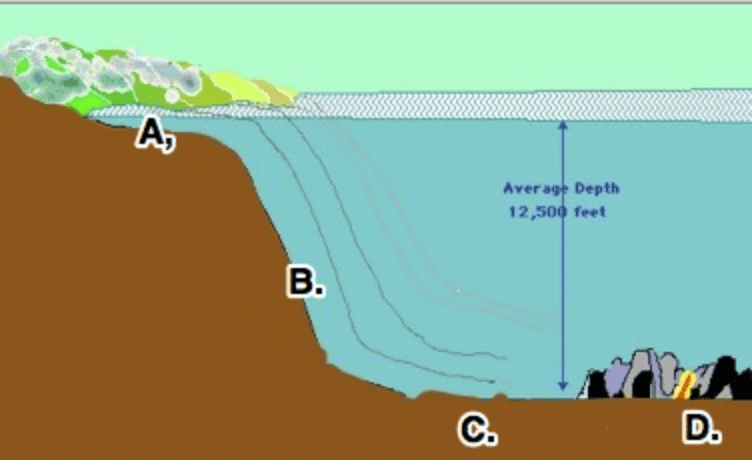
In the picture of the ocean floor, letter B marks what landform?
5
30 sec
S6E3c
Q.
Some ocean currents are caused by differences in the density of water from place to place around the globe. What two factors cause differences in ocean water density?
6
30 sec
S6E3c
Q.
In which way are evaporation and condensation similar?
7
30 sec
S6E3b
Q.
The distance shown in the diagram is known as the
8
30 sec
S6E3d
Q.
Which of these actions is the BEST evidence that waves can cause objects to move?
9
30 sec
S6E3d
Q.
Water vapor sometimes condenses into stratus clouds that are in contact with the ground. What forms as a result of the process?