Loading...


M1 Lower Limb Summative Review
Quiz by Jenny Ousley
Tag the questions with any skills you have. Your dashboard will track each student's mastery of each skill.
A 49-year-old man comes to the physician because of a 6-month history of progressive difficulty in walking. Physical examination shows absence of pulses in the arteries of the lower limb. An ultrasound examination of the lower limb shows an occlusion of his femoral artery at the proximal portion of the adductor canal. A diagnosis of peripheral vascular disease is made. Which of the following arteries will most likely provide collateral circulation to the thigh?
A 15-year-old boy is brought to the emergency department by his mother because of a lower limb injury. An x-ray of his leg shows a fracture of the left tibia, and a knee-high leg cast is placed. Several weeks later, upon removal of the cast, the patient has numbness of the dorsum of his right foot and inability to dorsiflex and evert his foot. Which is the most probable site of the nerve compression that resulted in these symptoms?
A 24-year-old woman is brought to the emergency department because of excruciating pain in her thigh. She was exercising at the local gym, and she fell suddenly and developed pain and swelling on the right buttock. This happened following a forceful thigh movement. Physical examination shows severe weakness of right hip extension and knee flexion. Adduction of the thigh is also slightly weak. An x-ray shows an avulsion fracture of the ischial tuberosity. Which of the following group of muscles has most likely been involved in this process?
A 22-year-old woman is brought to the emergency department 30 minutes after she was involved in a motor vehicle collision with her left and right leg pinned under her motorcycle. She appears to be well, and her vital signs are within normal limits. Physical examination shows no deformity of the lower limb, but there is tenderness over the right ischiopubic ramus. An x-ray of the pelvis shows an inferiorly displaced fracture of the right superior and inferior pubic rami with dislocation of the right sacroiliac joint and pubic symphysis. An MRI examination confirms the diagnosis and shows rupture of the right obturator membrane. Which of the following physical examination findings are most likely to be seen in this patient?
A 53-year-old woman comes to the physician because of a 6-month history of progressive difficulty in walking. Physical examination shows a positive Trendelenburg sign when she is asked to stand on her right leg. Which of the following nerves has been affected to produce the positive sign?
A 43-year-old woman receives deep intramuscular injections for the past week for treatment of a sexually transmitted disease. She complains to her doctor that she has difficulty walking. During physical examination her right hip drops every time she raises her right foot. Which of the following injection locations will most likely correspond with the physical presentation of this patient?
A 55-year-old man comes to the physician because of severe back pain for the past 2 days. The pain radiates down to the buttock, posterior thigh, and posterolateral leg. He also has numbness on the lateral side of his left foot. Physical examination shows decreased sensation to pain over the lateral side of the left foot. Deep tendon reflexes are absent at the left ankle, and there is a weakness of dorsiflexion of the left foot. Compression of which of the following nerve roots is the most likely cause of these findings?
A 75-year-old man is brought to the emergency department after he was rescued by a police officer in an abandoned house. The man is not able to ambulate without assistance. Physical examination shows limited range of motion at the right hip joint because of pain and a laterally rotated right leg with some shortening in a supine position. An x-ray is shown in image below. Based on findings on the imaging, which of the following conditions most likely occurred to him?

During an interview, a 30-year-old man who is a psychiatric patient suddenly becomes aggressive. To calm him down, the patient is given an intramuscular injection in the upper lateral quadrant of the buttock. The injection is given at this specific location to prevent damage to which of the following nerves?
A 58-year-old man comes to the physician because of pain in his lower limb for the past 2 months. Physical examination shows point tenderness in the region of his greater sciatic foramen, with pain radiating down the posterior aspect of his thigh. An MRI of his pelvis and lower limb shows that the patient suffers from piriformis entrapment syndrome. He is directed to treatment by a physical therapist for stretching and relaxation of the muscle. Entrapment of which of the following nerves most likely mimicks the syndrome?
A 45-year-old intoxicated man is brought to the emergency department 30 minutes after being struck by a tour bus while walking in the middle of the street. He is able to ambulate without assistance. Physical examination shows “adductor gait,” crossing one limb in front of the other due to unopposed hip adductors. Which of the following nerves most likely supply these muscles?
A 42-year-old man is brought to the emergency department after falling to the sidewalk from his ladder. Physical examination shows the patient is not able to put weight on his left leg. There is swelling and bruises around the left midthigh, as well as multiple lacerations on his left arm and leg. An x-ray of the femur shows a fracture of the proximal shaft of the left femur. Which of the following arteries supplies the affected part of the femur?
A 24-year-old man is brought to the emergency department 30 minutes after he was involved in a motor vehicle collision. An x-ray of the femur shows a fracture at the junction of the middle and lower thirds of the femur with the distal fragment of the fracture being pulled posteriorly. An angiogram of the lower limb shows that the popliteal vessels are compressed by the distal fragment of the fracture. Which of the following muscles is most likely to displace the distal fracture fragment?
A 20-year-old man comes to the physician because of a 3-month history of progressive difficulty flexing and medially rotating his thigh while running and climbing. Which of the following muscles is most likely damaged?
A 25-year-old man is admitted to the hospital for a detoxification program. He has been an intravenous drug abuser injecting himself with temazepam (a powerful intermediate acting drug in the same group as diazepam [Valium]) and heroin for 5 years, leaving much residual scar tissue over points of vascular access. The femoral veins in his groin are the only accessible and patent veins for intravenous use. Which of the following landmarks is the most reliable to identify these veins?
A 30-year-old woman is brought to the emergency department 20 minutes after she was involved in a motor vehicle collision with her right hip caught beneath the motorcycle at the scene. She is hypovolemic and appears to be in shock. An ultrasound examination shows massive hematoma in the medial thigh. A CT scan shows a fracture of the femur with a ruptured femoral artery. She is taken to the operating room for repair of the damaged structures. Two days postoperatively, the patient has loss of sensation to the anteromedial thigh and medial side of her leg and foot. Branches of which of the following nerves were most likely injured in the repair of the fracture?
A 55-year-old woman is brought to the emergency department 30 minutes after she was involved in a motor vehicle collision. She was the unrestrained driver. Physical examination shows that the patient’s foot is everted and she cannot easily invert it. A weakness in dorsiflexion and inversion of the foot is noted. Her ipsilateral patellar reflex is reduced in quality, although the calcaneal (Achilles) tendon reflex is brisk. Knee extension is almost normal, as are all hip movements and knee flexion. Sensation is greatly reduced on the dorsum of the foot. Which of the following nerves is most likely injured?
A 46-year-old woman is brought to the emergency department after stepping on a broken wine bottle on the sidewalk. A close observation of the wound shows that the sharp glass has entered the posterior part of her foot. It is suspected that her lateral plantar nerve may have been transected. Loss of which of the following will most likely be found by further examination if the assumption is right?
A 22-year-old man who practices martial arts comes to the physician because of left knee pain and serious disability that took place from a kick to the side of his left knee in a competition a week ago. Physical examination shows a large bruise just distal to the head of the fibula. An x-ray of the leg shows a comminuted fracture. Which of the following muscles will most likely be paralyzed?
A 32-year-old worker is brought to the emergency department because of an ankle injury. He says that during cleanup of an old residential area of the city, he accidentally cut the back of his right ankle with the blade of a brush cutter. Examination shows that a tendon lying posterior to the medial and lateral malleoli of the right ankle is severely transected obliquely. Which of the following bones serves as an insertion for the tendon?
An 82-year-old woman comes to the physician because of a 3-month history of pain in her right leg below the knee. She says that her limb pain gets worse during her workout routines in the health spa. An angiography of the lower limbs shows minimal flow through the artery passing through the aperture present in the proximal part of the leg, between the tibia and fibula. Which of the following arteries is most likely affected?
A 32-year-old man comes to the physician because of an ankle sprain. Yesterday, the patient, a basketball player, came down hard on his ankle during the match. Physical examination shows soft tissue swelling and severe tenderness on the medial aspect of the ankle. The patient is not able to put weight on the affected leg. An x-ray shows a bimalleolar fracture. Which of the following ligaments is most likely injured?
A 43-year-old woman comes to the physician because of 6-month history of pain in her lower limb. She says she has pain in the hip, thigh, and leg of the affected limb and pain during sexual intercourse. Physical examination shows reduced sensation over the first web space, dorsum, and lateral side and weakness in eversion of the involved foot. A diagnosis of a piriformis entrapment syndrome is made, with compression of the common fibular division of the sciatic nerve. Which of the following conditions is also most likely found during physical examination?
A 49-year-old man is brought to the emergency department after falling from a ladder, with his weight impacting on the heels of his feet. Physical examination shows tenderness and swelling of the bilateral heels and inability to stand on the feet. X-rays of his feet show bilateral comminuted calcaneal fractures. After the injury, the contraction of which one of the following muscles most likely aggravates the pain in the injured feet?
A 24-year-old woman is brought to the emergency department because of a small-caliber bullet wound to the knee from a drive-by assailant. Physical examination shows a penetrating wound to the popliteal fossa. The patient is immediately transferred to the operating room. The bullet had severed the nerve superficial to and coursing along the popliteal vein. Such an injury would most likely result in which of the following?
A 22-year-old man is brought to the emergency department after falling from his bicycle. During physical examination, the patient is not able to put weight on the right leg and is unable to perform certain movements. An x-ray of the leg shows a fracture of the right tibia above the ankle. An MRI shows that the major nerve in the posterior compartment of the leg is severed by the fracture. Which of the following signs would have been most likely found during the physical examination?
A 7-year-old girl is brought to the physician after she accidentally stepped on a sharp snail shell while walking to the beach. She receives a tetanus shot, and the wound is cleaned thoroughly and sutured. One week later, during a follow-up examination, she has great difficulty in flexing her great toe, even though there is no inflammation present in the sole of the foot. Which nerve is most likely damaged by the piercing of the shell?
A 73-year-old man comes to the physician because of 6-month history of progressive cold and pale foot. Physical examination shows a nontender, cyanotic cold foot. The pulse of the posterior tibial artery is absent. A Doppler ultrasound of the leg indicates a thrombotic occlusion of his popliteal artery. Absence of pulse during physical examination will most likely be found in which of the following locations?
Young parents are concerned that their 14-month-old daughter has not yet begun walking. Their pediatrician reassures them, saying that one of the muscles of the leg, the fibularis tertius, has to complete its central neurologic development before the child could lift the outer corner of the foot and walk without stumbling over her toes. What is the most common nerve supply of this muscle?
A 55-year-old woman is brought to the emergency department after being bitten by a stray dog on the dorsum of the foot. The wound is cleaned thoroughly, during which it is seen that no tendons have been cut, but the dorsalis pedis artery and the accompanying nerve have been injured. Which of the following conditions would be expected during physical examination?
A 31-year-old woman comes to the physician because of a 5-week history of facial paralysis of one side of her face. Plastic surgery of a nerve graft, taking a cutaneous nerve from the lower limb to replace the defective facial nerve, is planned. Six months after the successful procedure, there is restoration of function of previously paralyzed facial muscles. There is an area of skin on the back of the leg laterally and also on the lateral side of the foot that has no sensation. What nerve was used in the grafting procedure?
A 10-year-old girl is brought to the emergency department by her parent after falling from a tree while she was playing with her friends. She is able to walk, but she has severe knee pain. Physical examination shows tenderness at the distal aspect of the knee and swelling. An x-ray of the knee shows Osgood-Schlatter disease (see image below). Which of the following bony structures is most likely affected?

A 27-year-old woman is brought to the emergency department because of a penetrating injury in the popliteal region by an object thrown from a riding lawnmower. Physical examination shows no motor and sensory loss below the knee. During the operation, after making a midline incision in the skin of the popliteal fossa, a vein of moderate size is shown in the superficial tissues. What vein would be expected at this location?
A 58-year-old diabetic patient comes to the physician because of a 2-year history of a painful foot. Physical examination shows that the patient has peripheral vascular disease. There is no detectable dorsalis pedis arterial pulse, but the posterior tibial pulse is strong. Which of the following arteries will most likely provide adequate collateral supply from the plantar surface to the toes and dorsum of the foot?
A 32-year-old man is brought to the emergency department after an injury to his foot while playing football with his college friends. When the injury occurred, he heard a popping sound at the ankle joint. Physical examination shows an inability to stand on the toes on the affected leg and tenderness with severe swelling near the heel. An MRI of the ankle shows multiple tendinous tears (see image below). Which of the following bones is associated with the muscle tears?

A 45-year-old is brought to the emergency department by an ambulance after his left leg impacted a fence post when he was thrown from a powerful four-wheel all-terrain vehicle. Physical examination shows minor lacerations and swelling of the left knee and positive posterior drawer test. Which of the following structures was most likely injured?
A 34-year-old man comes to the physician because of a 1-week history of pain in his foot. The pain is intense with the first few steps in the morning. Physical examination shows tenderness and warm skin over the plantar surface of the foot indicating an inflammation of the tough band of tissue stretching from the calcaneus to the ball of the foot. Which of the following conditions is most characteristic of these symptoms?
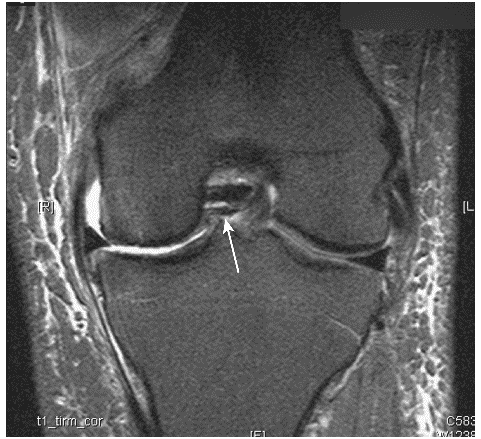
A 23-year-old man is brought to the emergency department after injuring his knee while playing football. Physical examination shows tenderness and swelling of the knee. The knee is being locked in a flexed position. An MRI of the knee shows a bucket-handle meniscal tear (see image below). Which of the following ligaments is most likely injured?
A 34-year-old man comes to the physician because of a 1-week history of pain in his foot. Physical examination shows inflammation of the tough band of tissue stretching from the calcaneus to the ball of the foot. Which of the following conditions is characteristic of these symptoms?
A 50-year-old woman is brought to the emergency department 30 minutes after she was involved in a motor vehicle collision. An MRI of the knee shows an injured anterior cruciate cruciate ligament. Physical examination shows a positive drawer sign. Which of the following signs is expected to be present during physical examination?
A 23-year-old male basketball player injured his foot during training and is admitted to the emergency department. An MRI examination shows a hematoma around the medial malleolus. Physical examination shows excessive eversion of the foot. Which of the following ligaments most likely has a tear?
A 72-year-old woman is brought to the emergency department because she lost consciousness. A CT scan of the brain shows an area of ischemic stroke. Neurologic examination shows no response to the ankle reflex test. Which of the following nerve roots is most likely responsible for this reflex?
A 19-year-old man is brought to the hospital because of a 2-hour history of being shot in the lateral aspect of the right foot by a bullet. The patient is hemodynamically stabilized, and his vital signs are within normal limits. An x-ray of the foot shows that the base of the fifth metatarsal is completely obliterated. Which of the following muscles is most likely affected by this injury?
A 29-year-old man is brought to the physician for removal of a cast from his left leg. He had sustained a fracture of the left lower limb 6 weeks prior, which was immobilized in a cast that extended from just below the knee to the foot. At the time of injury, there was severe pain but normal strength in the lower limb. When the cast was removed, physical examination showed a pronounced left foot drop with paresthesia and sensory loss over the dorsum of the left foot and lateral leg. Injury to which of the following nerves is the most likely cause of this patient’s symptoms?
A 12-year-old boy is brought to the physician by his father because of redness and swelling of his left foot for 24 hours. Three days earlier he had scraped his foot while wading in a drainage ditch. Physical examination of the foot shows a purulent abrasion with edema, erythema, and tenderness on the lateral side. Infection will most likely spread from the lateral side of the foot to the regional lymph nodes in which of the following areas?
A 22-year-old man is brought to the emergency department because he collided with one of his teammates and is unable to walk. Physical examination shows when the posterior drawer test is performed the tibia moves backward in relation to his femur. Injury to which structure is confirmed by performing this test?
A 24-year-old woman is brought to the emergency department because of inability to walk after she received a lateral blow to the knee during a tackle in a football game. Physical examination shows positive anterior drawer sign. An MRI shows injury to several structures of the knee, including her medial meniscus. Which of the following structures is also likely injured by the tackle?
A 58-year-old woman comes to the physician because of a 5-year history of varicose veins on the medial aspect of her foot. A varicose vein striping procedure is performed, and the veins are removed. One month later the patient returns to the physician because of loss of sensation over the medial aspect of her leg and foot. Which of the following nerves is most likely injured during the procedure?
A 22-year-old woman is brought to the emergency department 30 minutes after she was involved in a motor vehicle collision with her left and right leg pinned under her motorcycle. She appears to be well, and her vital signs are within normal limits. Physical examination shows bruising, and an obvious deformity is seen over her left knee joint. An x-ray shows a posteriorly dislocated supracondylar fracture. An ultrasound of the knee shows severe compression of the popliteal artery. Which of the following arteries would ensure adequate blood supply to the leg and foot in this patient?
A 22-year-old man is admitted to the emergency department because of a 30-minute history of acute right knee pain after sustaining a kick injury to an extended leg. An MRI of the lower limb showed that the trauma caused anterior displacement of the tibia with respect to his femur. Which of the following ligaments was most likely injured?