Loading...


M1 Upper Limb Summative Review Quiz
Quiz by Jenny Ousley
Tag the questions with any skills you have. Your dashboard will track each student's mastery of each skill.
A 24-year-old woman is brought to the emergency department after sustaining an injury to her shoulder during a basketball game. The right shoulder is externally rotated and abducted. Physical examination shows loss of the lateral contour of the shoulder. An x-ray shows anterior shoulder dislocation. What nerve is most commonly injured in this type of injury?
A 55-year old man comes to the physician because of a 2-week history of weakness and pain in his left shoulder that disturbs his sleep at night. Physical examination shows point-tenderness below the acromion. Tenderness is elicited when the patient abducts and internally rotates his arm against resistance. An MRI of the shoulder shows injury to the tendon of the supraspinatus muscle. Which of the following is true about the supraspinatus muscle?
A 5-year-old boy is brought to the emergency department after falling from a tree. The patient cradles his injured arm. Neurovascular examination finds no abnormalities. An x-ray shows a non-displaced fracture. The child’s parents are informed that their son’s fracture is the most commonly occurring fracture in children and can be treated nonoperatively. Which of the following bones was most likely fractured?
A 36-year-old man comes to the emergency department because of a dull ache in his shoulder and axilla (see image below). Vital signs are within normal limits. The pain is exacerbated with activity and is relieved by rest. Four days ago, he was hospitalized and a central venous line was placed. Physical examination shows a swollen right arm. What is the most likely cause of the patient’s current presentation?
A 22-year-old woman is brought to the emergency department 1 hour after sustaining a severe knife wound to the upper chest. Her temperature is 36.9°C (98.4°F), pulse is 82/min, respirations are 16/min, and blood pressure is 115/72 mm Hg. Physical examination shows a 3-cm deep entry wound at the deltopectoral groove. Vascular clamps are applied proximal and distal to the site of injury between the second and third parts of the axillary artery to control the bleeding. Which of the following arteries most likely provides collateral circulation to the scapula?
A 30-year-old man comes to the physician because of a 2-week history of dull, intermittent pain of the posterolateral right shoulder. The pain is exacerbated by overhead activities. Physical examination shows enlarged shoulder muscles that reduce the size of the quadrangular space. There is point tenderness over the quadrangular space and weakness on lateral rotation of the abducted humerus. An MRI of the shoulder shows atrophy of the teres minor. Which of the following structures would most likely be compressed?
A 42-year-old woman comes to the physician for a follow-up after injuring her left shoulder. Two months ago, she was hit on the left shoulder by a falling tree branch and was diagnosed with Erb-Duchenne palsy. She has progressively worsening pain and limited movement. Previous x-rays showed no fracture of the bones of the shoulder girdle. Which of the following conditions is also expected to be present during physical examination?
A 35-year-old man is brought to the emergency department after falling from a motorcycle and injuring his shoulder. The patient is alert and responsive. Vital signs are within normal limits. Physical examination shows the loss of the normal contour of the shoulder and an abnormal appearing depression below the acromion. Which of the following injuries did the patient most likely sustain?
A 28-year-old man is brought to the emergency department after falling off a street pole and landing directly on his right shoulder. His temperature is 37°C (98.6°F), pulse is 68/min, respirations are 12/min, and blood pressure is 109/79 mm Hg. Physical examination shows tenderness on movement of the shoulder. An x-ray of the right shoulder shows a fracture through the entire length of the floor of the intertubercular sulcus of the right humerus. The muscle most likely affected by the fracture is innervated by a nerve composed of which of the following nerve roots?
A 21-year-old woman comes to the physician for a follow-up appointment. One week ago, she sustained a dislocated glenohumeral joint of her shoulder while playing soccer and the shoulder was reduced in the emergency department. Physical examination shows decreased strength on medial rotation of her arm at the shoulder during today’s visit. This finding was most likely caused by a tear in which of the following muscles?
A newborn girl is brought to the physician because of limited movement of the right arm following a complicated delivery. Her mother has a history of diabetes. Vital signs are within normal limits. Physical examination shows an adducted and medially rotated right arm. Her right forearm is extended and pronated and the wrist is flexed. Which of the following ventral rami is most likely injured?
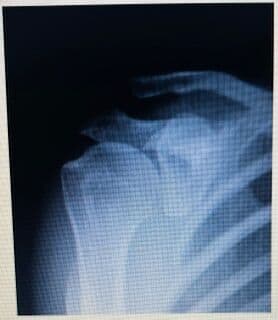
A 21-year-old man comes to the emergency department because of a pain in the right shoulder after a fall. Vital signs are within normal limits. Physical examination shows the reproduction of pain on passive adduction of the right arm across the chest. An x-ray of the right shoulder is shown in the image below. Which of the following structures were most likely stretched/torn resulting in this injury?
A 41-year-old woman comes to the physician for a follow-up examination. One year ago, she underwent a mastectomy of her left breast. She is scheduled for a latissimus dorsi muscle flap to cosmetically augment the site of her absent left breast. During surgery, part of the latissimus dorsi muscle is advanced to the anterior thoracic wall. Which artery forms the vascular base of this flap?
A 31-year-old man is brought to the emergency department 1 hour after falling onto his elbow during a hockey game. He has a restricted range of motion of his left arm due to pain. His temperature is 37°C (98.6°F), pulse is 90/min and regular, respirations are 18/min, and blood pressure is 128/76 mm Hg. Physical examination shows swelling and ecchymosis at the proximal shoulder. An x-ray of the shoulder shows a fracture of the surgical neck of the humerus with elevation and adduction of the distal fragment. Which of the following muscles most likely caused the adduction of the distal fragment?
A 54-year-old woman is brought to the emergency department after being found unconscious. The Glasgow coma scale score is 6, her temperature is 37°C (98.6°F), pulse is 97/min, respirations are 19/min, and blood pressure is 129/79 mm Hg. Physical examination shows an absent biceps brachii reflex. What is the spinal level of the afferent component of this reflex?
A 54-year-old woman is brought to the emergency department after being involved in a motor vehicle collision. Vital signs are within normal limits. Physical examination shows soft tissue edema and bruising around the neck. An x-ray of the left arm shows a mid-body humeral fracture. Which of the following areas will most likely have impaired or absent sensation?
A 67-year-old woman is brought to the emergency department after injuring her left shoulder from a fall. She has a history of osteoporosis. Physical examination shows bruising and dimpling of the upper part of the arm with exquisite tenderness over the affected area. An x-ray of the left shoulder is shown in image below. Which of the following nerves is most likely injured?

A 25-year-old man is brought to the emergency department because he fell on a slippery trail and injured his right upper limb. Physical examination shows abrasions over his triceps brachii muscle. An x-ray of his arm shows a fracture at the mid-body of the humerus. Which of the following nerves is most likely injured?
A 25-year-old man is brought to the emergency department because he fell on a slippery trail and injured his right upper limb. Physical examination examination shows abrasions over his triceps brachii muscle. An x-ray of his arm shows a fracture at the mid-body of the humerus. Which of the following muscles is most likely paralyzed?
A 26-year-old man comes to the physician because of a 1-week history of pain and weakness in the right shoulder after a tennis match. The pain is exacerbated by movement. He is referred to an orthopedic surgeon. During surgery, the supraspinatus muscle is reflected from its bed. Which artery was seen crossing the ligament that bridges the notch of the superior border of the scapula?
A 29-year-old man is brought to the emergency department after a painful fall against a rocky ledge. His temperature is 37.5°C (99.5°F), pulse is 95/min, respirations are 18/min, and blood pressure is 118/70 mm Hg. He has dull pain in the lateral shoulder with radiation to the proximal arm. An x-ray of the arm shows a hairline fracture of the surgical neck of the humerus. Which of the following tests is best for assessing the status of the nerve associated with this injury?
A 43-year-old man is brought to the emergency department after a motor vehicle collision in which he sustained a whiplash injury. On arrival, his temperature is 37°C (98.6°F), pulse is 110/min, respirations are 18/min, and blood pressure is 140/82 mm Hg. Physical examination shows loss of elbow extension, loss of extension of the MCP joints, and absence of ipsilateral triceps reflex. An MRI shows an intervertebral disc herniation in the cervical region. Which of the following spinal nerves is most likely affected?
A 45-year-old woman is brought to the emergency department after sustaining injuries from a motorbike collision. She was propelled over the handlebars of her bike, landing on the point of her left shoulder. Her temperature is 37°C (98.6°F), pulse is 100/min, respirations are 15/min, and blood pressure is 145/87 mm Hg. Physical examination shows a swollen, pale, and cool proximal arm. Any movement of the arm causes severe pain. An x-ray of the arm shows a fracture of the humerus and the formation of a large hematoma. A diagnosis of Volkmann ischemic contracture is made. At which of the following locations has the fracture most likely occurred?
A 68-year-old woman is brought to the emergency department 3 hours after she fell on the wet bathroom floor of her home. Physical examination shows a posterior displacement of the left distal wrist and hand. An x-ray of the wrist shows an oblique fracture of the radius. Which of the following types of fracture most likely occurred in this patient?
A 67-year-old woman comes to the emergency department after falling on an outstretched hand while walking her dog the evening before. Neurologic examination finds weakness of flexion of the wrist in a medial direction, a loss of sensation on the medial side of the hand, and clawing of the fingers. An x-ray of her elbow shows no abnormalities. At which of the following locations has the nerve injury most likely occurred?
A 54-year-old woman is brought to the emergency department after a fall. She has pain along the left arm and limited mobility of the left upper limb. Vital signs are within normal limits. Physical examination shows absence of the brachioradialis reflex. The ventral ramus of which spinal nerve is responsible for this reflex?
A 54-year-old man is brought to the emergency department because of constant severe substernal chest pain and sweating for 2 hours. An ECG shows ST-segment elevation in leads V1–V3 and the patient is diagnosed with an anterior wall myocardial infarction. Angiography is performed and coronary artery bypass surgery using a radial artery graft is proposed. Which of the following tests should be performed during physical examination before the bypass graft operation?
A 4-year-old boy is brought to the emergency department because of left arm pain after being lifted by his parents. Movement of his right upper extremity is restricted due to pain. He holds his arm at his side with his elbow extended and forearm pronated. There are no visible hematomas or swelling. Which of the following structures is most likely injured in this patient?
A 22-year-old woman comes to the physician for a routine examination. During venipuncture, the phlebotomist is unable to withdraw blood and quickly realizes that she passed the needle completely through the vein. Which of the following structures located deep to the median cubital vein has acted as a barrier and has prevented her from puncturing an artery?
A 72-year-old woman is brought to the emergency department after a fall on her outstretched left arm. She has significant elbow pain. Physical examination shows a palpable defect over her biceps brachii tendon, and pain during elbow flexion without any restriction on movement. An x-ray of the left arm does not show fractures or dislocations. She is diagnosed with rupture of the biceps brachii tendon. Which of the following muscles most likely allow the patient to continue to flex her elbow?
A 55-year-old woman comes to the clinic because of a 1-week history of right elbow pain. The pain started after a game of tennis. The pain begins at the elbow and extends into the dorsum of the forearm. Physical examination shows mild swelling and tenderness over the lateral epicondyle. Which one of the following wrist movements will most likely exacerbate the pain?
A 4-year-old boy is brought to the emergency department by his mother because of left arm pain. His mother explains the pain started after she tugged his left arm when crossing the road to pull him out of the way of an oncoming car. Over the next few hours, his mother became worried as her son was not moving his left arm while playing with his toys. On physical examination, the child’s arm is slightly flexed and pronated. The laxity of which of the following structures resulted in this finding?
A 14-year-old boy is brought to the emergency department after falling on his outstretched hand. Physical examination shows point tenderness above the humeral epicondyles and a pulsatile mass just above the cubital fossa. There is weakness on pronation, wrist flexion, and grip strength. Thumb flexion and opposition are also impaired. Flexion at the DIP joints of the fourth and fifth digits is normal. An x-ray shows a supracondylar fracture of the humerus. Which of the following structures are most likely injured?
A 25-year-old man is brought to the emergency department because he fell on a slippery trail and injured his right upper limb. Physical examination shows abrasions over his arm. An x-ray of his arm is shown below. Which of the following deficits will most likely be encountered during physical examination?

A 21-year-old woman comes to the emergency department after she was struck in the arm by a line drive during a softball game. Physical examination shows weakness on abduction and extension of the thumb. There is also weakness in extension of the wrist and metacarpophalangeal (MCP) joints. An x-ray of the arm shows no abnormalities. An MRI shows soft tissue injury to the central aspect of the lateral humerus. Which of the following muscles is most likely spared from injury?
A 61-year-old man is brought to the emergency department after being hit by a bat on the left arm. Physical examination shows weakness of extension at the wrist and MCP joints, and loss of sensation on the dorsum of the hand proximal to the first two digits. An x-ray of the left arm shows a hairline fracture of the body of the humerus just distal to its midpoint. Which of the following nerves is most likely injured?
A 16-year-old man is brought to the emergency department with pain and swelling of his right wrist after falling from his bike onto a flexed, outstretched hand. An x-ray of the forearm shows a fracture of the distal radius. The fractured bone displaced a carpal bone in the palmar direction, resulting in nerve compression within the carpal tunnel. Which of the following carpal bones is most likely dislocated?
A 17-year-old boy suffered the most common of fractures of the carpal bones when he fell on his outstretched hand. Which bone would this be?
A 43-year-old man comes to the physician because of a 2-week history of a painful right shoulder. He has pain when reaching over his head and difficulty sleeping on his right side. Physical examination shows tenderness to palpation below the acromion. The empty can test is positive. Which of the following is most likely present when the patient abducts his arm?
A 65-year-old man is brought to the emergency department after falling on his outstretched hand. The patient complains of severe right shoulder pain. Physical examination shows an externally rotated and slightly abducted right arm. Flattening of the deltoid muscle is noted and sensation is also absent over the right deltoid muscle. Which of the following is the most likely diagnosis?
A 45-year-old man comes to the emergency department after sustaining an injury to his left arm during a bicycle race. The patient has pain and swelling of his left elbow. Physical examination shows warmth, swelling, and tenderness of the left elbow with decreased sensation over the medial 1½ digits. An x-ray of the left upper limb is shown. Which of the following muscles is most likely paralyzed?
A 32-year-old woman is brought to the emergency department 1 hour after a motor vehicle collision. She is awake and alert upon arrival. Her temperature is 37°C (98.6°F), pulse is 90/min, respirations are 16/min, and blood pressure is 118/72 mm Hg. Physical examination shows tenderness and bruising over the left arm. Flexion and supination of the forearm are severely weakened and she has loss of sensation on the lateral surface of the forearm. An x-ray of the upper limb shows multiple fractures of the humerus. Which of the following nerves is most likely injured?
Laboratory studies in the outpatient clinic on a 24-year-old woman included assessment of circulating blood chemistry. Which of the following arteries is most likely at-risk during venipuncture in the cubital fossa?
A 32-year-old woman comes to the hospital for hemodialysis. Physical examination shows venous access in her upper limb was unexpectedly difficult as the caliber of the major vein on the lateral aspect her arm was too small. A vein was found on the medial side of the arm that passed through the superficial and deep fascia to join veins beside the brachial artery. Which of the following veins is most likely located?
A 55-year-old woman is brought to the emergency department after being involved in a motor vehicle collision. She is awake, alert, and oriented. Vital signs are within normal limits. Physical examination shows exquisite tenderness of the flexor muscles of the forearm on palpation and fixed flexion of the digits. Swelling, cyanosis, and decreased sensation of the hand is also noted. Which of the following is the most likely diagnosis?
A 32-year-old woman comes to the emergency department 1 hour after injuring her elbow when she fell from her bicycle. Vital signs are within normal limits. Physical examination shows a Benediction sign of the hand with the first three digits in the extended position and the fourth and fifth fingers in the flexed position. Which of the following nerves are most likely injured?
A 22-year-old football player is brought to the emergency department because of a wrist injury after falling on his outstretched hand. During surgery, the anatomical snuffbox is exposed and an artery is visualized crossing the fractured bone that forms the floor for this space. Which of the following arteries was most likely visualized?
A 36-year-old man is brought to the emergency department because of a deep knife wound on the medial side of his distal forearm. Vital signs are within normal limits. Physical examination shows weakness on abduction and adduction of the digits. He is unable to hold a piece of paper between his fingers. Sensation of the fifth digit and the medial side of the fourth digit is absent. Which of the following nerves is most likely injured?
A 19-year-old man comes to the physician because of numbness and pain in his fingers. He is a professional cyclist and has been training long distances on rough terrain. Physical examination shows sensory loss to the medial two and a half digits on the dorsal aspect of his hand. A diagnosis of handlebar neuropathy is made. What other signs may be elicited during physical examination?
A 29-year-old woman comes to the emergency department after falling on an outstretched hand. Physical examination shows pain on movement of the wrist associated with numbness and tingling on the radial side of the palm and palmar aspect of the thumb, index, and middle fingers. X-ray of the wrist shows anterior dislocation of a carpal bone. Which of the following carpal bones is most likely dislocated?