Create geometric models to solve real-world and mathematical problems to: • Find the area of triangles by composing into rectangles and decomposing into right triangles. • Find the area of special quadrilaterals and polygons by decomposing into triangles or rectangles.
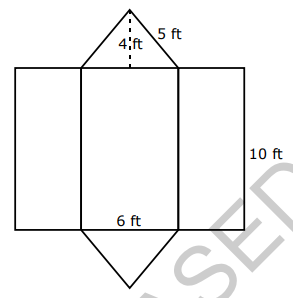
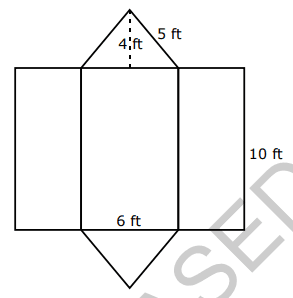
Represent right prisms and right pyramids using nets made up of rectangles and triangles, and use the nets to find the surface area of these figures. Apply these techniques in the context of solving real-world and mathematical problems.
Use the coordinate plane to solve real-world and mathematical problems by: • Drawing polygons in the coordinate plane given coordinates for the vertices. • Using coordinates to find the length of a side joining points with the same first coordinate or the same second coordinate.
Apply and extend previous understandings of the volume of a right rectangular prism to find the volume of right rectangular prisms with fractional edge lengths. Apply this understanding to the context of solving real-world and mathematical problems.
Track each student's skills and progress in your Mastery dashboards
Give this quiz to my class
Q 1/6
Score 0
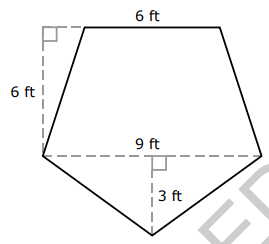
What is the area of the pentagon shown below?
60
27 square feet
58.5 square feet
85.5 square feet
117 square feet
Q 2/6
Score 0
60
6 questions
Q.
What is the area of the pentagon shown below?
1
60 sec
NC.6.G.1
Q.
2
60 sec
NC.6.G.4
Q.
3
60 sec
NC.6.G.4
Q.
4
60 sec
NC.6.G.3
Q.
5
60 sec
NC.6.G.2
Q.
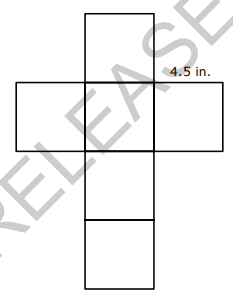
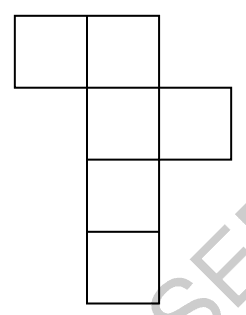
Karen has a cube that has a side length of 6 in. The net of the cube is shown.
What is the surface area of the cube?