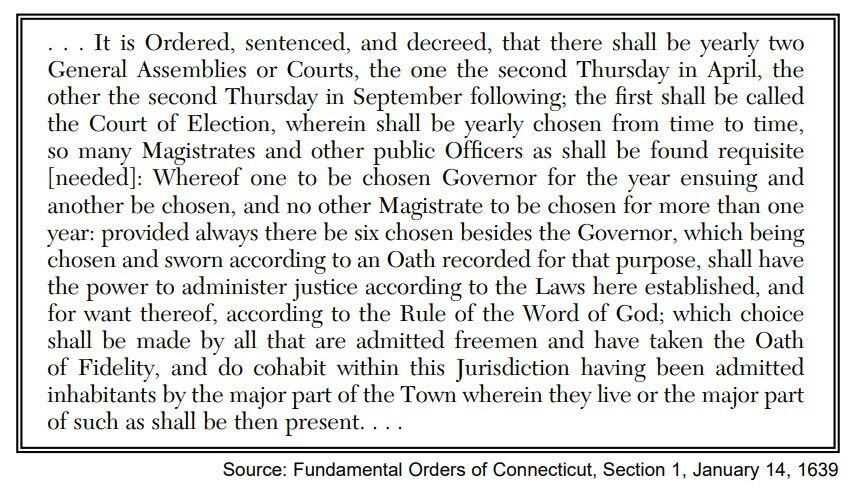
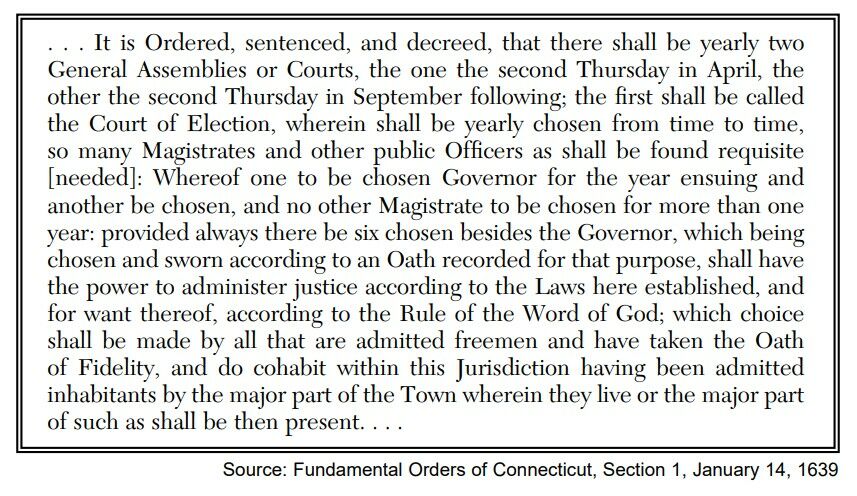
A number of factors influenced colonial economic development, social structures, and labor systems, causing variation by region. Students will examine the impacts of geographic factors on patterns of settlement and the development of colonial economic systems. Students will examine the factors influencing variations in colonial social structures and labor systems. Students will analyze slavery as a deeply established component of the colonial economic system and social structure, indentured servitude vs. slavery, the increased concentration of slaves in the South, and the development of slavery as a racial institution.
Under the new Constitution, the young nation sought to achieve national security and political stability as the three branches of government established their relationships with each other and the states.
Students will identify presidential actions and precedents established by George
Washington, including those articulated in his Farewell Address.
Students will examine Hamilton’s economic plan, the debate surrounding the plan,
and its impacts on the development of political parties.
Students will examine the tradition of a peaceful transfer of power established in
the presidential election of 1800 and compare it to the presidential election of 2000,
focusing on the roles of the Electoral College and Congress in 1800 and the Electoral
College and the Supreme Court in 2000.
Students will examine Supreme Court cases, including Marbury v. Madison,
McCulloch v. Maryland and Gibbons v. Ogden, and analyze how these decisions
strengthened the powers of the federal government.
Under the new Constitution, the young nation sought to achieve national security and political stability, as the three branches of government established their relationships with each other and the states. Students will identify presidential actions and precedents established by George Washington, including those articulated in his Farewell Address. Students will examine Hamilton's economic plan, the debate surrounding the plan, and its impacts on the development of political parties. Students will examine the tradition of a peaceful transfer of power established in the presidential election of 1800 and compare it to the presidential election of 2000,focusing on the roles of the Electoral College and Congress in 1800 and the Electoral College and the Supreme Court in 2000. Students will examine Supreme Court cases, including Marbury v. Madison, McCulloch v. Maryland, and Gibbons v. Ogden, and analyze how these decisions strengthened the powers of the federal government.
American nationalism was both strengthened and challenged by territorial expansion and economic growth. Students will examine how the Louisiana Purchase, the War of 1812, and the Monroe Doctrine strengthened nationalism. Students will examine the market revolution, including technological developments, the development of transportation networks, the growth of domestic industries, the increased demands for free and enslaved labor, the changing role of women, and the rise of political democracy. Students will examine Jackson's presidency, noting the ways it strengthened presidential power yet challenged constitutional principles in the case of Worcester v. Georgia (1832), including the controversy concerning the Indian Removal Act and its implementation.
Long-standing disputes over States rights and slavery and the secession of Southern states from the Union, sparked by the election of Abraham Lincoln, led to the Civil War. After the issuance of the Emancipation Proclamation, freeing the slaves became a major Union goal. The Civil War resulted in tremendous human loss and physical destruction. Students will compare the relative strengths of the Union and the Confederacy in terms of industrial capacity, transportation facilities, and military leadership, and evaluate the reasons why the North prevailed over the South and the impacts of the war. Students will examine the expansion of executive and federal power as they relate to the suspension of habeas corpus within the Union and the issuance of the Emancipation Proclamation. Students will analyze the ideas expressed in the Gettysburg Address, considering its long-term effects.
Rapid industrialization and urbanization created significant challenges and societal problems that were addressed by a variety of reform efforts. Students will examine demographic trends associated with urbanization and immigration between 1840 and 1920, including push-pull factors regarding Irish immigration and immigration from southern and eastern Europe. Students will examine problems faced by farmers between 1870 and 1900 and examine the goals and achievements of the Grange Movement and the Populist Party. Students will examine the attempts of workers to unionize from 1870 to 1920 in response to industrial working conditions, including the Knights of Labor, the American Federation of Labor, the American Railway Union, the International Ladies Garment Workers? Union, and the Industrial Workers of the World, considering actions taken by the unions and the responses to these actions. Students will examine Progressive Era reforms, such as the 16th and 17th amendments (1913) and the establishment of the Federal Reserve System (1913). Students will examine the efforts of the women's suffrage movement after 1900, leading to ratification of the 19th amendment (1920). Students will trace the temperance and prohibition movements leading to the ratification of the 18th amendment (1919). Students will trace reform efforts by individuals and the consequences of those efforts, including: Jane Addams and Hull House Jacob Riis? How the Other Half Lives New York Governor Theodore Roosevelt and the Tenement Reform Commission Upton Sinclair's The Jungle and the Meat Inspection Act Margaret Sanger and birth control Ida Tarbell's The History of the Standard Oil Company Ida Wells and her writings about lynching of African Americans Booker T. Washington's contributions to education, including the creation of Tuskegee Institute? W. E. B. Du Bois and the founding of the National Association for the Advancement of Colored People (NAACP), the publication of The Crisis, and the Silent Protest (1917)
The 1920s was a time of cultural change in the country, characterized by clashes between modern and traditional values. Students will examine the cultural trends associated with the Roaring Twenties, including women's efforts at self-expression and their changing roles. Students will examine the impact of Prohibition on American society. Students will examine change in immigration policy as reflected by the passage of the Quota Acts of the 1920s. Students will examine the reasons for the resurgence of the Ku Klux Klan. Students will examine the key issues related to the Scopes trial.
In the late 1800s, various strategic and economic factors led to a greater focus on foreign affairs and debates over the United States? role in the world. Students will examine factors such as the economic and strategic interests that led the United States to seek foreign markets, resources, and coaling stations, including interest in Hawaii. Students will investigate the causes and effects of the Spanish-American War, evaluating Spanish, Cuban, and United States interests and actions. Students will examine debates between anti-imperialists and imperialists surrounding ratification of the Treaty of Paris of 1898 and annexation of the Philippines. Students will investigate expanding American influence in the Caribbean and Latin America through the creation of the Panama Canal and the Roosevelt Corollary.
For many Americans, the 1920s was a time of prosperity. However, underlying economic problems, reflected in the stock market crash of 1929, led to the Great Depression. President Franklin D. Roosevelt's responses to the Great Depression increased the role of the federal government. Students will examine the reasons for economic prosperity during the 1920s. Students will examine the underlying weaknesses of the economy that led to the stock market crash of 1929 and the Great Depression. Students will compare and contrast the responses of Presidents Herbert Hoover and Franklin D. Roosevelt to the Great Depression. Students will examine the human and environmental causes of the Dust Bowl and its effects. Students will evaluate President Roosevelt's leadership during the Depression, including key legislative initiatives of the New Deal, expansion of federal government power, and the constitutional challenge represented by his court packing effort.
United States entry into World War II had a significant impact on American society. Students will examine United States mobilization efforts and wartime production and their effects on unemployment rates. Students will examine the reasons for President Roosevelt's executive order for Japanese removal, the impact of removal on Japanese people living in the United States, and the Supreme Court's decision in Korematsu v. United States (1944). Students will examine the contributions of women, African Americans, Native Americans, Asian Americans, Mexican workers, and Mexican Americans to the war effort, as well as the discrimination that they experienced in the military and workforce.
After World War II, ideological differences led to political tensions between the United States and the Soviet Union. In an attempt to halt the spread of Soviet influence, the United States pursued a policy of containment. Students will trace key decisions made at wartime conferences as they applied to Poland, Eastern Europe, and postwar Germany, and note how continuing disagreements over these decisions helped bring about the start of the Cold War. Students will trace United States containment policies, including the Truman Doctrine (1947), the Marshall Plan (1948), and the North Atlantic Treaty Organization (1949), and actions taken during the Berlin blockade, and consider how they represent a shift in American foreign policy. Students will examine domestic concerns about the spread of communism and the rise of McCarthyism. Students will examine the consequences of Truman's decision to fight a limited war in defense of South Korea. Students will trace the United States involvement in Vietnam, including President Johnson's decision to escalate the fighting in Vietnam. Students will examine reasons for declining public confidence in government, including America's involvement in Vietnam, student protests, the growing anti war movement, and the Watergate affair. Students will examine the congressional effort to limit presidential power through the War Powers Act.
Individuals, diverse groups, and organizations have sought to bring about change in American society through a variety of methods. Students will trace the following efforts in terms of issues/goals, key individuals and groups, and successes/limitations: Modern women's movement (e.g., The Feminine Mystique [1963], National Organization for Women , Equal Pay Act and Title IX, Roe v. Wade) Native Americans (e.g., American Indian Movement, Russell Means, native identity, and land claims) Brown Power (Chicano) movement (e.g., Cesar Chavez, United Farm Workers) People with disabilities (e.g. Individuals with Disabilities Education Act [1975], Americans with Disabilities Act [1990] ) Rights of the accused (e.g., Mapp v. Ohio [1961], Gideon v. Wainwright [1963], Miranda v. Arizona [1966]) Immigration (e.g., Immigration Act of 1965, Immigration Act of 1986, continuing debates over immigration) Gay Rights and the LGBT movement (e.g., Stonewall Inn riots [1969], efforts for equal legal rights) Environment (e.g., Silent Spring [1962], Clean Air Act of 1970, Clean Water Act of 1972, Endangered Species Act of 1973, Environmental Protection Agency [1970], Reagan's policy) Student rights (e.g., Engel v. Vitale [1962], Tinker v. Des Moines School District [1969], New Jersey v. TLO [1985]) Students will thoroughly investigate at least one of the efforts above.
After World War II, long-term demands for equality by African Americans led to the civil rights movement. The efforts of individuals, groups, and institutions helped to redefine African American civil rights, though numerous issues remain unresolved. Students will examine the roles and impact of individuals such as Rev. Martin Luther King Jr., Stokely Carmichael, Fannie Lou Hamer, and Malcolm X on the movement and their perspectives on change. Students will examine the role of groups such as the National Association for the Advancement of Colored People (NAACP), Southern Christian Leadership Conference (SCLC), and Student Non-Violent Coordinating Committee (SNCC) in the movement, their goals and strategies, and major contributions. Students will examine judicial actions and legislative achievements during the movement, such as Brown v. Board of Education of Topeka (1954), the Civil Rights Act of 1964, Heart of Atlanta Motel, Inc. v. United States (1964) and the Voting Rights Act of 1965. Students will analyze the significance of key events in the movement, including the Montgomery bus boycott, federal intervention at Little Rock, Arkansas; the Birmingham protest; and the March on Washington.
Track each student's skills and progress in your Mastery dashboards