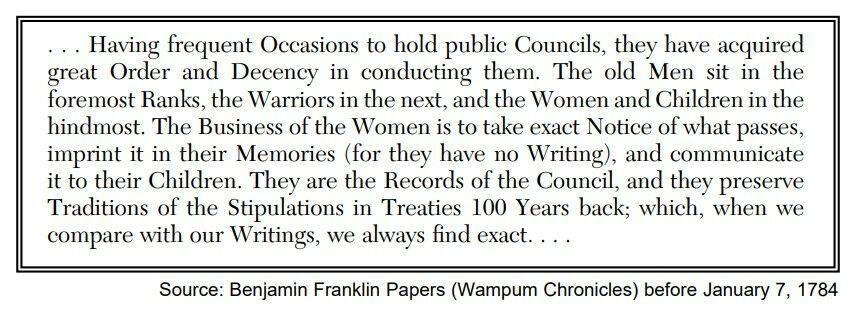
Contact between Native American groups and Europeans occurred through cultural exchanges, resistance efforts, and conflict. Students will trace European contact with Native Americans, including the Dutch, the English, the French and the Spanish. Students will examine the impacts of European colonization on Native Americans, who eventually lost much of their land and experienced a drastic decline in population through diseases and armed conflict.
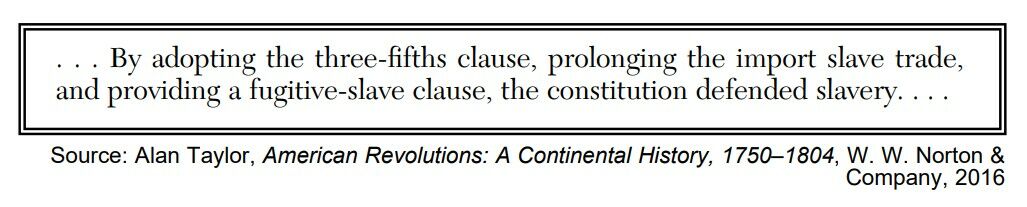
Weaknesses of the Articles of Confederation led to a convention whose purpose was to revise the Articles of Confederation but instead resulted in the writing of a new Constitution. The ratification debate over the proposed Constitution led the Federalists to agree to add a bill of rights to the Constitution. Students will examine the weaknesses and successes of government under the Articles of Confederation. Students will explore the development of the Constitution, including the major debates and their resolutions, which included compromises over representation, taxation, and slavery. Students will examine the structure, power, and function of the federal government as created by the Constitution, including key constitutional principles such as the division of power between federal and state government, the separation of powers at the federal level, the creation of checks and balances, the sovereignty of the people, and judicial independence. Students will examine the key points of debate expressed in the Federalist Papers and the Anti Federalist Papers, focusing on the protection of individual rights and the proper size for a republic. Students will examine the rights and protections provided by the Bill of Rights and to whom they initially applied.
Different perspectives concerning constitutional, political, economic, and social issues contributed to the growth of sectionalism. Students will compare different perspectives on States rights by examining the Kentucky and Virginia Resolutions and the nullification crisis. Students will investigate the development of the abolitionist movement, focusing on Nat Turner's Rebellion, Sojourner Truth, William Lloyd Garrison (The Liberator), Frederick Douglass (The Autobiography of Frederick Douglass and The North Star), and Harriet Beecher Stowe (Uncle Tom's Cabin). Students will examine the emergence of the women's rights movement out of the abolitionist movement, including the role of the Grimké sisters, Lucretia Mott, and Elizabeth Cady Stanton, and evaluate the demands made at the Seneca Falls Convention (1848). Students will examine the issues surrounding the expansion of slavery into new territories, by exploring the Missouri Compromise, Manifest Destiny, Texas and the Mexican-American war, the Compromise of 1850, the Kansas-Nebraska Act, the Dred Scott decision, and John Brown's raid.
Between 1865 and 1900, constitutional rights were extended to African Americans. However, their ability to exercise these rights was undermined by individuals, groups, and government institutions. Students will examine the 13th, 14th, and 15th amendments and consider the role of Radical Republicans in Reconstruction. Students will investigate the ways individuals, groups, and government institutions limited the rights of African Americans, including the use of Black Codes, the passage of Jim Crow laws, the Ku Klux Klan, restrictions on voting rights, and Supreme Court cases including the Civil Rights Cases (1883) and Plessy v. Ferguson (1896). Students will examine the ways in which freedmen attempted to build independent lives, including the activities of the Freedmen's Bureau, the creation of educational institutions, and political participation. Students will examine the impacts of the election of 1876 and the compromise of 1877 on African Americans.
The 14th and 15th amendments failed to address the rights of women. Students will examine the exclusion of women from the 14th and 15th amendments and the subsequent struggle for voting and increased property rights in the late 19th century. The students will examine the work of Susan B. Anthony.
New technologies and economic models created rapid industrial growth and transformed the United States. Students will examine the technological innovations that facilitated industrialization, considering energy sources, natural resources, transportation, and communication. Students will examine the growth of industries under the leadership of businessmen such as John D. Rockefeller, Andrew Carnegie, J.P. Morgan, and Henry Ford and analyze their business practices and organizational structures. Students will evaluate the effectiveness of state and federal attempts to regulate business by examining the Supreme Court decision in Wabash, St. Louis & Pacific R.R. v. Illinois (1886), the Interstate Commerce Act (1887), the Sherman Antitrust Act (1890), and President Theodore Roosevelt's trust-busting role as evidenced in Northern Securities Co. v. United States (1904).
Under the new Constitution, the young nation sought to achieve national security and political stability, as the three branches of government established their relationships with each other and the states. Students will identify presidential actions and precedents established by George Washington, including those articulated in his Farewell Address. Students will examine Hamilton's economic plan, the debate surrounding the plan, and its impacts on the development of political parties. Students will examine the tradition of a peaceful transfer of power established in the presidential election of 1800 and compare it to the presidential election of 2000,focusing on the roles of the Electoral College and Congress in 1800 and the Electoral College and the Supreme Court in 2000. Students will examine Supreme Court cases, including Marbury v. Madison, McCulloch v. Maryland, and Gibbons v. Ogden, and analyze how these decisions strengthened the powers of the federal government.
In the late 1800s, various strategic and economic factors led to a greater focus on foreign affairs and debates over the United States? role in the world. Students will examine factors such as the economic and strategic interests that led the United States to seek foreign markets, resources, and coaling stations, including interest in Hawaii. Students will investigate the causes and effects of the Spanish-American War, evaluating Spanish, Cuban, and United States interests and actions. Students will examine debates between anti-imperialists and imperialists surrounding ratification of the Treaty of Paris of 1898 and annexation of the Philippines. Students will investigate expanding American influence in the Caribbean and Latin America through the creation of the Panama Canal and the Roosevelt Corollary.
Rapid industrialization and urbanization created significant challenges and societal problems that were addressed by a variety of reform efforts. Students will examine demographic trends associated with urbanization and immigration between 1840 and 1920, including push-pull factors regarding Irish immigration and immigration from southern and eastern Europe. Students will examine problems faced by farmers between 1870 and 1900 and examine the goals and achievements of the Grange Movement and the Populist Party. Students will examine the attempts of workers to unionize from 1870 to 1920 in response to industrial working conditions, including the Knights of Labor, the American Federation of Labor, the American Railway Union, the International Ladies Garment Workers? Union, and the Industrial Workers of the World, considering actions taken by the unions and the responses to these actions. Students will examine Progressive Era reforms, such as the 16th and 17th amendments (1913) and the establishment of the Federal Reserve System (1913). Students will examine the efforts of the women's suffrage movement after 1900, leading to ratification of the 19th amendment (1920). Students will trace the temperance and prohibition movements leading to the ratification of the 18th amendment (1919). Students will trace reform efforts by individuals and the consequences of those efforts, including: Jane Addams and Hull House Jacob Riis? How the Other Half Lives New York Governor Theodore Roosevelt and the Tenement Reform Commission Upton Sinclair's The Jungle and the Meat Inspection Act Margaret Sanger and birth control Ida Tarbell's The History of the Standard Oil Company Ida Wells and her writings about lynching of African Americans Booker T. Washington's contributions to education, including the creation of Tuskegee Institute? W. E. B. Du Bois and the founding of the National Association for the Advancement of Colored People (NAACP), the publication of The Crisis, and the Silent Protest (1917)
While the United States attempted to follow its traditional policy of neutrality at the beginning of World War I, the nation eventually became involved in the war. President Woodrow Wilson led the nation into war with the hope of reforming the international order through his Fourteen Points. Students will investigate the reasons for President Wilson's shift from neutrality to involvement in World War I. Students will examine Wilson's goals as expressed in the Fourteen Points, his role at the Versailles Peace Conference, and the compromises he was forced to make to gain approval for the League of Nations. Students will examine the reasons why President Wilson was unsuccessful in gaining support for Senate ratification of the Treaty of Versailles.
Under the new Constitution, the young nation sought to achieve national security and political stability as the three branches of government established their relationships with each other and the states.
Students will identify presidential actions and precedents established by George
Washington, including those articulated in his Farewell Address.
Students will examine Hamilton’s economic plan, the debate surrounding the plan,
and its impacts on the development of political parties.
Students will examine the tradition of a peaceful transfer of power established in
the presidential election of 1800 and compare it to the presidential election of 2000,
focusing on the roles of the Electoral College and Congress in 1800 and the Electoral
College and the Supreme Court in 2000.
Students will examine Supreme Court cases, including Marbury v. Madison,
McCulloch v. Maryland and Gibbons v. Ogden, and analyze how these decisions
strengthened the powers of the federal government.
For many Americans, the 1920s was a time of prosperity. However, underlying economic problems, reflected in the stock market crash of 1929, led to the Great Depression. President Franklin D. Roosevelt's responses to the Great Depression increased the role of the federal government. Students will examine the reasons for economic prosperity during the 1920s. Students will examine the underlying weaknesses of the economy that led to the stock market crash of 1929 and the Great Depression. Students will compare and contrast the responses of Presidents Herbert Hoover and Franklin D. Roosevelt to the Great Depression. Students will examine the human and environmental causes of the Dust Bowl and its effects. Students will evaluate President Roosevelt's leadership during the Depression, including key legislative initiatives of the New Deal, expansion of federal government power, and the constitutional challenge represented by his court packing effort.
The United States and the Soviet Union engaged in a nuclear arms race that eventually led to agreements that limited the arms buildup and improved United States-Soviet relations. Students will trace the acceleration of the nuclear arms race, beginning with the detonation of an atomic bomb by the Soviet Union in 1949, through 1969, including the effects of Sputnik and the Space Race. Students will examine Soviet motives for placing missiles in Cuba and the impact of the Cuban missile crisis on Soviet-American relations, leading to the adoption of the Nuclear Test Ban Treaty. Students will examine the policy of detente and its effect on the nuclear arms race.
In response to the terrorist attacks of September 11, 2001, the United States launched the War on Terror, which involved controversial foreign and domestic policies. Students will trace the reactions to the September 11, 2001, attacks, including responses of the American public, the authorization of the War on Terror, the invasion of Afghanistan, and the passage of the USA PATRIOT Act. Students will examine the decision to invade Iraq, which was based on allegations concerning weapons of mass destruction, and trace the course of the war. Students will evaluate the USA PATRIOT Act, including constitutional issues raised about the violation of civil liberties by the federal government's electronic surveillance programs.
Track each student's skills and progress in your Mastery dashboards