Natural cycles and patterns include:
• Earth spinning around once every 24 hours (rotation), resulting in day and night;
• Earth moving in a path around the Sun (revolution), resulting in one Earth year;
• the length of daylight and darkness varying with the seasons;
• weather changing from day to day and through the seasons;
• the appearance of the Moon changing as it moves in a path around Earth to complete a single cycle
Weather is the condition of the outside air at a particular moment.
Matter exists in three states: solid, liquid, gas.
• solids have a definite shape and volume;
• liquids do not have a definite shape but have a definite volume;
• gases do not hold their shape or volume
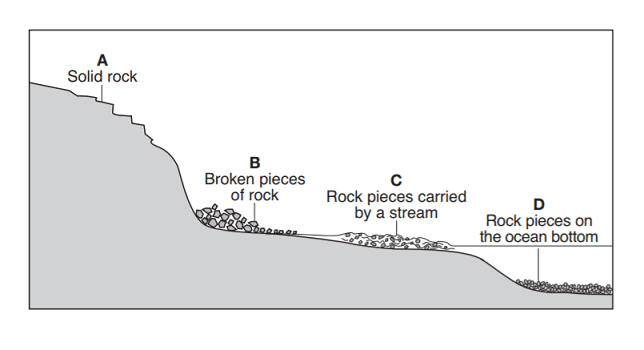
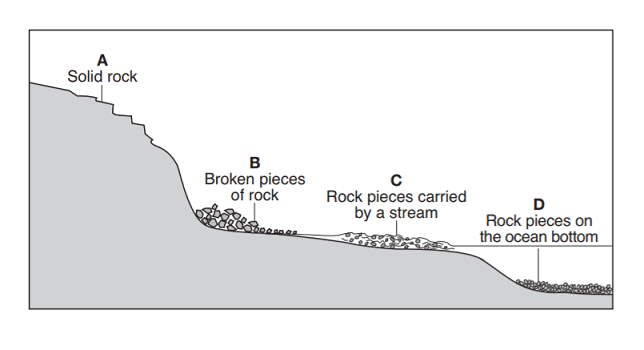
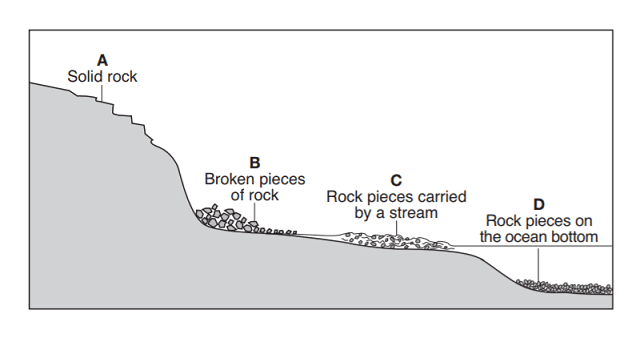
Erosion and deposition result from the interaction among air, water, and land.
• interaction between air and water breaks down earth materials;
• pieces of earth material may be moved by air, water, wind, and gravity;
• pieces of earth material will settle or deposit on land or in the water in different places;
• soil is composed of brokendown pieces of living and nonliving earth material
Matter has properties (color, hardness, odor, sound, taste, etc.) that can be observed through the senses.
Temperature can affect the state of matter of a substance.
The amount of change in the motion of an object is affected by friction.
Some materials transfer energy better than others (heat and electricity).
Humans utilize interactions between matter and energy.
• chemical to electrical, light, and heat: battery and bulb;
• electrical to sound (e.g. doorbell buzzer);
• mechanical to sound (e.g., musical instruments, clapping);
• light to electrical (e.g., solarpowered calculator)
Objects have properties that can be observed, described, and/or measured: length, width, volume, size, shape, mass or weight, temperature, texture, flexibility, reflectiveness of light.
Energy and matter interact: water is evaporated by the Sun’s heat; a bulb is lighted by means of electrical current; a musical instrument is played to produce sound; dark colors may absorb light, light colors may reflect light.
Mechanical energy may cause change in motion through the application of force and through the use of simple machines such as pulleys, levers, and inclined planes.
Plants and animals closely resemble their parents and other individuals in their species.
Senses can provide essential information (regarding danger, food, mates, etc.) to animals about their environment.
Growth is the process by which plants and animals increase in size.
Each plant has different structures that serve different functions in growth, survival, and reproduction.
• roots help support the plant and take in water and nutrients;
• leaves help plants utilize sunlight to make food for the plant;
• stems, stalks, trunks, and other similar structures provide support for the plant;
• some plants have flowers;
• flowers are reproductive structures of plants that produce fruit which contains seeds;
• seeds contain stored food that aids in germination and the growth of young plants
Each generation of animals goes through changes in form from young to adult. This completed sequence of changes in form is called a life cycle. Some insects change from egg to larva to pupa to adult.
Particular animal characteristics are influenced by changing environmental conditions including: fat storage in winter, coat thickness in winter, camouflage, shedding of fur.
Each kind of plant goes through its own stages of growth and development that may include seed, young plant, and mature plant.
Living things grow, take in nutrients, breathe, reproduce, eliminate waste, and die.
An organism’s external physical features can enable it to carry out life functions in its particular environment.
Each animal has different structures that serve different functions in growth, survival, and reproduction.
• wings, legs, or fins enable some animals to seek shelter and escape predators;
• the mouth, including teeth, jaws, and tongue, enables some animals to eat and drink;
• eyes, nose, ears, tongue, and skin of some animals enable the animals to sense their surroundings;
• claws, shells, spines, feathers, fur, scales, and color of body covering enable some animals to protect themselves from predators and other environmental conditions, or enable them to obtain food;
• some animals have parts that are used to produce sounds and smells to help the animal meet its needs;
• the characteristics of some animals change as seasonal conditions change (e.g., fur grows and is shed to help regulate body heat; body fat is a form of stored energy and it changes as the seasons change)
An organism’s pattern of behavior is related to the nature of that organism’s environment, including the kinds and numbers of other organisms present, the availability of food and other resources, and the physical characteristics of the environment.
Track each student's skills and progress in your Mastery dashboards