Divide up to four-digit dividends by one-digit divisors with answers written as whole-number quotients and remainders.
Solve word problems involving multiplication of a whole number by a fraction (denominators limited to 2, 3, 4, 5, 6, 8, 10, 12, and 100).
Add two fractions with respective denominators 10 and 100. Example: Express 3/10 as 30/100, and add 3/10 + 4/100 = 30/100 + 4/100 = 34/100.
Demonstrate an understanding that in a multi-digit whole number (through 1,000,000), a digit in one place represents ten times what it represents in the place to its right. Example: Recognize that in the number 770, the 7 in the hundreds place is ten times the 7 in the tens place.
Round multi-digit whole numbers (through 1,000,000) to any place.
Compare two multi-digit numbers through 1,000,000 based on meanings of the digits in each place, using >, =, and < symbols.
Add and subtract multi-digit whole numbers (limit sums and subtrahends up to and including 1,000,000).
Multiply a whole number of up to four digits by a one-digit whole number and multiply 2 two-digit numbers.
Compare two fractions with different numerators and different denominators (denominators limited to 2, 3, 4, 5, 6, 8, 10, 12, and 100) using the symbols >, =, or < and justify the conclusions.
Decompose a fraction or a mixed number into a sum of fractions with the same denominator (denominators limited to 2, 3, 4, 5, 6, 8, 10, 12, and 100), recording the decomposition by an equation. Justify decompositions (e.g., by using a visual fraction model). Example 1: 3/8 = 1/8 + 1/8 + 1/8 OR 3/8 = 1/8 + 2/8 Example 2: 2 1/12 = 1 + 1 + 1/12 = 12/12 + 12/12 + 1/12
Add and subtract mixed numbers with a common denominator (denominators limited to 2, 3, 4, 5, 6, 8, 10, 12, and 100; no regrouping with subtraction; fractions do not need to be simplified; and no improper fractions as the final answers).
Solve word problems involving addition and subtraction of fractions referring to the same whole or set and having like denominators (denominators limited to 2, 3, 4, 5, 6, 8, 10, 12, and 100).
Use decimal notation for fractions with denominators 10 or 100. Example: Rewrite 0.62 as 62/100 and vice versa.
Compare two decimals to hundredths using the symbols >, =, or <, and justify the conclusions.
Interpret a multiplication equation as a comparison. Represent verbal statements of multiplicative comparisons as multiplication equations. Example 1: Interpret 35 = 5 × 7 as a statement that 35 is 5 times as many as 7 and 7 times as many as 5. Example 2: Know that the statement 24 is 3 times as many as 8 can be represented by the equation 24 = 3 × 8 or 24 = 8 × 3.
Recognize, describe, extend, create, and replicate a variety of patterns.
Solve multi-step word problems posed with whole numbers using the four operations. Answers will be either whole numbers or have remainders that must be interpreted yielding a final answer that is a whole number. Represent these problems using equations with a symbol or letter standing for the unknown quantity.
Identify the missing symbol (+, –, ×, ÷, =, <, and >) that makes a number sentence true (single-digit divisor only).
Find all factor pairs for a whole number in the interval 1 through 100. Recognize that a whole number is a multiple of each of its factors. Determine whether a given whole number in the interval 1 through 100 is a multiple of a given onedigit number. Determine whether a given whole number in the interval 1 through 100 is prime or composite.
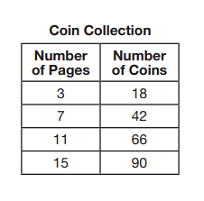
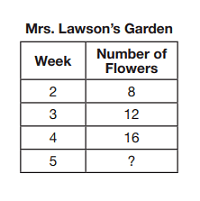
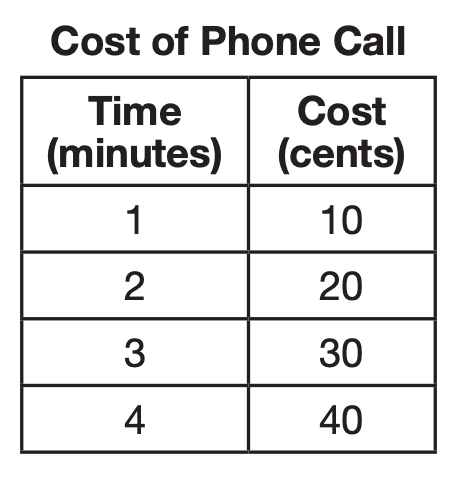
Determine the missing elements in a function table (limit to +, –, or × and to whole numbers or money).
Determine the rule for a function given a table (limit to +, –, or × and to whole numbers).
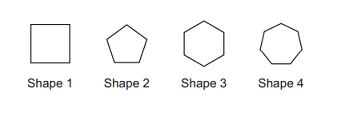
List properties, classify, draw, and identify geometric figures in two dimensions.
Classify two-dimensional figures based on the presence or absence of parallel or perpendicular lines or the presence or absence of angles of a specified size. Recognize right triangles as a category, and identify right triangles.
Recognize a line of symmetry for a twodimensional figure as a line across the figure such that the figure can be folded along the line into mirroring parts. Identify line-symmetric figures and draw lines of symmetry (up to two lines of symmetry).
Solve problems involving length, weight (mass), liquid volume, time, area, and perimeter.
Use the four operations to solve word problems involving distances, intervals of time (such as elapsed time), liquid volumes, masses of objects; money, including problems involving simple fractions or decimals; and problems that require expressing measurements given in a larger unit in terms of a smaller unit.
Identify time (analog or digital) as the amount of minutes before or after the hour. Example 1: 2:50 is the same as 10 minutes before 3:00. Example 2: Quarter past six is the same as 6:15.
Multiply a whole number by a unit fraction (denominators limited to 2, 3, 4, 5, 6, 8, 10, 12, and 100 and final answers do not need to be simplified or written as a mixed number). Example: 5 × (1/4) = 5/4
Solve problems involving addition and subtraction of fractions by using information presented in line plots (line plots must be labeled with common denominators, such as 1/4, 2/4, 3/4).
Make a line plot to display a data set of measurements in fractions of a unit (e.g., intervals of 1/2, 1/4, or 1/8).
Use appropriate tools and units to sketch an angle and determine angle measurements.
Solve addition and subtraction problems to find unknown angles on a diagram in real-world and mathematical problems. (Angles must be adjacent and non-overlapping.)
Track each student's skills and progress in your Mastery dashboards