Divide unit fractions by whole numbers and whole numbers by unit fractions.
Demonstrate an understanding that in a multi-digit number, a digit in one place represents 1/10 of what it represents in the place to its left. Example: Recognize that in the number 770, the 7 in the tens place is 1/10 the 7 in the hundreds place.
Compare two decimals to thousandths based on meanings of the digits in each place using >, =, and < symbols.
Add, subtract, multiply, and divide decimals to hundredths (no divisors with decimals).
Solve addition and subtraction problems involving fractions (straight computation or word problems)
Add and subtract fractions (including mixed numbers) with unlike denominators. (May include multiple methods and representations.) Example: 2/3 + 5/4 = 8/12 + 15/12 = 23/12
Solve multiplication and division problems involving fractions and whole numbers (straight computation or word problems).
Demonstrate an understanding of multiplication as scaling (resizing). Example 1: Comparing the size of a product to the size of one factor on the basis of the size of the other factor without performing the indicated multiplication. Example 2: Explaining why multiplying a given number by a fraction greater than 1 results in a product greater than the given number (recognizing multiplication by whole numbers greater than 1 as a familiar case); explaining why multiplying a given number by a fraction less than 1 results in a product smaller than the given number.
Analyze and complete calculations by applying the order of operations.
Write simple expressions that model calculations with numbers and interpret numerical expressions without evaluating them. Example 1: Express the calculation “add 8 and 7, then multiply by 2” as 2 × (8 + 7). Example 2: Recognize that 3 × (18,932 + 921) is three times as large as 18,932 + 921 without having to calculate the indicated sum or product
Create, extend, and analyze patterns.
Apply the formulas V = l × w × h and V = B × h for rectangular prisms to find volumes of right rectangular prisms with whole-number edge lengths in the context of solving real-world and mathematical problems. Formulas will be provided.
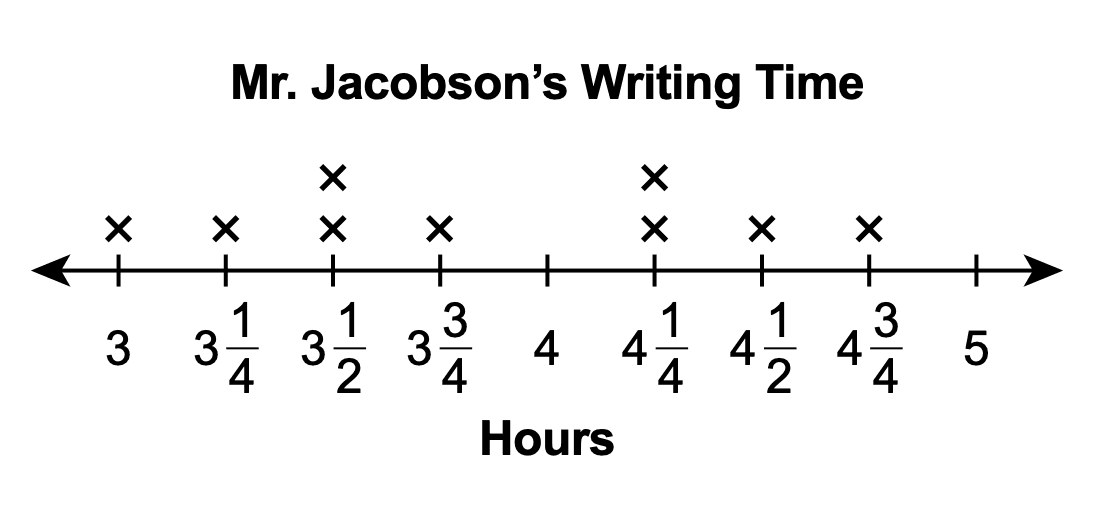
Solve problems involving computation of fractions by using information presented in line plots.
Display and interpret data shown in tallies, tables, charts, pictographs, bar graphs, and line graphs, and use a title, appropriate scale, and labels. A grid will be provided to display data on bar graphs or line graphs.
Use, describe, and develop procedures to solve problems involving volume.
Track each student's skills and progress in your Mastery dashboards