Interpret and compute quotients of fractions (including mixed numbers), and solve word problems involving division of fractions by fractions. Example 1: Given a story context for (2/3) ÷ (3/4), explain that (2/3) ÷ (3/4) = 8/9 because 3/4 of 8/9 is 2/3. (In general, (a/b) ÷ (c/d) = (a/b) × (d/c) = ad/bc.) Example 2: How wide is a rectangular strip of land with length 3/4 mi and area 1/2 square mi? Example 3: How many 2 1/4-foot pieces can be cut from a 15 1/2-foot board?
Apply the distributive property to express a sum of two whole numbers, 1 through 100, with a common factor as a multiple of a sum of two whole numbers with no common factor. Example: Express 36 + 8 as 4(9 + 2).
Represent quantities in real-world contexts using positive and negative numbers, explaining the meaning of 0 in each situation (e.g., temperature above/below zero, elevation above/below sea level, credits/debits, positive/negative electric charge).
Locate and plot integers and other rational numbers on a horizontal or vertical number line; locate and plot pairs of integers and other rational numbers on a coordinate plane.
Write, interpret, and explain statements of order for rational numbers in real-world contexts. Example: Write – 3°C > – 7°C to express the fact that – 3°C is warmer than – 7°C.
Find the unit rate a/b associated with a ratio a:b (with b ≠ 0) and use rate language in the context of a ratio relationship. Example 1: “This recipe has a ratio of 3 cups of flour to 4 cups of sugar, so there is 3/4 cup of flour for each cup of sugar.” Example 2: “We paid $75 for 15 hamburgers, which is a rate of $5 per hamburger.”
Identify parts of an expression using mathematical terms (e.g., sum, term, product, factor, quotient, coefficient, quantity). Example: Describe the expression 2(8 + 7) as a product of two factors.
Solve unit rate problems including those involving unit pricing and constant speed. Example: If it took 7 hours to mow 4 lawns, then at that rate, how many lawns could be mowed in 35 hours? At what rate were lawns being mowed?
Analyze the relationship between the dependent and independent variables using graphs and tables and/or relate these to an equation.
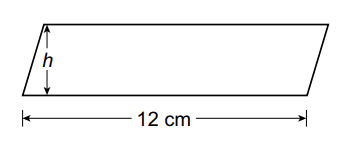
Determine the area of triangles and special quadrilaterals (i.e., square, rectangle, parallelogram, rhombus, and trapezoid). Formulas will be provided.
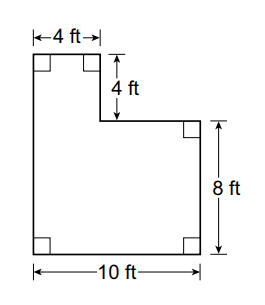
Determine the area of irregular or compound polygons. Example: Find the area of a room in the shape of an irregular polygon by composing and/or decomposing.
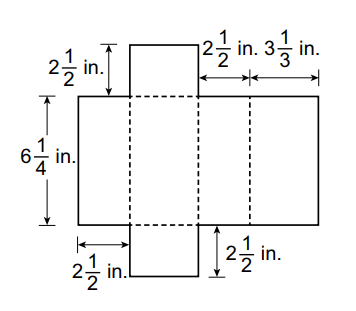
Represent three-dimensional figures using nets made of rectangles and triangles.
Display, analyze, and summarize numerical data sets in relation to their context.
Display numerical data in plots on a number line, including line plots, histograms, and box-andwhisker plots.
Determine quantitative measures of center (e.g., median, mean, mode) and variability (e.g., range, interquartile range, mean absolute deviation).
Relate the choice of measures of center and variability to the shape of the data distribution and the context in which the data were gathered.
Track each student's skills and progress in your Mastery dashboards