Loading...

Quarter II: Quiz 1 on Microscopy
Quiz by Pricelo Jr. Pausanos
Track each student's skills and progress in your Mastery dashboards
What optical instrument that can help you see objects and living organisms that are too small to be seen by the naked eye?
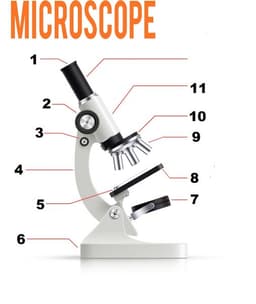
Darwin has prepared specimen on onion cells to observe its internal structure. Which two parts of the microscope will he use to magnify the image of his specimen?
An animal cell being observed is seen at the topmost part of the field of view under the Low Power Objective (LPO). If you want to position the specimen at the center, to which direction should you move the slide?
Which part will you adjust if the onion cell you are observing under the HPO is not clear?
Which part of the microscope has holders for the different objective lenses and allows the rotation of the lenses while viewing?
When lifting or moving the microscope, which part will you use?
Which of the following is used to hold the glass slide in place and prevent it from moving?
Match the parts of the microscope in Column A with its functions in Column B.
What is the position of the letter “e” as seen under the Low Power Objective (LPO)?
Which of the following statements describes how to focus a specimen under the compound microscope?
A plant cell is viewed using 10x Eyepiece magnification and 40x High Power Objective (HPO). How many times will it be magnified?
Which of the following refers to the bright circle of light when viewing a specimen through the eyepiece?
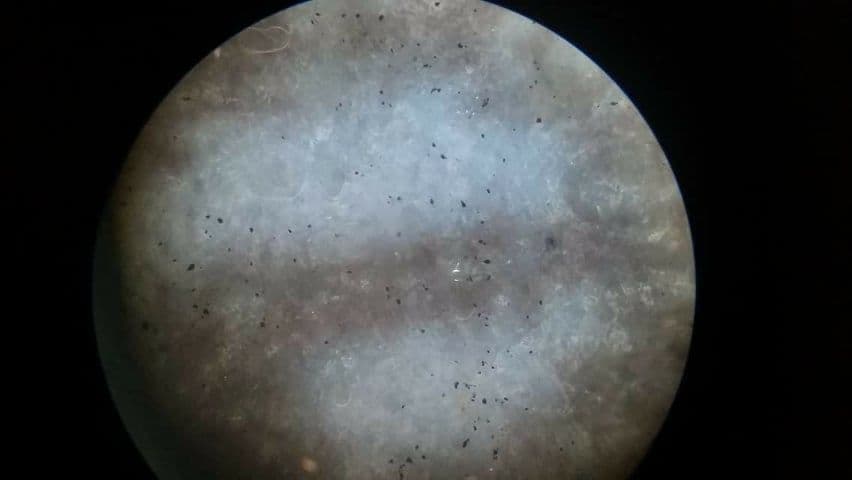
The optics of a microscope’s lenses change the orientation of the image that the observer sees. When light shines on the specimen at the bottom, it travels through or reflects off the surface, passing up through the lenses of the objectives into the eyepiece. The lenses are convex, thus light that goes through a specimen is focused and therefore magnified.
Match the parts of the microscope in Column A with its functions in Column B.
Match the parts of the microscope in Column A with its functions in Column B.
Match the parts of the microscope in Column A with its functions in Column B.
