Loading...


Spectra, Valence Electrons, and Quantum Numbers Review
Quiz by Kelli Hornberger
Track each student's skills and progress in your Mastery dashboards
How many valence electrons does aluminum (Al) have available for bonding?
Which set of numbers gives the correct possible values of ml for l = 1?
What does the angular momentum quantum number tell you?
Which set of numbers gives the correct possible values of l for n = 2?
Which element would most likely have chemical properties similar to that of fluorine (F)?
In certain conditions, hydrogen gas produces the emission spectra shown. What causes the bright lines seen in the spectra?
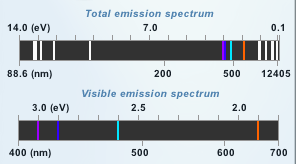
Which statement is part of Bohr's atomic model?
Which transition by an electron will release the greatest amount of energy?

Which best explains what happens when an electron moves from an excited state to the ground state?
What causes the appearance of lines in an emission spectrum?
An absorption spectrum of oxygen is shown. What is most likely the emission spectrum of oxygen?

A Lewis dot structure for this atom has five electrons around the symbol. Which of the following could be the atom?
Beryllium has 4 valence electrons.
Bromine, atomic number 35, belongs to Group 17. How many electrons does bromine have in its outermost energy level?
How many electrons total are found in the f orbital?
How many orbitals are available to hold electrons in the 4th energy level (n = 4)?
For a principal quantum number, "n", equal to 2, what is the total electron capacity of that level?
What is the correct representation for an orbital which has an "n" value of 4 and an "L" value of 2?
Which of the following sublevels does not exist?
What quantum number describes the energy level of an orbital?
Which set of quantum numbers is not allowed?
With each higher energy level, the electrons are
The proper pair of the L value with the orbital shape.
Which values can n be?
The principal quantum number, n, represents the