The student applies mathematical process standards to select appropriate customary and metric units, strategies, and tools to solve problems involving measurement. The student is expected to:
Solve problems that deal with measurements of length, intervals of time, liquid volumes, mass, and money using addition, subtraction, multiplication, or division as appropriate.
The student applies mathematical process standards to solve problems by collecting, organizing, displaying, and interpreting data. The student is expected to:
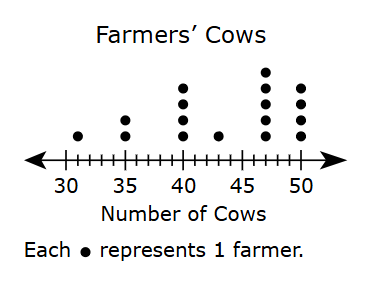
Represent data on a frequency table, dot plot, or stem-and-leaf plot marked with whole numbers and fractions; and
The student applies mathematical process standards to develop and use strategies and methods for whole number computations and decimal sums and differences in order to solve problems with efficiency and accuracy. The student is expected to:
Determine products of a number and 10 or 100 using properties of operations and place value understandings;
The student applies mathematical process standards to solve problems involving angles less than or equal to 180 degrees. The student is expected to:
Determine the approximate measures of angles in degrees to the nearest whole number using a protractor;
The student applies mathematical process standards to represent, compare, and order whole numbers and decimals and understand relationships related to place value. The student is expected to:
Represent the value of the digit in whole numbers through 1,000,000,000 and decimals to the hundredths using expanded notation and numerals;
The student applies mathematical process standards to analyze geometric attributes in order to develop generalizations about their properties. The student is expected to:
Classify two-dimensional figures based on the presence or absence of parallel or perpendicular lines or the presence or absence of angles of a specified size.
The student applies mathematical process standards to develop and use strategies and methods for whole number computations and decimal sums and differences in order to solve problems with efficiency and accuracy. The student is expected to:
Solve with fluency one- and two-step problems involving multiplication and division, including interpreting remainders.
The student applies mathematical process standards to analyze geometric attributes in order to develop generalizations about their properties. The student is expected to:
Identify and draw one or more lines of symmetry, if they exist, for a two-dimensional figure;
The student applies mathematical process standards to solve problems by collecting, organizing, displaying, and interpreting data. The student is expected to:
Solve one- and two-step problems using data in whole number, decimal, and fraction form in a frequency table, dot plot, or stem-and-leaf plot.
The student applies mathematical process standards to represent and generate fractions to solve problems. The student is expected to:
Determine if two given fractions are equivalent using a variety of methods;
The student applies mathematical process standards to develop concepts of expressions and equations. The student is expected to:
Represent multi-step problems involving the four operations with whole numbers using strip diagrams and equations with a letter standing for the unknown quantity;
The student applies mathematical process standards to represent, compare, and order whole numbers and decimals and understand relationships related to place value. The student is expected to:
Relate decimals to fractions that name tenths and hundredths; and
The student applies mathematical process standards to represent and generate fractions to solve problems. The student is expected to:
Compare two fractions with different numerators and different denominators and represent the comparison using the symbols >, =, or <;
The student applies mathematical process standards to develop concepts of expressions and equations. The student is expected to:
Represent problems using an input-output table and numerical expressions to generate a number pattern that follows a given rule representing the relationship of the values in the resulting sequence and their position in the sequence;
The student applies mathematical process standards to represent and generate fractions to solve problems. The student is expected to:
Represent fractions and decimals to the tenths or hundredths as distances from zero on a number line.
The student applies mathematical process standards to develop concepts of expressions and equations. The student is expected to:
Solve problems related to perimeter and area of rectangles where dimensions are whole numbers.
The student applies mathematical process standards to develop and use strategies and methods for whole number computations and decimal sums and differences in order to solve problems with efficiency and accuracy. The student is expected to:
Add and subtract whole numbers and decimals to the hundredths place using the standard algorithm;
The student applies mathematical process standards to represent, compare, and order whole numbers and decimals and understand relationships related to place value. The student is expected to:
Interpret the value of each place-value position as 10 times the position to the right and as one-tenth of the value of the place to its left;
The student applies mathematical process standards to select appropriate customary and metric units, strategies, and tools to solve problems involving measurement. The student is expected to:
Convert measurements within the same measurement system, customary or metric, from a smaller unit into a larger unit or a larger unit into a smaller unit when given other equivalent measures represented in a table; and
The student applies mathematical process standards to select appropriate customary and metric units, strategies, and tools to solve problems involving measurement. The student is expected to:
Identify relative sizes of measurement units within the customary and metric systems;
The student applies mathematical process standards to represent and generate fractions to solve problems. The student is expected to:
Evaluate the reasonableness of sums and differences of fractions using benchmark fractions 0, 1/4, 1/2, 3/4, and 1, referring to the same whole; and
The student applies mathematical process standards to represent and generate fractions to solve problems. The student is expected to:
Represent and solve addition and subtraction of fractions with equal denominators using objects and pictorial models that build to the number line and properties of operations;
The student applies mathematical process standards to manage one's financial resources effectively for lifetime financial security. The student is expected to:
Distinguish between fixed and variable expenses;
The student applies mathematical process standards to develop and use strategies and methods for whole number computations and decimal sums and differences in order to solve problems with efficiency and accuracy. The student is expected to:
Represent the quotient of up to a four-digit whole number divided by a one-digit whole number using arrays, area models, or equations;
The student applies mathematical process standards to develop and use strategies and methods for whole number computations and decimal sums and differences in order to solve problems with efficiency and accuracy. The student is expected to:
Use strategies and algorithms, including the standard algorithm, to multiply up to a fourdigit number by a one-digit number and to multiply a two-digit number by a two-digit number. Strategies may include mental math, partial products, and the commutative, associative, and distributive properties;
Track each student's skills and progress in your Mastery dashboards