Loading...


SUMMATIVE TEST for Wk 5- 6 (S8-MT-IIIe-f-10)
Quiz by Kim Dela Cruz
Track each student's skills and progress in your Mastery dashboards
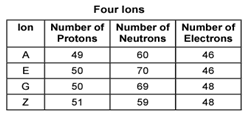
Which ion has the greatest mass?
A. A
D. Z
B. E
C. G
Which phrase describes the different isotopes of an element?
Which ion has the greatest mass?

Which statement describes two different isotopes of carbon?
Which element is listed with the number of protons in each of its atoms?
potassium atom has a mass number of 37. What is the number of neutrons in this atom?
Which phrase describes the different isotopes of an element?
Magnesium (Mg) has a mass number of 24 and contains 12 protons. How many neutrons are present in the atom of magnesium?
An atom of boron (B) has 5 protons and 6 neutrons. What is the mass number of this atom?
A chlorine (Cl) has 17 protons and 18 neutrons. What is the mass number of chlorine?
An atom of phosphorus has an atomic number of 15 and a mass number of 31. How many neutrons does it contain?
An atom of sodium has an atomic number of 11 and a mass number of 23. Which of the following statements is correct?
Below is a list of elements with their mass number and number of protons. Match each element with the correct number of neutrons. Click the data on the left to the correct number of neutrons on the right.
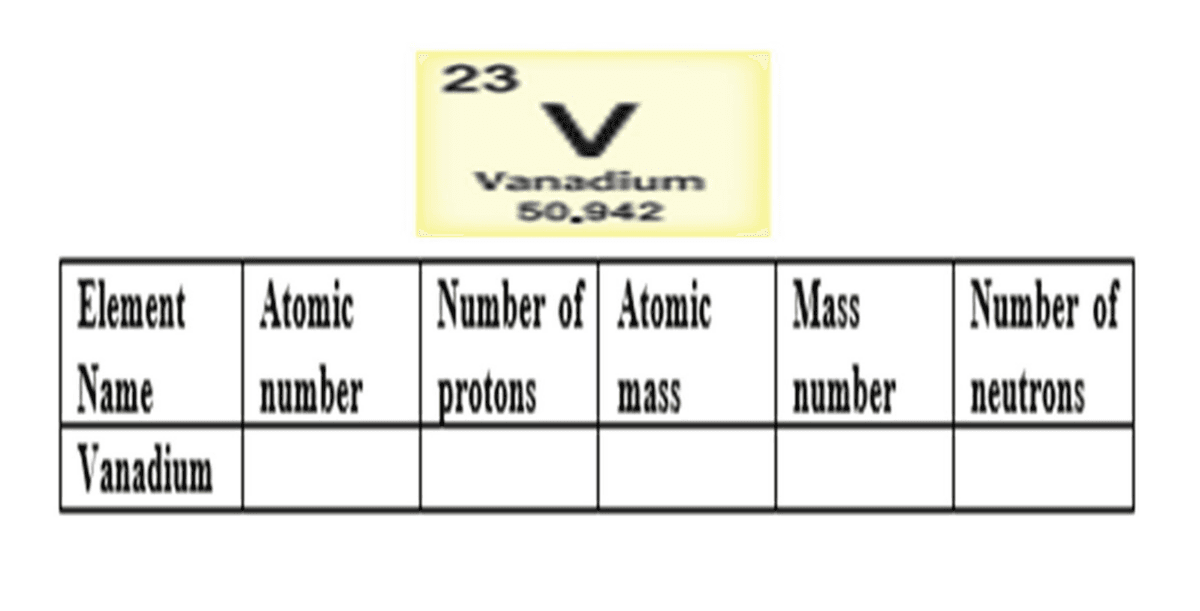
Using the Periodic Table of elements, specify the atomic number, number of protons, atomic mass, mass number and number of neutrons of vanadium. Arrange your answers according to the sequence of column in the table given below (from left to right)
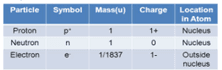
Which subatomic particle has no charge?
Which subatomic particle would be attracted to a positively charged metallic plate?
Which is true about the table at the right?
Given the diagram of helium atom with its particles, which will have the least mass?

Group each subatomic particle to its correct charge and location within the atom.
An atom is said have a neutral charge if it contains the same number of what two particles?
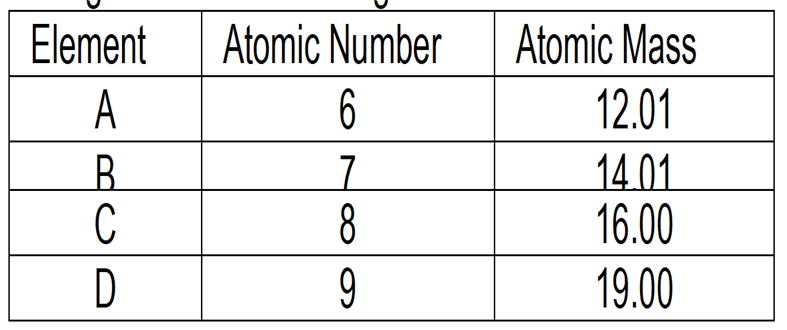
Scenario: You are given a table showing the atomic number and atomic mass of four elements:
Question 1: Which element has the most protons in its nucleus?
Question 2: If you were to compare the sizes of atoms of these elements, which element would
you expect to be the smallest?