Identify the basic characteristics of organisms, including prokaryotic or eukaryotic, unicellular or multicellular, autotrophic or heterotrophic, and mode of reproduction, that further classify them in the currently recognized kingdoms;
Track each student's skills and progress in your Mastery dashboards
Give this quiz to my class
Q 1/12
Score 0
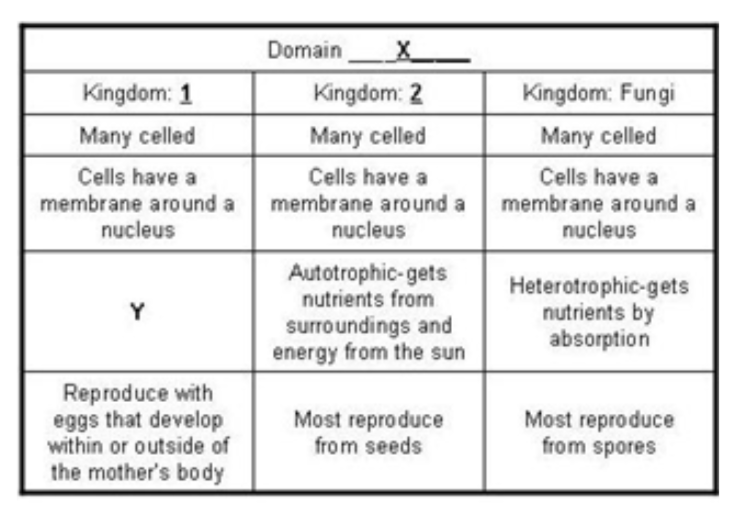
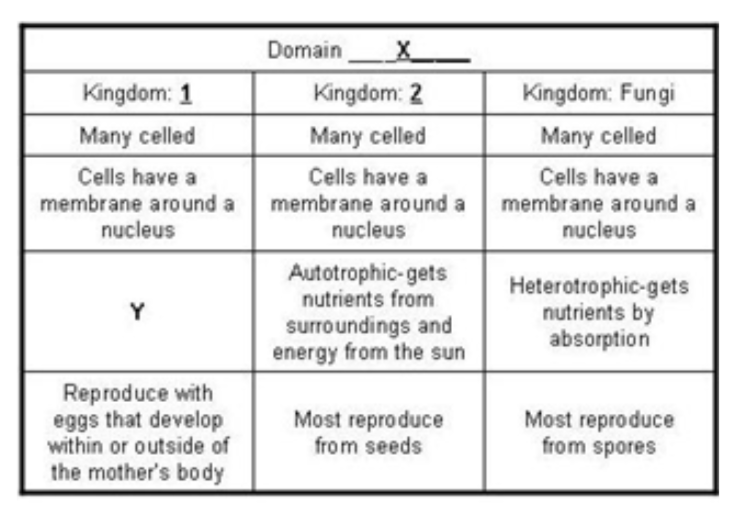
Characteristics of Kingdom 2 are most related to:
30
Kingdom Plantae
Kingdom Protista
Kingdom Animalia
None of the above
Q 2/12
Score 0
According to the table, the greatest difference between Kingdom 1 and Kingdom 2 is
30
Kingdom 2 has membrane nucleus
Kingdom 2 get nutrients by absorption.
Kingdom 1 reproduces by seeds
Kingdom 2 gets nutrients from its surroundings and the sun
12 questions
Q.
Characteristics of Kingdom 2 are most related to:
1
30 sec
6.12d
Q.
According to the table, the greatest difference between Kingdom 1 and Kingdom 2 is
2
30 sec
6.12d
Q.
3
30 sec
6.12d
Q.
Based on the following characteristics, what kingdom would you classify the organism below?
Eukaryotic
Autotrophic
Unicellular
Asexual Reproduction
4
30 sec
6.12d
Q.
Examine the choices in the illustration. Which characteristics would correctly match C?
5
30 sec
6.12d
Q.
Kelly went for a nature walk in a wooded area. They identified an organism with a flat, shell-like shape that was attached to a dead log from which it obtained its nourishment. Which kingdom should she classify the organism under?
6
30 sec
6.12d
Q.
True or False - Autotrophic organisms use nutrients and other animals to get their nourishment.
7
30 sec
6.12d
Q.
Based on the characteristics, what kingdom would you classify the organism below?
Prokaryotic
Autotrophic
Unicellular
Asexual Reproduction
Normal Environment
8
30 sec
6.12d
Q.
According to the diagram the organisms: Alfalfa
Dog
Rose bush
Mosquito
Wheat
Hamster
Oak Tree are all apart of what kingdom?
9
30 sec
6.12d
Q.
How many kingdoms are used to classify organisms?
10
30 sec
6.12d
Q.
Which kingdom has the oldest and most primitive organisms in nature?
11
30 sec
6.12d
Q.
Students collected the above samples on a trip to a pond. After examining them under the microscope they decided to classify them as.......