TEKS Grade 8 Science - 8.11 Diagnostic - Organisms
Quiz by Grade 8 Science - Texas Education Agency
Grade 8
Science (2017)
Texas Essential Knowledge and Skills (TEKS)
Feel free to use or edit a copy
includes Teacher and Student dashboards
Measures 3 skills from
With a free account, teachers can
- edit the questions
- save a copy for later
- start a class game
- automatically assign follow-up activities based on students’ scores
- assign as homework
- share a link with colleagues
- print as a bubble sheet
10 questions
Show answers
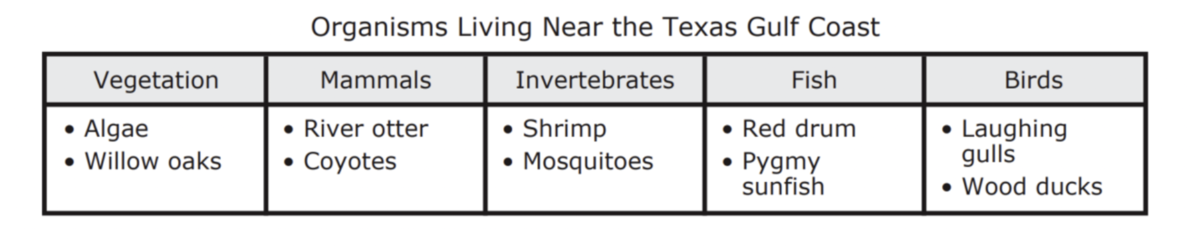
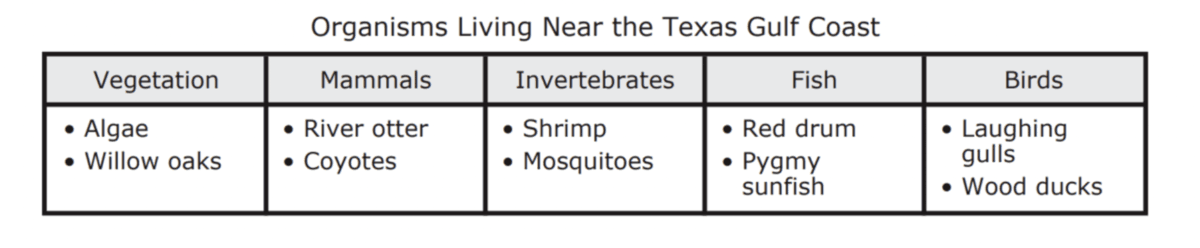
- Q1The chart lists organisms in five different categories living near the Texas Gulf Coast. Based on the chart, which food chain best models a flow of energy in this ecosystem?Sun ⟶ Pygmy sunfish⟶ Shrimp⟶ Wood ducksSun⟶ Willow oaks⟶ Algae ⟶ River ottersSun ⟶ Mosquitoes ⟶ Shrimp⟶ CoyotesSun⟶ Algae⟶ Shrimp⟶ Red drum30s8.11a
- Q2Wild hogs introduced to Texas from Europe became feral after the hogs escaped from the ranches where they lived. Feral hogs are omnivores that feed on native plants, crops, and small animals. Feral hogs can damage an ecosystem by rooting through the soil to look for food and trampling small plants. Which types of native organisms do feral hogs most likely compete with for food sources?Decomposers and herbivoresCarnivores and producersProducers and decomposersHerbivores and carnivores30s8.11a
- Q3Giant salvinia is an aquatic plant that floats on water and reproduces rapidly. When these plants die, decomposition by bacteria affects oxygen levels in the water. As more plants die, less oxygen is available in the water. Students observe a pond covered by giant salvinia. Which statement is the best prediction the students can make about the immediate future of the pond?"The amount of bacteria in the pond will suddenly decrease.The number of different types of plants around the pond will increase.The depth of the water in the pond will increase.Fish populations in the pond will begin to decrease.30s8.11a
- Q4Researchers are studying lichens growing on trees in a forest ecosystem. At the beginning of the study, the researchers identified twelve lichen species in the forest. Later, a forest fire happened in the study area. The researchers returned to the area and found only six lichen species. Which inference is best supported from the researchers’ observations?The biodiversity in a forest increases after a fire.Forest fires will permanently remove certain species from the ecosystem.Certain lichen species are better adapted to survive forest fires than others.Most lichen species are unaffected by forest fire.30s8.11b
- Q5An environmental change drastically reduced the population of milkweed plants in an area. The milkweed plants provided the only source of food for a nearby population of monarch butterfly caterpillars. Which statement describes the most likely effect of this environmental change on this population of monarch butterflies?The number of monarch butterflies will increase because their reproduction rate will increase to ensure some individuals survive.The number of monarch butterflies will stay the same because their caterpillars will begin consuming nectar from different types of flowers.The number of monarch butterflies will stay the same because butterflies reproduce so rapidly their populations can withstand most food shortages.The number of monarch butterflies will decrease because their caterpillars will not have enough food.30s8.11b
- Q6A student observes several species of plants growing in a drainage ditch. Some species have short roots, while others have long roots. During periods of heavy rain, the ditch fills with fast-moving water, which uproots more plants that have short roots than long roots. Which short-term effect will most likely result from a year with more heavy rain than normal?Most plants in the ditch will be plants with short roots.There will be no change in the numbers of plants with long roots and short roots.Most plants in the ditch will be plants with long roots.There will be an equal number of plants in the ditch with long roots and short roots.30s8.11b
- Q7Which of these human activities is most likely to cause the excessive growth of phytoplankton in the world’s oceans?The logging of old-growth forests, which results in erosionThe mining of fossil fuels, which requires digging underground tunnelsThe spraying of chemical herbicides that reduce carbon dioxide in the airThe use of chemical fertilizers that are carried by runoff into rivers30s8.11c
- Q8A coastal area that once supported a thriving fishing industry is overfished. The number of species found living in the marine ecosystem decreases. Which of these activities is most likely to increase the natural biodiversity in the area?Building artificial reefs and limiting fishing activityBuilding artificial reefs and increasing fishing activityIntroducing non-native species to fill unoccupied habitats and banning fishingEliminating non-native species and encouraging fishing for large predatory fish30s8.11c
- Q9Which is a way that human activities on land can affect ocean systemsRunoff from farms can wash pesticides into rivers that empty into the oceanOverfishing can reduce the populations of ocean fishOil released during ocean-floor drilling can wash up on shoreA volcanic eruption reduces the amount of sunlight that reaches ocean producers.30s8.11c
- Q10Black walnut trees produce a nontoxic chemical that becomes highly toxic when it is exposed to air or soil. How does this chemical help black walnut trees compete with plants growing nearby?By attracting herbivores to the other plantsBy suppressing the growth of the other plantsBy limiting the amount of water available to the other plantsBy increasing the photosynthesis rates in the other plants30s8.11a