Loading...

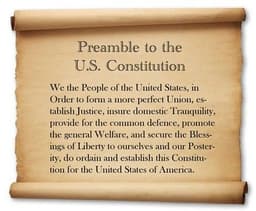
The Preamble to the U.S. Constitution
Quiz by Patricia Walsh
Customize this quiz to suit your class
Instantly translate to 100+ languages
Tag the questions with any skills you have. Your dashboard will track each student's mastery of each skill.
Give this quiz to my class
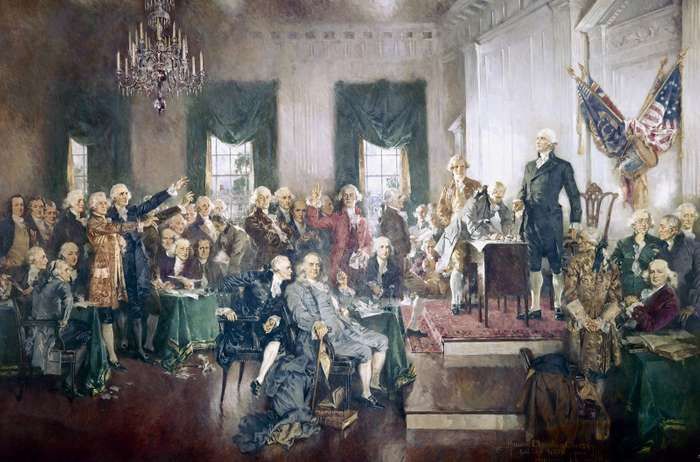
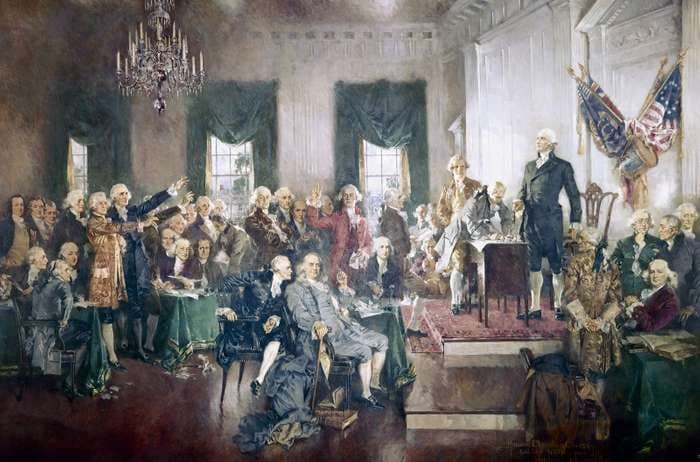
 Unit 4: Preamble to the U.S. ConstitutionDemocratic Constitution in South Africa Struggle against Apartheid • Apartheid was the name of a system of racial discrimination unique to South Africa. • This system was particularly oppressive for the blacks. → They were forbidden from living in white areas. • Since 1950, the blacks, coloured and Indians fought against the apartheid system. • The African National Congress (ANC) was the umbrella organisation that led the struggle against the policies of segregation. • In 1964, Nelson Mandela and seven other leaders were sentenced to life imprisonment in 1964 for daring to oppose the apartheid regime in his country. Towards a New Constitution • As protests and struggles against apartheid had increased, the white regime changed its policies. • After 28 years of imprisonment, Nelson Mandela released from jail. • At the midnight of 26 April 1994, democracy was adopted as a form of government in South Africa. • After two years, a constitution came out which gave to its citizens the most extensive rights available in any country. Why do we need a Constitution? • A constitution is necessary because: → It generates a degree of trust and coordination that is necessary for different kind of people to live together. → It specifies how the government will be constituted, who will have power to take which decisions. → It lays down limits on the powers of the government and tells us what the rights of the citizens are. → It expresses the aspirations of the people about creating a good society. Making of the Indian Constitution • In 1928, Motilal Nehru and eight other Congress leaders drafted a constitution for India. • In 1931, the resolution at the Karachi session of the Indian National Congress dwelt on how independent India’s constitution should look like. • Factors contributed to the making of our Constitution. → Ideals of French Revolution → The practice of parliamentary democracy in Britain → The Bill of Rights in the US → The socialist revolution in Russia The Constituent Assembly • In July 1946, Elections to the Constituent Assembly were held. → The drafting of the document called the constitution was done Constituent Assembly. → Dr. Rajendra Prasad was the Chairman of the Constituent Assembly. → In December 1946, the first meeting was held. • After the country was divided into India and Pakistan, the Constituent Assembly also got divided. • The Assembly adopted the Constitution on 26 November 1949 but it came into effect on 26 January 1950. • To mark this day we celebrate January 26 as Republic Day every year. • The Constituent Assembly worked in a systematic, open and consensual manner. → First some basic principles were decided and agreed upon. → Then a Drafting Committee chaired by Dr. B.R. Ambedkar prepared a draft constitution for discussion. → More than two thousand amendments were considered. Philosophy of the Constitution • The Constitution begins with a short statement of its basic values which is called the Preamble to the constitution. The preamble focuses on: → Justice, social, economic and political. → Liberty of thoughts, expression, belief, faith and worship. → Equality of status and of opportunity. → Fraternity assuring the dignity of the individual and the unity and integrity of the nation. What is the concept of popular sovereignty? The idea that the government’s authority comes from the people -- a key idea mentioned in the Preamble of the Constitution What were some of the goals outlined in the Preamble of the Constitution? “To form a more perfect Union” -- wanted states to cooperate with one another and have a strong relationship between the states and the national government “To establish justice” -- wanted to be ruled by laws, not by the might of soldiers or the decisions of kings; wanted laws to apply to everyone “To insure domestic tranquility” -- government’s job to keep peace and maintain order within the country “Provide for the common defense” -- national government responsible for protecting the nation against foreign enemies “To promote the general Welfare” -- government could support an economy and a society in which people could prosper “Secure the Blessings of Liberty to ourselves and our Posterity” -- government would protect the freedoms gained in the American Revolution and preserve them for future Americans as wellThe PreambleInterpret the intentions of the Preamble of the ConstitutionUnit 3: The Preamble & Articles 1, 2 and 31.6 Intentions of the PreamblePREAMBLE OF THE INDIAN CONSTITUTION