Loading...


Third Quarter Science 8 Pretest
Quiz by Rhodalia Salamat
Track each student's skills and progress in your Mastery dashboards
Matter is anything that occupies space and has mass. All of the following choices are considered matter EXCEPT:
Property of matter that depends on the amount is called Extensive Property, Which of the following pairs is considered extensive property?
Based on the arrangement of its particles, which illustration above represents liquid?

Illustration I has closely packed particles, has definite shape and volume. What state of matter does it represent?
Which change can be easily be reversed?
Jolene wants to experiment with sugar cubes. Which of the following causes a sugar cube to only change physically, not chemically?
Which of the following situation/s is a/an example/s of physical change?

Which of the following statements best describes the picture? Which of the following statements best describes the picture?

What kind of phase change takes place in the picture?

During the month of June-November tropical cyclone is frequent to happen s recorded by PAGASA because this is the time of the year when water from the ocean _______ due to the high temperature of the surroundings.
Which part of the figures shows water molecules being heated up by the environment causing it to change to a gaseous state?
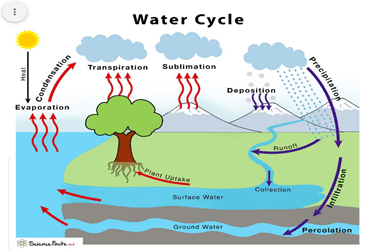
Which part of the figure changes the water vapor back to the liquid phase?
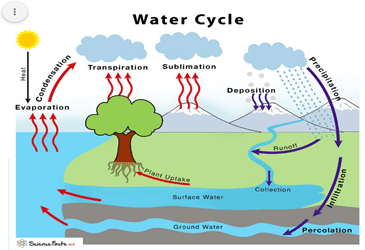
A chemical change is different than a physical change because in a chemical change _______.
When a new substance is formed with different properties than the original substance it is called a ____________.
A chemical change ____________.
When silver metal comes in contact with sulfur, silver sulfide forms and the silver appears darker. What exactly does it imply? _________________.
In a chemical reaction _________________.
Which of the following is an example of a chemical change?
Which of the following is NOT an example of an atom?
How many molecules comprise methane (CH4)?
Who among the scientists discovered the electron?
Through the alpha particles scattering experiment, Rutherford's team conceptualized a model of an atom called _____________.
What is the charge of an electron?
Which subatomic particle has a positive charge?
Which subatomic particles is located outside the nucleus?
In a positive ion (Cation), there are __________ electrons __________ protons.
How many electrons of oxygen (O-2) have if its atomic number is 8?
An atom of lithium has 3 protons, 3 neutrons, and 3 electrons. Which set of subatomic particles will represent an isotope of lithium?
Calcium has atomic number of 20. A neutral calcium atom has an electronic configuration of _________________.
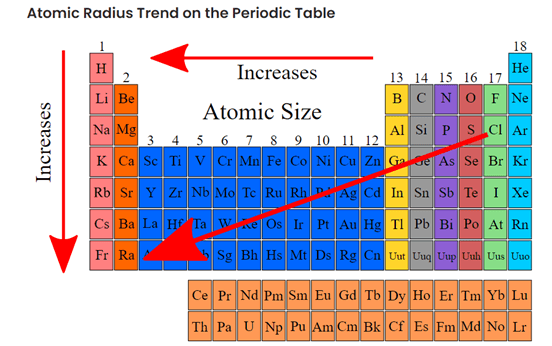
Arrange the following elements according to their decreasing atomic radius. Refer to the given Periodic Table.
I. Mg II.Ca III. Sr IV. Ba