Loading...

Track each student's skills and progress in your Mastery dashboards
It's cold outside and you begin to rub your hands together to get yourself warm. What energy transformations occur? Select all that apply.
Which type of energy transformation occurs when a flashlight shines?
Given three spoons: wood, metal, and plastic. What would be the order the spoons would heat the fastest?
Sort the events according to the type of thermal energy it BEST represents.
Convection is a means of heat transfer that involves fluids, such as liquids or gasses. The process of convection is responsible for air and water currents as in the illustration. As the temperature of fluids increases their molecular motion increases, therefore as fluids warm their density decreases.
A classroom demonstration of convection involves placing a small covered container filled with warm water to which food coloring has been added into a large container of cold water. Based on the information in the prompt, select the THREE observations that would be expected in this demonstration.

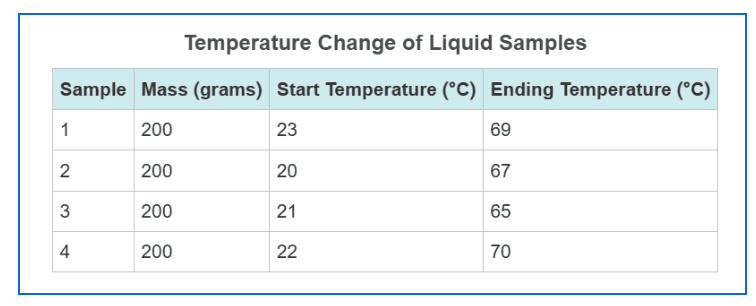
Mr. Harris assigned his class the task to identify and order unknown liquids by their specific heat. Four liquids are heated at the same temperature setting for ten minutes. The temperature change of each sample is recorded in the table above. Order the unknown liquid samples by specific heat from LOWEST to HIGHEST.
An iron ball and an aluminum ball of mass 100 g each are heated to the same temperature and then cooled to a temperature of 20°C. The heat lost by the iron ball is 3.6 kJ. The heat lost by the aluminum ball is 7.2 kJ. What does this imply?
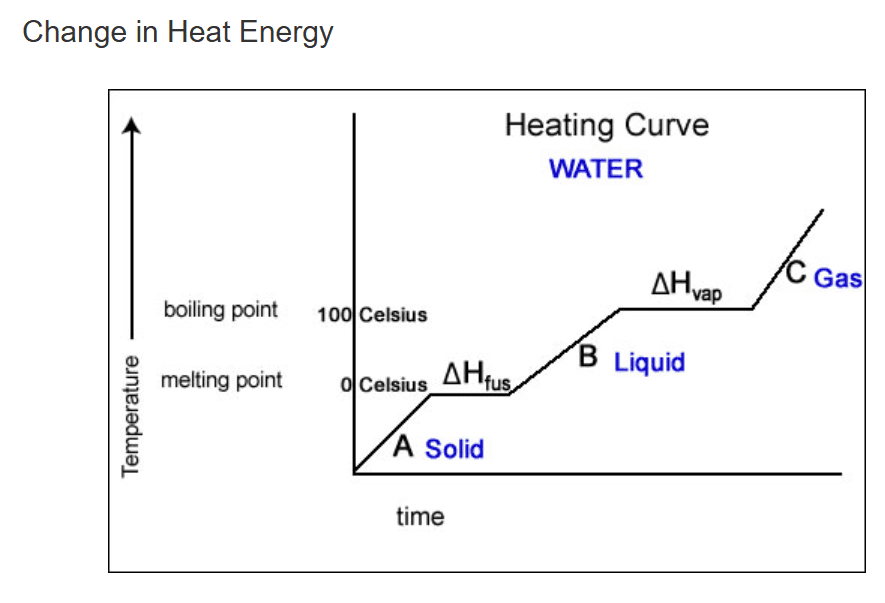
Review the heating curve of water. Solid → liquid → gas. In order for these changes to occur, what must happen?

Consider the heating curve of water seen here. Compare and contrast the change from ice to liquid with that of liquid to gas, as represented by the graph. All BUT ONE statement is true.
Listed in the Item Bank are key terms and expressions, each of which is associated with one of the columns. Some terms may display additional information when you click on them. Drag and drop each item into the correct column.
A student is given a red and a blue liquid. The two samples of liquids are heated in identical beakers over identical Bunsen burners. The red liquid shows a dramatically faster increase in temperature. Which of these is the most likely explanation for this?
A student needs help completing an energy transfer diagram for a ceiling fan. Which BEST fills in the blanks labeled M and N to describe the transfer of energy?


