
A Ghostly New Creature Paired Text
Quiz by Sharon Rhoads
Feel free to use or edit a copy
includes Teacher and Student dashboards
Measure skillsfrom any curriculum
Tag the questions with any skills you have. Your dashboard will track each student's mastery of each skill.
- edit the questions
- save a copy for later
- start a class game
- automatically assign follow-up activities based on students’ scores
- assign as homework
- share a link with colleagues
- print as a bubble sheet
- Q1
Based on paragraphs 4 and 5 of the selection "A Ghostly New Creature," what can be concluded about the study of newly discovered animals?
Most animal research is conducted by government agencies.
Scientists are searching constantly for unknown types of animals.
Studying ocean animals is easier than studying land animals.
Identifying a new species requires careful analysis of an animal.
30s - Q2
In "Ghostly New Creatures," the author includes the photograph of the octopod most likely to help the reader better understand --
why the octopod lives so deep in the ocean
how far the octopod can move without having fins
why scientists named the octopod after a cartoon character
how the octopod uses its suckers to grasp objects
30s - Q3
What is the best summary of "Ghostly New Creatures"?
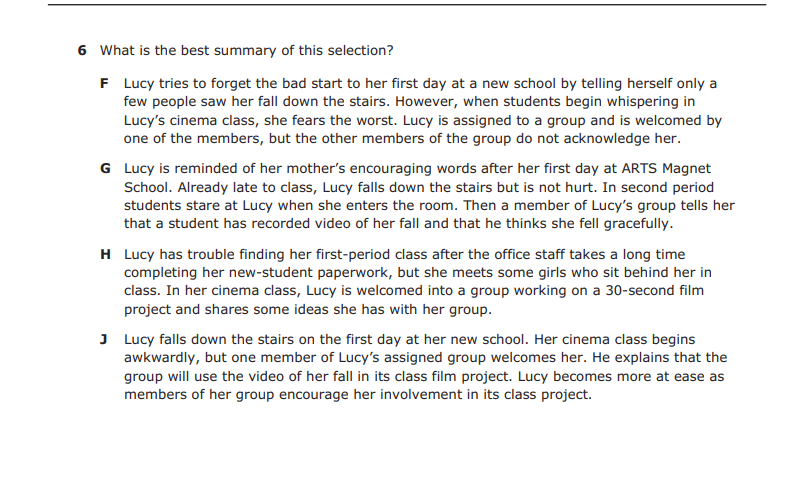
A
B
C
D
30s - Q4
In "Ghostly New Creatures," which idea about the octopod best explains why the author includes the map?
Octopods are found in many oceans throughout the world.
The ghostly octopod is common only to the ocean area around Hawaii.
Octopods are most commonly found near islands.
The ghostly octopod was found near the Hawaiian Islands.
30s - Q5
What can the reader conclude from Michael Vecchione's comments throughout the selection, "A Ghostly New Creature?"
Vecchione is not interested in learning more about the new octopod.
Vecchione is fascinated by the discovery of new species.
Vecchione was the coordinator of the project that discovered the unknown creature.
Vecchione was first to understand the significance of finding the new octopod.
30s - Q6
Which definition best matches the way the word screening is used in paragraph 1 of "Tiptoeing Scientists?"
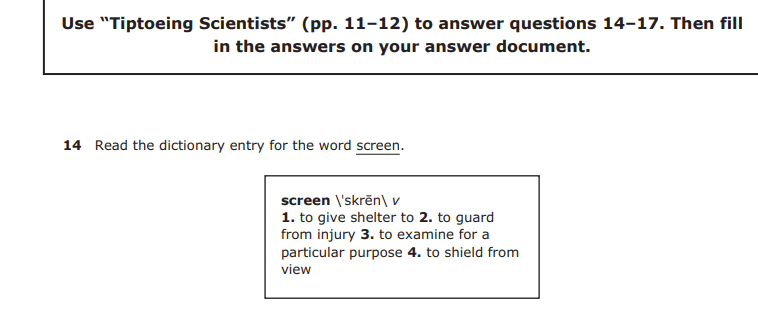
Definition 1
Definition 2
Definition 3
Definition 4
30s - Q7
Throughout "Tiptoeing Scientist," which idea about tiny frogs does the author highlight?
Scientists are finding tiny frogs throughout the mountain ranges of the world.
Researchers locate tiny frogs by their bold and unique coloring.
Tiny frogs can be very difficult for scientists to capture.
Tiny frogs have poisonous skin that helps to protect them.
30s - Q8
Based on information in "Tiptoeing Scientist," what can the reader conclude about the Brazilian frogs?
They make their homes in the treetops.
Their bright color makes them easy to locate among the leaves.
Most of their diet consists of dead leaves.
They have adaptations that help keep them from danger.
30s - Q9
For what reason does the author include the photograph after paragraph 3 of the selection, "Tiptoeing Scientists?"
To prove that this species is the smallest of all frogs ever discovered.
To highlight the effectiveness of the frog's natural camouflage.
To emphasize how small the frog is by comparing it to a familiar object.
To demonstrate that the frog has a unique call
30s - Q10
In both selections, how are Michael Vecchione's work and Marcio Pie's work different?
Vecchione uses high-tech equipment to observe animals, but Pie does not.
Vecchione studies animals that can be difficult to find, but Pie does not.
Pie is employed by a government agency, but Vecchione is self-employed.
Pie conducts research about many kinds of animals, but Vecchione studies only octopods.
30s - Q11
One similarity between the scientists in both selections is that they both --
study animals that live in the oceans
learn about animals from the sounds they make
perform their work in isolated areas
capture the animal they each study
30s - Q12
In what way is scientist C.J. Moore from "Tiptoeing Scientists" unlike Michael Vecchione from "A Ghostly New Creature"?
Moore studies animals in their natural habitats
Moore will likely have an opportunity to observe a newly discovered animal more than once.
Moore is dedicated to finding new animal species in new locations.
Moore researches animals that are commonly found throughout the world.
30s - Q13
Which sentence from the selection "Tiptoeing Scientists" is related to this idea?
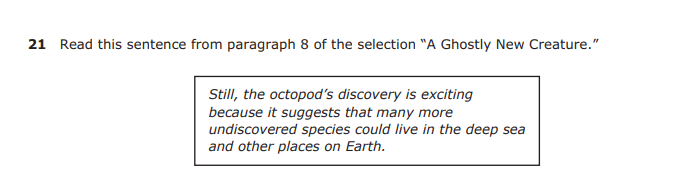
He and his team have tiptoed to the location where they last heard them singing. (p.1)
But they must look very carefully because these frogs are smaller than a fingernail. (p.1)
The tiny amphibians were incredibly difficult to catch because they jump like crickets. (p.4)
In spite of the countless challenges, new tiny frogs are being found among the planet's habitats that previously been understudied. (p.5)
30s - Q14
How do the frogs in the selection, "Tiptoeing Scientists" differ from the octopod in "A Ghostly New Creature"?
The frogs' bodies have coloration that protects the frogs. The octopods body does not have coloration for protection.
The frogs are found on islands in the Pacific Ocean near Hawaii. The octopod was sighted off the coast of Brazil in South America.
The frogs' size is typical for its species. The octopod's size is smaller than normal.
The frogs are well adapted to their environment. The octopod has not adapted to its environment.
30s