Cardiovascular_System
Quiz by Robert Badeau
Feel free to use or edit a copy
includes Teacher and Student dashboards
Measure skillsfrom any curriculum
Measure skills
from any curriculum
Tag the questions with any skills you have. Your dashboard will track each student's mastery of each skill.
With a free account, teachers can
- edit the questions
- save a copy for later
- start a class game
- automatically assign follow-up activities based on students’ scores
- assign as homework
- share a link with colleagues
- print as a bubble sheet
13 questions
Show answers
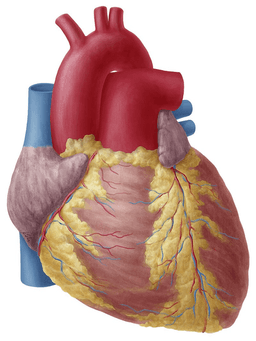
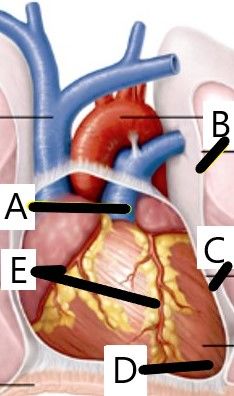
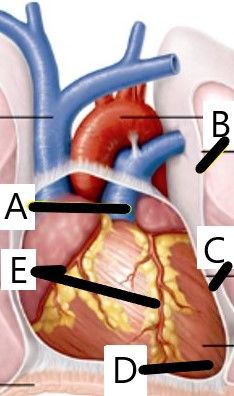
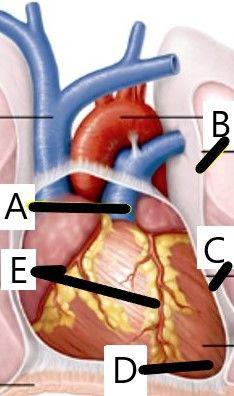
- Q1Please identify the letter where the apex of the heart would lie.BCAD20s
- Q2Please identify the letter that best represents the blood flow to cardiac myocytes.BDEA20s
- Q3Please identify the letter that best represents the pericardiumEBCD20s
- Q4These are the receiving for blood chambers of the heartEndocardiumArteriesVentriclesAtria20s
- Q5These are the discharging of blood chambers of the heart.VentriclesAtriaArteriesEndocardium20s
- Q6How many blood circuits exist in the cardiovascular system?214320s
- Q7In the diagram above, the top part (of the heart) is where what happens?Synaptic transferOxygenation of bloodDe-oxygenation of bloodPericarditis20s
- Q8In the diagram above, the lower part (of the heart) is where what happens?PericarditisOxygenation of bloodDe-oxygenation of bloodSynaptic transfer20s
- Q9The walls of the left ventricle are substantially thicker than the walls of the right ventricle. Why?It pumps blood over the much longer systemic pathway through the body.It pumps blood over the much shorter systemic pathway through the body.It pumps blood over the much shorter pulmonary pathway through the body.It pumps blood over the much longer pulmonary pathway through the body.20s
- Q10In the picture above, please describe what is happening.As ventricles contract and intraventricular pressure rises, blood is pushed up against AV valves, forcing them open.Blood is returning to the atria putting pressure against the semilunar valves; the semilunar valves are forced open.As ventricles contract and intraventricular pressure rises, blood is pushed up against semilunar valves, forcing them open.Blood is returning to the atria putting pressure against the atrioventricular valves (AV); the AV valves are forced open.20s
- Q11In the picture above, please describe what is happening.As ventricles relax and intraventricular pressure falls, blood flows back from veins, filling cusps of the semilunar valves and forcing them to close.As ventricles contract and intraventricular pressure falls, blood flows back from arteries, filling cusps of the semilunar valves and forcing them to close.As ventricles relax and intraventricular pressure falls, blood flows back from arteries, filling cusps of the semilunar valves and forcing them to close.As ventricles relax and intraventricular pressure falls, blood flows back from arteries, filling cusps of the atrioventricular valves and forcing them to close.20s
- Q12According to the Centers for Disease Control (www.cdc.gov), the age-adjusted leading cause of death in the USA for years 2016 and 2017 was:CancerSuicideUnintentional injuriesHeart disease20s
- Q13This is produced by serous pericardial membranes and collects in the pericardial cavity. This allows the heart to beat easily in a frictionless environment.Serous fluidSynovial fluidAtrioventricular fluidMyocardial fluid20s