Tag the questions with any skills you have. Your dashboard will track each student's mastery of each skill.
Give this quiz to my class
Q 1/13
Score 0
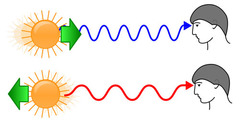
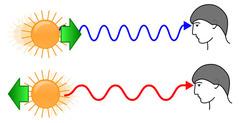
the stretching of the wavelength of light so the light is seen as 'shifted' towards the blue part of the spectrum; happens when object and observer are moving toward each other
30
blue shift
Q 2/13
Score 0
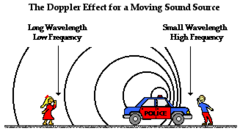
the apparent change in frequency of electromagnetic or sound waves caused by the relative motions of the source and the observer
30
Doppler Effect
13 questions
Q.
the stretching of the wavelength of light so the light is seen as 'shifted' towards the blue part of the spectrum; happens when object and observer are moving toward each other
1
30 sec
Q.
the apparent change in frequency of electromagnetic or sound waves caused by the relative motions of the source and the observer
2
30 sec
Q.
arrangement of electromagnetic waves according to their wavelengths and frequencies
3
30 sec
Q.
the number of electromagnetic waves traveling past a fixed point in a specific unit of time (usually one second)
4
30 sec
Q.
part of the electromagnetic spectrum where wavelengths are just longer than those of ordinary, visible red light but shorter than those of microwaves; also known as heat
5
30 sec
Q.
a small packet of light energy
6
30 sec
Q.
the transfer of energy (heat) through space by electromagnetic waves
7
30 sec
Q.
part of the electromagnetic spectrum where wavelengths are longest, consisting of microwaves, radar, radio and TV waves; generally used for long-distance communication
8
30 sec
Q.
the stretching of the wavelength of light so the light is seen as 'shifted' towards the red part of the spectrum; happens when object and observer are moving away from each other
9
30 sec
Q.
part of the electromagnetic spectrum where wavelengths are just shorter than those of ordinary, visible violet light but longer than those of x-rays
10
30 sec
Q.
part of the electromagnetic spectrum where wavelengths are just longer than those of ultraviolet radiation and just shorter than those of infrared radiation; a form of electromagnetic radiation that is visible to most human eyes
11
30 sec
Q.
the top of an electromagnetic wave
12
30 sec
Q.
the distance between the crest of one wave and the crest of the next wave