Loading...

Track each student's skills and progress in your Mastery dashboards
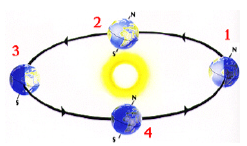
What season occurs in the Northern Hemisphere in position 3?
fall
winter
spring
summer
Day and night on Earth is caused by the Earth's
What season occurs in the Northern Hemisphere in position 3?

Which positions show where a solstice would occur?

How long does it take for the Earth to make one revolution around the sun?
The tilt of the Earth's axis is responsible for
In position 3, which hemisphere would receive the most direct sunlight?

A class is creating a series of posters showing what they have learned about Earth and the solar system.
According to the 'X' on the diagram, what season is currently being experienced by the Northern Hemisphere, and how much light is it receiving?

What do we call the point in Earth's orbit where the days or the nights are the longest or shortest of the year?
What do we call the point in Earth's orbit where the day and night are equal?
What direction does earth rotate and revolve?
Identify the moon phase in the picture below:

About how long does it take the moon to complete one full cycle of moon phases?
In what position must the moon be for a lunar eclipse to occur?
Use the following diagram below to answer the following question:

Identify the moon phase below:

Solar Eclipses occur when the earth, moon, and sun are lined up in this order:
Lunar Eclipses occur when the sun, moon, and earth are lined up in this order:
During a lunar eclipse, the moon is in a _______________ phase.
Why don't we have an eclipse every month?
What position does the moon need to be in for a Spring Tide to occur?

What position does the moon need to be in for a Neap Tide to occur?

During a ______________ tide, the difference between tides is minimal.
Example:
High Tide: 3 ft
Low Tide: 1 ft
During a _________________ tide, the difference between tides is maximal (greatest).
Example:
Low Tide: 1 ft
High Tide: 9 ft
Earth's tides are caused by:

