Tag the questions with any skills you have. Your dashboard will track each student's mastery of each skill.
Give this quiz to my class
Q 1/34
Score 0
An estuary is a body of water in which fresh water draining from the land mixes with salt water from the ocean. The result of this mixture is an environment with abundant plant and animal life. The Indian River Lagoon is a 156-mile-long estuary on Florida’s east coast. It is a diverse estuary, supporting thousands of species of plants and animals.
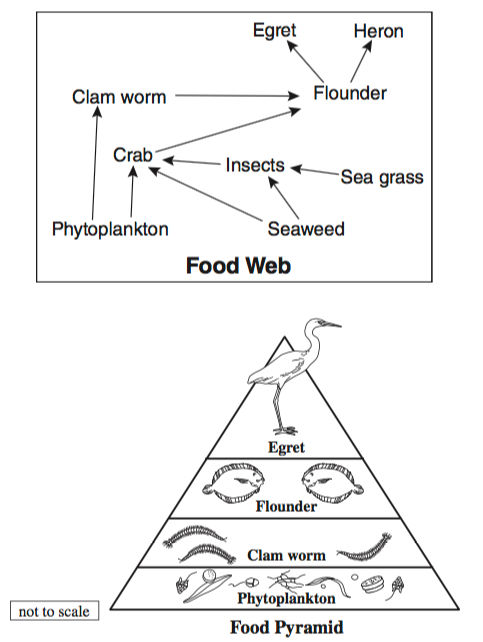
The food web and food pyramid shown below are examples of the relationships that exist in the Indian River Lagoon ecosystem.
Which of the following statements most accurately describes the energy transfer between the levels of the food pyramid in the Indian River Lagoon?
30
Energy travels up from the phytoplankton to the clam worm.
Energy moves from the flounder to both the clam worm and egret.
Energy is released into the environment only from the egret.
Energy stays in the phytoplankton at the lowest level.
Q 2/34
Score 0
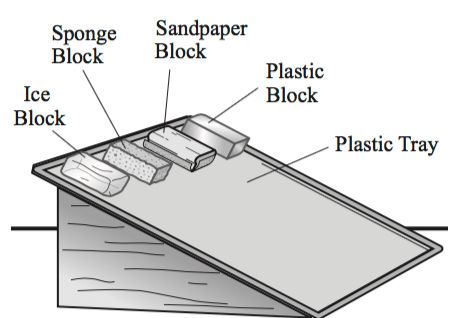
Felipe and Marsha were studying forces and decided to do an experiment. They placed four equally sized blocks made of different materials on an elevated plastic tray. They watched each of the blocks move down the tray. Their setup is shown above. Which of the following conclusions can Felipe and Marsha make about the forces that cause the blocks to move down the tray?
30
The force of friction is the same on each block.
The force of gravity is greater than the force of friction on all the blocks.
The force of gravity causes all the blocks to move at the same speed.
The force of friction causes the speed of each block to increase.
34 questions
Q.
An estuary is a body of water in which fresh water draining from the land mixes with salt water from the ocean. The result of this mixture is an environment with abundant plant and animal life. The Indian River Lagoon is a 156-mile-long estuary on Florida’s east coast. It is a diverse estuary, supporting thousands of species of plants and animals.
The food web and food pyramid shown below are examples of the relationships that exist in the Indian River Lagoon ecosystem.
Which of the following statements most accurately describes the energy transfer between the levels of the food pyramid in the Indian River Lagoon?
1
30 sec
Q.
Felipe and Marsha were studying forces and decided to do an experiment. They placed four equally sized blocks made of different materials on an elevated plastic tray. They watched each of the blocks move down the tray. Their setup is shown above. Which of the following conclusions can Felipe and Marsha make about the forces that cause the blocks to move down the tray?
2
30 sec
Q.
Keesha did an experiment to study the rate of photosynthesis in the water plant Elodea.
She placed a piece of Elodea in a beaker of water and set the beaker 10 centimeters (cm)
from a light source. Keesha counted the bubbles released from the plant every minute for
five minutes (min). She repeated the process two more times. First, she moved the light to
20 cm from the beaker, and then she moved the light to 30 cm from the beaker. Keesha’s setup and data are shown. What is the outcome variable (dependent variable) in this experiment?
3
30 sec
Q.
These statements were taken from the procedures of four different investigations. The statement from which investigation is an example of repetition?
4
30 sec
Q.
Two types of models that can be used to show details of the structures of cells are shown. Which of the following describes a limitation of the drawing but NOT the clay model?
5
30 sec
Q.
Scientific knowledge may change as new evidence or information is discovered. Which of the following would NOT be a result of new scientific research and information?
6
30 sec
Q.
A timeline of some models of atoms throughout history is shown. These models have contributed to the formation of the atomic theory. Which statement best summarizes the development of the atomic theory over time?
7
30 sec
Q.
The points labeled on the chart represent the approximate size of Earth, the Milky Way, the Moon, and the Sun. The approximate size of the Solar System is also shown. Which point on the chart best represents the approximate size of the Sun?
8
30 sec
Q.
One physical property of a star is apparent magnitude. Which of the following is used in determining the apparent magnitude of a star?
9
30 sec
Q.
The surface of Mercury has many more craters than the surface of Earth has. Which of the following statements best explains why Mercury has many more craters than Earth has?
10
30 sec
Q.
The water level at the beach changes during the day. What causes the different water levels?
11
30 sec
Q.
Deforestation occurs when large areas of trees are cut down. Which of the following impacts on the environment would result from deforestation?
12
30 sec
Q.
The oldest rock formation identified on Earth is found on the shoreline of Hudson Bay in Canada. This rock formed 4.28 billion years ago. Which information does a scientist need to most accurately determine the age of a rock?
13
30 sec
Q.
Interactions between layers of Earth cause convection currents to move crustal plates. The diagram below shows four layers of Earth. In which layer of Earth are the convection currents that directly result in tectonic plate motion found?
14
30 sec
Q.
The climate of an area can be different from its weather. Which of the following statements describes the climate of an area?
15
30 sec
Q.
The arrows in the picture below show several ways heat is transferred from the Sun as it strikes sand on the surface of a beach. Which arrow shows convection?
16
30 sec
Q.
Matthew has six cubes of different materials. Each cube has a mass of 10 grams (g). Matthew sorts the cubes into two groups using one physical property. Which physical property did Matthew most likely use to sort the cubes into two groups?
17
30 sec
Q.
Lithium (Li), Sodium (Na), Potassium (K), Rubidium (Rb), Cesium (Cs), and Francium (Fr) are in the same column in the periodic table. Why are these elements in the same column in the periodic table?
18
30 sec
Q.
When a candle is lit, the wick burns, the wax melts, the candle changes shape, and the air around the candle heats up. Which of the following is an example of a chemical change?
19
30 sec
Q.
Sunlight is composed of energy that is visible to humans and energy that is not visible to humans. Which statement describes how the visible energy from the Sun is different from the nonvisible energy?
20
30 sec
Q.
The diagram demonstrates how a magnifying lens can make a penny appear larger. What property of the magnifying lens is most responsible for allowing it to magnify the penny?
21
30 sec
Q.
Emma constructed a simple motor. When connected correctly, the coil of copper wire spins. Which of the following best describes the energy transformation that takes place between the paper clips and the spinning coil?
22
30 sec
Q.
Mrs. Aldaco added a room-temperature copper (Cu) cube and an aluminum (Al) cube that she just removed from the freezer to a beaker of boiling water. She left the cubes in the water for three hours. Which of the following describes a heat flow that took place during those three hours?
23
30 sec
Q.
Luis rubbed a balloon on his hair and held the balloon next to the wall. He observed the balloon stick to the wall. Which of the following is responsible for the balloon sticking to the wall?
24
30 sec
Q.
The diagram shows forces acting on a model airplane. Both its speed and height above the ground are constant. Which of the following conditions would cause the model airplane to descend toward the ground?
25
30 sec
Q.
Structures in the human body work together to perform specific functions. The diagram shows the organization of structures found in the human body. A picture of which of the following structures belongs in the box above?
26
30 sec
Q.
The cell theory applies to all organisms, including the five shown. Which of the following statements describes how these organisms are an example of the cell theory?
27
30 sec
Q.
Plant cells are different from animal cells. The diagram identifies four different structures in a plant cell. Compared to the structures in an animal cell, which of the following structures is found only in a plant cell?
28
30 sec
Q.
In order to maintain homeostasis, the systems of the human body work together to keep a constant internal temperature. Which of the following best describes how the human body responds in a cold environment?
29
30 sec
Q.
Mushrooms, bread molds, and yeasts are classified together in the fungi kingdom. Specific characteristics are used to classify these organisms. Which of the following is a characteristic used to classify these organisms as fungi?
30
30 sec
Q.
A certain reptile species is a herbivore and exists only on an isolated island. Which of the following would most likely result in the extinction of the reptile species over a period of twenty thousand years?
31
30 sec
Q.
The gene for curled ears (C) is dominant over the gene for straight ears (c). The picture shows a cat with curled ears (Cc) and a cat with straight ears (cc). What percent of the offspring are expected to have curled ears as a result of a cross between the cats shown?
32
30 sec
Q.
Mangrove trees are common to the Florida Everglades. The tree roots serve as a place for freshwater oysters to attach when the tide is high, as shown in the picture. The oysters are protected from predators when attached to the roots underwater. The oysters do not harm the trees nor do they provide any benefit to the trees. Which of the following relationships is most similar to the relationship between the mangrove trees and the oysters?
33
30 sec
Q.
A diagram of the carbon cycle is shown below. Each arrow represents a process in the cycle. Which of the following best describes the process that occurs at arrow X?