Loading...


Grade 9 PISA TEST
Quiz by Patrick Brylle Candelaria
Tag the questions with any skills you have. Your dashboard will track each student's mastery of each skill.
The Case of the Missing Mountain Range
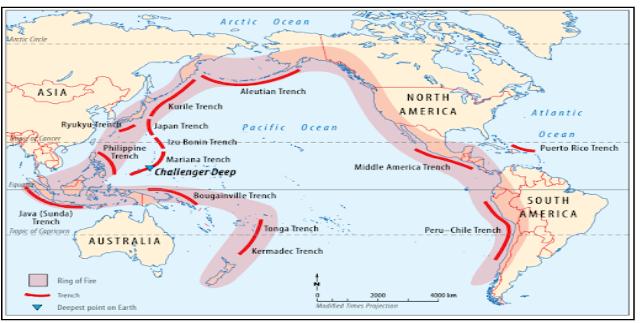
You are a young geologist studying ancient rock formations in South America. While looking at a world map showing the age of rock formations, you notice that rocks in the eastern part of South America match very closely with rocks in western Africa.
You wonder: Could South America and Africa have once been connected?
You begin studying plate tectonics, which describes how the Earth's lithosphere is broken into plates that move over time.
Given the following data table:
LOCATION AGE OF ROCK TYPE OF PLATE BOUNDARY
Mid-Atlantic 0 - 5 Divergent
Andes Mountains 50 - 150 Convergent
San Andreas Fault 10 - 30 Transform
Based on the data, which type of plate boundary is most likely to create new oceanic crust?
Subduction
Convergent
Divergent
Transform
FOSSIL FUELS
Fossils of the same ancient species found on multiple continents strongly suggest that these landmasses were once connected as a single supercontinent, like Pangaea.
The presence of identical fossils on continents now separated by vast oceans indicates that the species lived together before the continents drifted apart due to plate tectonics.
Why are fossils of the same ancient species found on continents that are now far apart?
Humans moved the fossils during ancient migrations.
The species swam across the oceans.
The continents have always been separated, but wind carried the fossils.
The continents were once joined, allowing species to live across them.
The Case of the Missing Mountain Range
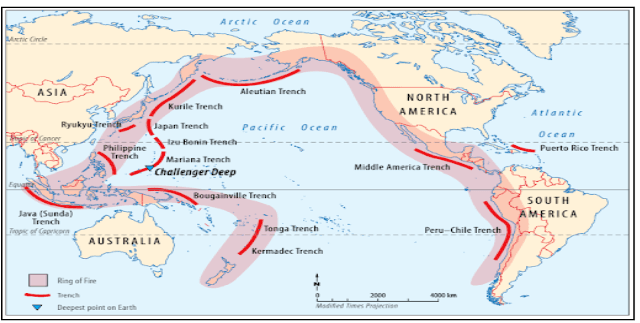
You are a young geologist studying ancient rock formations in South America. While looking at a world map showing the age of rock formations, you notice that rocks in the eastern part of South America match very closely with rocks in western Africa.
You wonder: Could South America and Africa have once been connected?
You begin studying plate tectonics, which describes how the Earth's lithosphere is broken into plates that move over time.
Given the following data table:
LOCATION AGE OF ROCK TYPE OF PLATE BOUNDARY
Mid-Atlantic 0 - 5 Divergent
Andes Mountains 50 - 150 Convergent
San Andreas Fault 10 - 30 Transform
Based on the data, which type of plate boundary is most likely to create new oceanic crust?
FOSSIL FUELS
Fossils of the same ancient species found on multiple continents strongly suggest that these landmasses were once connected as a single supercontinent, like Pangaea.
The presence of identical fossils on continents now separated by vast oceans indicates that the species lived together before the continents drifted apart due to plate tectonics.
Why are fossils of the same ancient species found on continents that are now far apart?

LAW OF INERTIA
The Law of Inertia, also known as Newton's First Law of Motion, states that:
An object at rest will remain at rest, and an object in motion will continue in motion at a constant velocity, unless acted upon by an external force.
⚙️ Key Concepts
Inertia is the tendency of an object to resist changes in its state of motion.
The greater the mass of an object, the greater its inertia.
Motion does not require a continuous force—only a force to change motion.
Ana is walking to school with her backpack. While walking, she accidentally trips on a rock and stops suddenly. However, her backpack, which was loosely strapped to her back, continues to move forward and falls to the ground in front of her.
Why does Ana’s backpack continue to move forward after she stops walking?
LAW OF INERTIA
The Law of Inertia, also known as Newton's First Law of Motion, states that:
An object at rest will remain at rest, and an object in motion will continue in motion at a constant velocity, unless acted upon by an external force.
⚙️ Key Concepts
Inertia is the tendency of an object to resist changes in its state of motion.
The greater the mass of an object, the greater its inertia.
Motion does not require a continuous force—only a force to change motion.
Ana is walking to school with her backpack. While walking, she accidentally trips on a rock and stops suddenly. However, her backpack, which was loosely strapped to her back, continues to move forward and falls to the ground in front of her.
Ana notices that when she straps the backpack tightly to her back, it does not fall forward when she stops suddenly. Why does this happen?
The Philippine eagle, a critically endangered species lives only in Luzon’s rainforests. Satellite data shows:
*deforestation rate: 2.5% per year due to logging and farming
*Eagles pairs left : 400 (2023 estimate)
Conservation efforts: reforestation projects and community education
⚙️ Key Concepts
Deforestation especially in rainforests leads to habitat loss, which is the
primary threat to the survival of species like the Philippine eagle.
Why is deforestation a critical threat to the Philippine Eagle?
The Philippine eagle, a critically endangered species lives only in Luzon’s rainforests. Satellite data shows:
*deforestation rate: 2.5% per year due to logging and farming
*Eagles pairs left : 400 (2023 estimate)
Conservation efforts: reforestation projects and community education
⚙️ Key Concepts
Community education helps people understand why protecting the eagle matters and teaches them how their actions like avoiding deforestation or protecting nest can make a difference.
How does community education support eagle conservation?
IONIC COMPOUND
When writing formulas for ionic compounds using Roman numerals, the Roman numeral indicates the oxidation state or charge of the metal cation, particularly important for transition metals and some post-transition metals that can exist in multiple oxidation states, and the anions remains consistent.
The Roman numeral in the name of the compound directly represents the charge of the metal cation, determine the anion’s charge from its position on the periodic table or its known polyatomic ion charge. The principle of charge neutrality still applies. The total positive charge from the metal cation(s) must equal the total negative charge from the anion(s). Use the criss - cross method to determine subscript.
Question:
Filomena , a student, is engaged in a task that involves naming the components of fertilizer. She asked to write the formula for “potassium nitrate” after seeing its name. She recognizes nitrate as NO3 and potassium as K+. She writes the formula as KNO3 correctly. Next, you ask her to identify the compound that has the formula FePO4, which is another common component of fertilizer. She writes “iron phosphate”, another common fertilizer ingredient, even though she correctly recognizes iron and phosphate. Although she correctly recognizes iron and phosphate, she writes “iron phosphate. What step in the process has Felomina missed, and how can you assist her in determining that “Iron(III) phosphate is the correct name?
IONIC COMPOUND
When writing formulas for ionic compounds using Roman numerals, the Roman numeral indicates the oxidation state or charge of the metal cation, particularly important for transition metals and some post-transition metals that can exist in multiple oxidation states, and the anions remains consistent.
The Roman numeral in the name of the compound directly represents the charge of the metal cation, determine the anion’s charge from its position on the periodic table or its known polyatomic ion charge. The principle of charge neutrality still applies. The total positive charge from the metal cation(s) must equal the total negative charge from the anion(s). Use the criss - cross method to determine subscript.
Question:
You’re looking at the label of an orchid-specific fertilizer bag. The active ingredient is identified as Iron(III) phosphate with chemical formula FePO4.
What does this formula tell you about the ratio of iron to phosphate ions in the fertilizer?