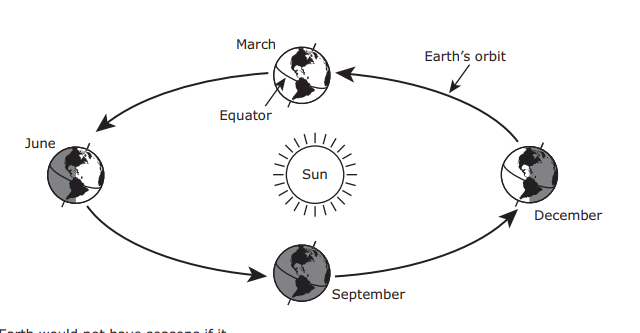
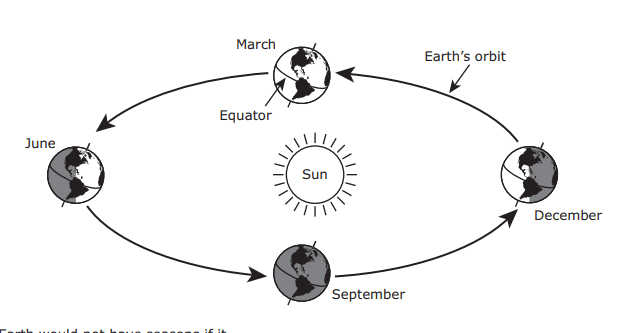
Analyze and interpret data to relate the tilt of the Earth to the distribution of sunlight throughout the year and its effect on seasons.
Track each student's skills and progress in your Mastery dashboards
Give this quiz to my class
Q 1/9
Score 0
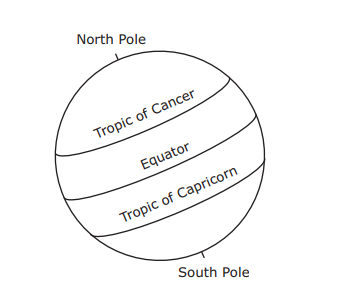
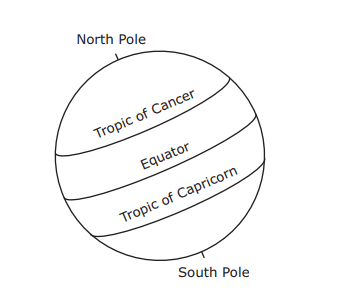
Which of these locations on Earth experiences the least change in the number of daylight hours throughout the year?
60
Tropic of Capricorn
North Pole
Equator
Tropic of Cancer
Q 2/9
Score 0
Earth would not have seasons if it —
60
took an additional month to orbit the sun
no longer tilted on its axis
revolved around the sun in the opposite direction
stopped rotating on its axis
9 questions
Q.
Which of these locations on Earth experiences the least change in the number of daylight hours throughout the year?
1
60 sec
S6E2c
Q.
Earth would not have seasons if it —
2
60 sec
S6E2c
Q.
A student wants to use a spinning basketball to model the day-and-night cycle on Earth. What should the student do in order to best model the cause of the day-and-night cycle?
3
60 sec
S6E2c
Q.
In the summer many people enjoy going to the beach. The photograph shows a beach in Argentina, which is located in the Southern Hemisphere. Which diagram shows the position of Earth when it is summer in Argentina?
4
60 sec
S6E2c
Q.
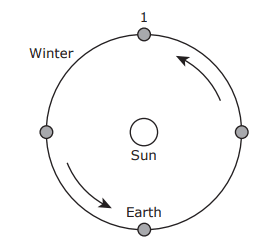
Students in a science class in Marfa, Texas, made a poster with a diagram to represent a seasonal change in the Northern Hemisphere. Which statement best describes conditions for Earth at Position 1 in the diagram?
5
60 sec
S6E2c
Q.
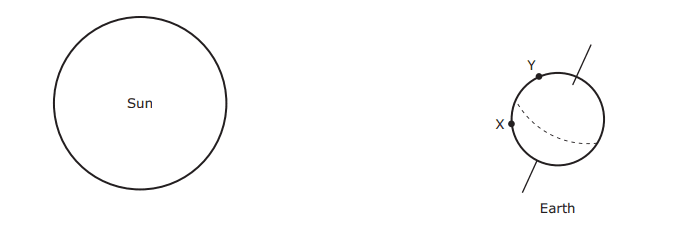
A student draws the model shown below. Which of these best compares the conditions at Location X and Location Y?
6
60 sec
S6E2c
Q.
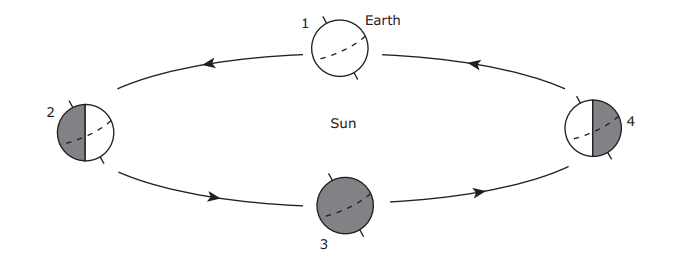
The diagram below shows four positions in Earth’s orbit around the sun. The Northern Hemisphere experiences the beginning of spring when Earth is in —
7
60 sec
S6E2c
Q.
Which of these changes would likely occur if the rate of Earth’s rotation on its axis increased?
8
60 sec
S6E2c
Q.
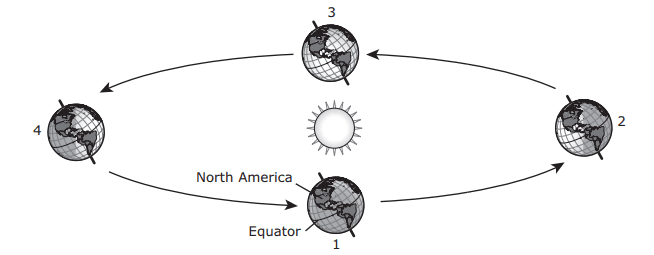
The model shows Earth in several positions relative to the sun. In which position is it winter in North America?