Loading...


Mediastinum, Heart Pleura Preformative Quiz
Quiz by Jenny Ousley
Tag the questions with any skills you have. Your dashboard will track each student's mastery of each skill.
A 2-year-old boy is brought to the emergency department by his mother because of shortness of breath. Physical examination shows tachypnea, nasal flaring, abdominal retractions during breathing. Cardiac examination shows a continuous machinery-like murmur. A cardiac catheterization is performed and shows the contrast medium to be visible immediately in the left pulmonary artery when released into the arch of the aorta. What is the most likely explanation for this finding?
A 35-year-old man comes to the physician because of a 4-month history of progressive difficulty with swallowing solid food. Vital signs are within normal limits. Physical examination shows a diastolic murmur at the apex of the heart. A CT scan of the chest shows a dilated left atrium. Which structure is most likely being compressed by the expansion of the left atrium to result in the patient’s symptoms?
A 42-year-old man is brought to the emergency department after a head-on motor vehicle collision. He was an unrestrained driver and sustained blunt trauma to his sternum from the steering wheel. Physical examination shows extensive ecchymoses on the anterior chest wall. What part of the heart would be most likely to be injured by the impact?
A 48-year-old man is brought to the emergency department by his wife because of 5-day history of chest pain. The pain is worse with exertion and improves with rest. His pulse is 98/min, blood pressure is 130/80 mm Hg, and respirations are 25/min. Coronary angiography shows nearly total blockage of the circumflex artery near its origin from the left coronary artery. When this artery is exposed to perform a bypass procedure, what accompanying vein must be protected from injury?
A 55-year-old man was brought to the emergency department 5-days ago with chest pain. Cardiac catheterization showed the vessel that supplies much of the left ventricle and the right and left bundle branches of the cardiac conduction system to be blocked. The patient is scheduled to undergo a coronary bypass operation. Which artery is the surgeon most concerned with?
A 58-year-old man is brought to the emergency department with severe chest pain that is worse with exertion. Upon cardiac catheterization, it is found that he has a significant occlusion in his right coronary artery, distal to the right sinus of the aortic valve. His collateral cardiac circulation is minimal. Assuming the patient is right coronary dominant, which of the following arteries would be most likely to still have normal blood flow?
A 3-month-old girl born full term via spontaneous vaginal delivery is diagnosed with a membranous ventricular septal defect and undergoes a cardiac repair. The septal defect is patched inferior to the noncoronary cusp of the aorta. Two days postoperatively, the girl develops severe arrhythmias affecting both ventricles. Which part of the conduction tissue was most likely injured during the procedure?
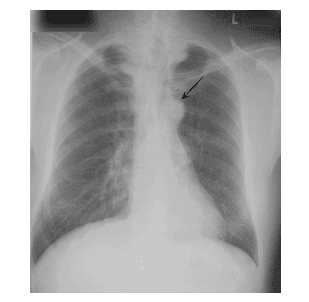
A 41-year-old man is brought to the emergency department with complaints of shortness of breath, dizziness, and sharp chest pain. Patient has a long history of smoking and hypertension. His temperature is 37°C (96.8°F), pulse is 120/min, respirations are 24/min, and blood pressure is 100/65 mm Hg. The large arrow in the x-ray of the chest indicates the region of pathology (see image below). What is this structure?
A 33-year-old man is brought to the emergency department with severe traumatic injuries after being involved in a motor vehicle collision. His temperature is 37°C (98.6°F), pulse is 115/min, and blood pressure is 89/39 mm Hg. A central venous line is placed for fluid resuscitation. Which of the following injuries is most likely to occur if a subclavian central venous line procedure is incorrectly performed?
A 35-year-old woman was brought to the emergency department for a drug overdose. The patient is unresponsive and an empty bottle of acetaminophen was found in her handbag. The patient required insertion of a nasogastric tube and administration of activated charcoal. What are the three sites in the esophagus where one should anticipate resistance due to compression on the organ?
A 58-year-old woman is brought to the emergency department because of fainting. ECG shows a third-degree heart block and she is scheduled for a pacemaker placement. The electrical conducting leads of the pacemaker must be passed into the heart. Which of the following is the correct order of structures for passage of the leads into the right ventricle?
A 68-year-old man is brought to the emergency department because of difficulty swallowing food. His pulse is 85/min, respirations are 22/min, and blood pressure is 126/78 mm Hg. A barium swallow shows esophageal constriction secondary to compression. Echocardiogram shows significant cardiac hypertrophy. Which of the following is the most likely cause of the patient’s dysphagia?
A 23-year-old man is brought to the emergency department after being involved in a motor vehicle collision. His pulse is 115/min, blood pressure is 120/78 mm Hg, and respirations are 25/min. Physical examination shows bruising of the chest. What is the location of the preganglionic neuronal cell bodies involved in increasing the heart rate?